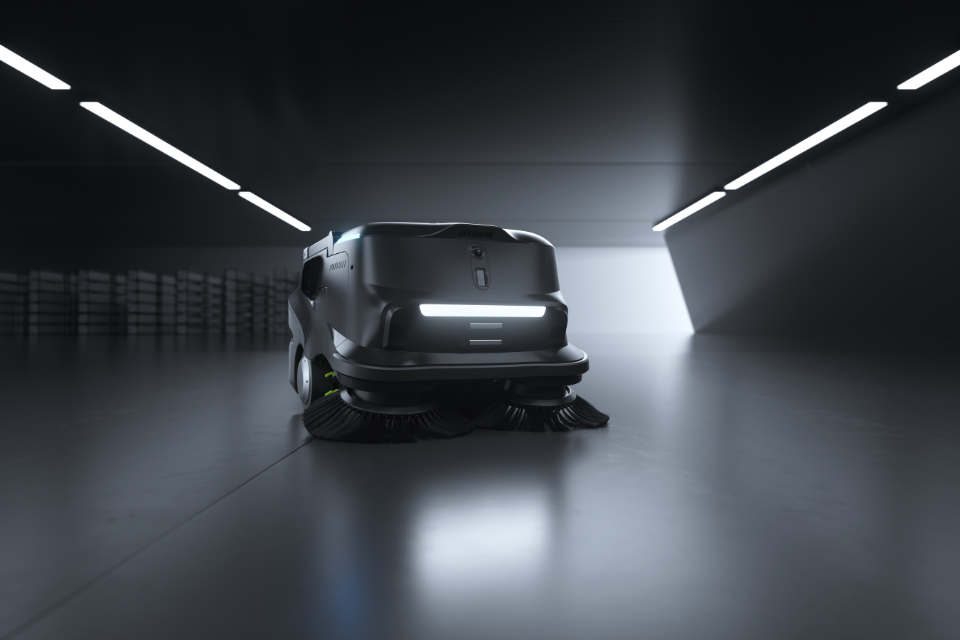
Industrial robots automate material transport, assembly processes, and recurring tasks in production, warehousing, and intralogistics. Today, the spectrum extends far beyond classic stationary robot arms: Autonomous Mobile Robots (AMR), transport robots, pallet robots, cobots, and mobile manipulators can be flexibly integrated into existing production and logistics processes. Terra Robotics offers various solutions for this from manufacturers such as PUDU Robotics, DOBOT, OrionStar, and UBTECH.
Which industrial robot is suitable depends on the specific process. Payload, transport goods, transfer points, cycle time, reach, traffic routes, and existing machinery determine whether a mobile transport robot, a cobot, or automated pallet handling is the right solution.
Transport robots for intralogistics and material flow
A large part of internal logistics consists of recurring routes. Materials must be brought from the warehouse to production lines, containers moved between workstations, or finished products transported for shipping. This is precisely where autonomous transport robots can take over a significant portion of manual walking and driving paths.
The PUDU T300, for example, is designed as a compact industrial transport robot for material flow, warehousing, and line supply. With a payload of up to 300 kg, it is suitable for recurring transport within production and logistics.
For heavier tasks, the PUDU T600 series offers a payload of up to 600 kg. In addition to the classic version, a particularly flat underride model is available, which can move underneath transport frames and suitable racks. This creates flexible options for material replenishment, line supply, and internal transport.
Further applications and solutions for automated material transport can be found in the Industry & Logistics section.
Pallet handling with the PUDU MP2000
For particularly heavy material flows, the PUDU MP2000 expands the portfolio with automated pallet handling. The system was developed for the autonomous transport of pallets and is designed for loads of up to 2,000 kg.
The MP2000 is therefore aimed in particular at warehouses, production sites, and logistics centers where pallets are regularly moved between goods receipt, buffer zones, storage locations, and production areas.
In contrast to permanently installed conveyor technology, mobile robotics solutions can be more flexibly adapted to new routes and changed hall layouts. Especially for growing production sites or changing material flows, this scalability can be a significant advantage.
OrionStar CarryBot for warehousing and picking
Not every material transport requires a payload of several hundred kilograms. For lighter goods movement, picking, and defined warehouse processes, the OrionStar CarryBot series is a good option.
The CarryBot is positioned as an autonomous transport robot for warehouses, picking zones, and internal goods movement. Depending on the variant, different transport attachments are available. The platform is designed for a total load of up to 100 kg and can therefore move boxes, containers, and other smaller transport goods between defined transfer points.
This allows industrial robotics to be precisely adapted to the actual material flow: from smaller transport robots to heavy-duty AMRs and pallet robots.
Cobots and robot arms for assembly and production
Industrial robotics does not end with transport. In manufacturing and assembly, collaborative robots and classic robot arms can take over recurring processing and handling tasks.
Typical areas of application are pick-and-place, machine loading, packaging, palletizing, screwdriving, dispensing, and quality inspection. Especially for clearly defined, frequently recurring processes, such automation can stabilize processes and relieve employees of monotonous tasks.
DOBOT offers various robot arms with different payloads and reaches for this purpose. The DOBOT CR10A, for example, is suitable for palletizing, handling, and machine loading with a larger work area. The DOBOT CR12A is designed for handling, assembly, and medium-duty automation tasks.
Other systems are available for smaller precision tasks or significantly higher payloads. This allows the robot arm to be selected to fit the workpiece and process, rather than having to adapt the application to a single robot type.
Concrete applications involving robot arms, grippers, and production processes are examined in more detail on the Assembly & Handling page.
Grippers, vision, and machine integration
A robot arm alone does not constitute a complete automation solution. A specific application only emerges with the right end effector.
Depending on the task, parallel grippers, adaptive grippers, vacuum systems, or customer-specific tools can be used. In cases of varying component positions, cameras and vision systems may also be necessary. Selection is based on the weight, geometry, surface, and desired cycle time of the workpiece.
Communication with existing machinery also plays a central role. Interfaces to production equipment, controllers, or higher-level systems must be considered on a project-specific basis.
In this way, a complete automation cell is created from a robot arm, gripper, sensor technology, and machine communication, rather than an isolated robot.
AMR, AGV, and AGC: flexible mobile robotics
Different terms are used when automating intralogistics. Classic automated guided vehicles (AGVs) often move along more defined paths. AMRs, on the other hand, use modern navigation, maps, and sensors to adjust their routes more dynamically within permitted areas.
Which technology is better suited depends on the location. Stable production processes with consistent routes have different requirements than warehouses where traffic routes or transfer points change regularly.
Especially for material transport, it is therefore important not to look at the robot in isolation. Transfer stations, traffic routes, forklift traffic, priorities, and possible WMS or ERP interfaces are also part of the overall concept. Robot-assisted intralogistics encompasses precisely this interaction between warehouse, production, picking, and shipping.
From a single industrial robot to a robot fleet
Many companies start with a clearly defined process. For example, a transport robot initially takes over material replenishment between two stations. After a successful pilot operation, additional routes or further robots can be added.
For larger installations, fleet management becomes increasingly important. Tasks must be distributed, priorities considered, and unnecessary blockages between multiple robots prevented. Depending on the robot system and technical integration, central platforms can help monitor operating data and robot deployment.
With the Terra Cloud, Terra Robotics also offers a platform for professional robotics and fleet management. Functions and the scope of integration are considered according to the system and project being used.
Buying, renting, or economically evaluating industrial robots
Investment in an industrial robot should always be evaluated against the actual process. Decisive factors are not only the purchase price and technical specifications, but also, for example, previous walking distances, required working time, process frequency, integration, maintenance, and potential scaling.
With the ROI calculator for service and transport robots, companies can calculate initial economic scenarios for recurring transport processes.
In addition to a classic purchase, leasing, hire purchase, or Robot as a Service may be options depending on the project. This allows industrial automation to be introduced step by step and expanded later.
Terra Robotics supports companies with use case analysis, the selection of suitable industrial robots, integration, and commissioning. From compact AMRs like the PUDU T300 and T600 to the MP2000 for pallet handling and DOBOT robot arms for assembly and handling, a robotics solution can be developed that fits the actual production and logistics process.