Unitree G1 EDU humanoider Roboter in einer modernen Industrie- und Forschungsumgebung

Humanoid Robots | Intelligence meets movement

  • Intelligence
  • Precision
  • AI power
  • Innovation

Humanoid robots combine artificial intelligence, precision, and freedom of movement into a new generation of intelligent automation. Models such as Unitree H1, H1/2, G1, and G1-Edu work autonomously, respond to their environment, and adapt flexibly to complex tasks, whether in industry, research, or development. With Terra Robotics, you benefit from cutting-edge technology, direct manufacturer support, and a secure cloud infrastructure in Germany!

Areas of application

Humanoid robots at a glance

Free initial consultation

Dobot ATOM-W

Mobile dual-arm humanoid for industrial automation, AI research, and precision manipulation tasks.

  • Grünes Icon zeigt humanoiden Roboter als Symbol für moderne Robotik und Automatisierung 20 degrees of freedom
  • Grünes Icon mit Hantel im Zahnradsymbol als Zeichen für hohe Traglast smarter Transportroboter LiDAR navigation
  • Grünes Icon mit Pfeilen, Uhr, Ortsmarke und Zahnrad zeigt flexible intelligente Bewegungsoptionen Precise manipulation
  • Grünes Icon mit Person und Pfeilen zu Auswahlfeldern symbolisiert Entscheidungsprozesse visuell Embodied AI & Teleop
Free initial consultation
To the product!
Free initial consultation

Dobot ATOM-D

Humanoid research platform for teaching, data collection, embodied AI, and VR teleoperation.

  • Grünes Icon zeigt humanoiden Roboter als Symbol für moderne Robotik und Automatisierung 16 degrees of freedom
  • Grünes Icon mit Hantel im Zahnradsymbol als Zeichen für hohe Traglast smarter Transportroboter 6-DoF hands
  • Grünes Icon mit Pfeilen, Uhr, Ortsmarke und Zahnrad zeigt flexible intelligente Bewegungsoptionen VR teleoperation
  • Grünes Icon mit Person und Pfeilen zu Auswahlfeldern symbolisiert Entscheidungsprozesse visuell Mobile Base
Free initial consultation
To the product!
Free initial consultation

Unitree H1 / H1-2

The Unitree H1 stands for impressive freedom of movement, stability, and intelligent performance.

  • Grünes Icon zeigt adaptive Prozesse mit Nutzersymbol und Checkmark Elementen für flexible Abläufe Dynamic mobility
  • Grünes Icon zeigt humanoiden Roboter als Symbol für moderne Robotik und Automatisierung Torque control
  • Grünes Icon mit Hand über Sensorringen als Symbol für berührungslose Sensorsteuerung smarter Roboter 3D Sensor Technology
  • Grünes Icon mit Person und Kontrollsymbol zeigt übersichtliche Qualitätskontrolle in Prozessen Whole Body Control
Free initial consultation
To the product!
Free initial consultation

Walker Tienkung

High-end humanoid for research, future labs, and spectacular presentations.

  • Grüne Farbrolle mit tropfender Farbe als Symbol für kreatives Design smarter Robotik Premium design
  • Grünes Icon mit Hand und Laptop symbolisiert Zukunftstechnologie und digitale Innovation For tech shows
  • Icon einer Hand mit Qualitätssiegel und Haken für hochwertige Serviceroboter PR Magnet
  • Grünes Icon mit Verkehrshütchen und Pfeil als Symbol für intelligente Hindernisvermeidung smarter Roboter Dynamic movements
Free initial consultation
To the product!
Free initial consultation

Unitree G1-EDU

The Unitree G1-Edu combines adaptive learning capabilities with precise control and smart design.

  • Grünes Icon mit offenem Buch und Lupe symbolisiert klare Forschung sowie präzise Wissensanalyse Research & Education
  • Grünes KI Icon im Quadrat als Symbol für künstliche Intelligenz smarter Roboter Open-Source AI
  • Grünes Icon mit Monitor und Code Symbol steht für Programmierung und Softwareentwicklung Flexible programming
  • Grünes Icon mit Checkliste, Daumen hoch und Zahnrad symbolisiert praxisorientierte Prozesse Practice-oriented
Free initial consultation
To the product!

Progress in motion

Humanoid robots are considered the cutting edge of modern robotics. They combine precise mechanics with AI-driven perception and adaptive motion intelligence. Models such as the Unitree G1 and Unitree H1 are capable of moving dynamically, learning independently, and performing complex tasks safely – from the laboratory environment to the production floor.

Humanoider Unitree H1 Roboter in dynamischer Nahaufnahme mit leuchtenden Spezialeffekten

Our Models

Unitree G1 | Compact, agile, research-oriented
The G1 is the ideal entry point into humanoid robotics. Compact, precise, and modular in design, it offers an ideal test system for research, education, and AI development.

Unitree H1 & H1-2 | Power, balance, and intelligence
The H-series redefines performance. Standing up to two meters tall, with 360° perception and fluid motion control, they operate with precision in industrial scenarios, assembly processes, and research facilities.

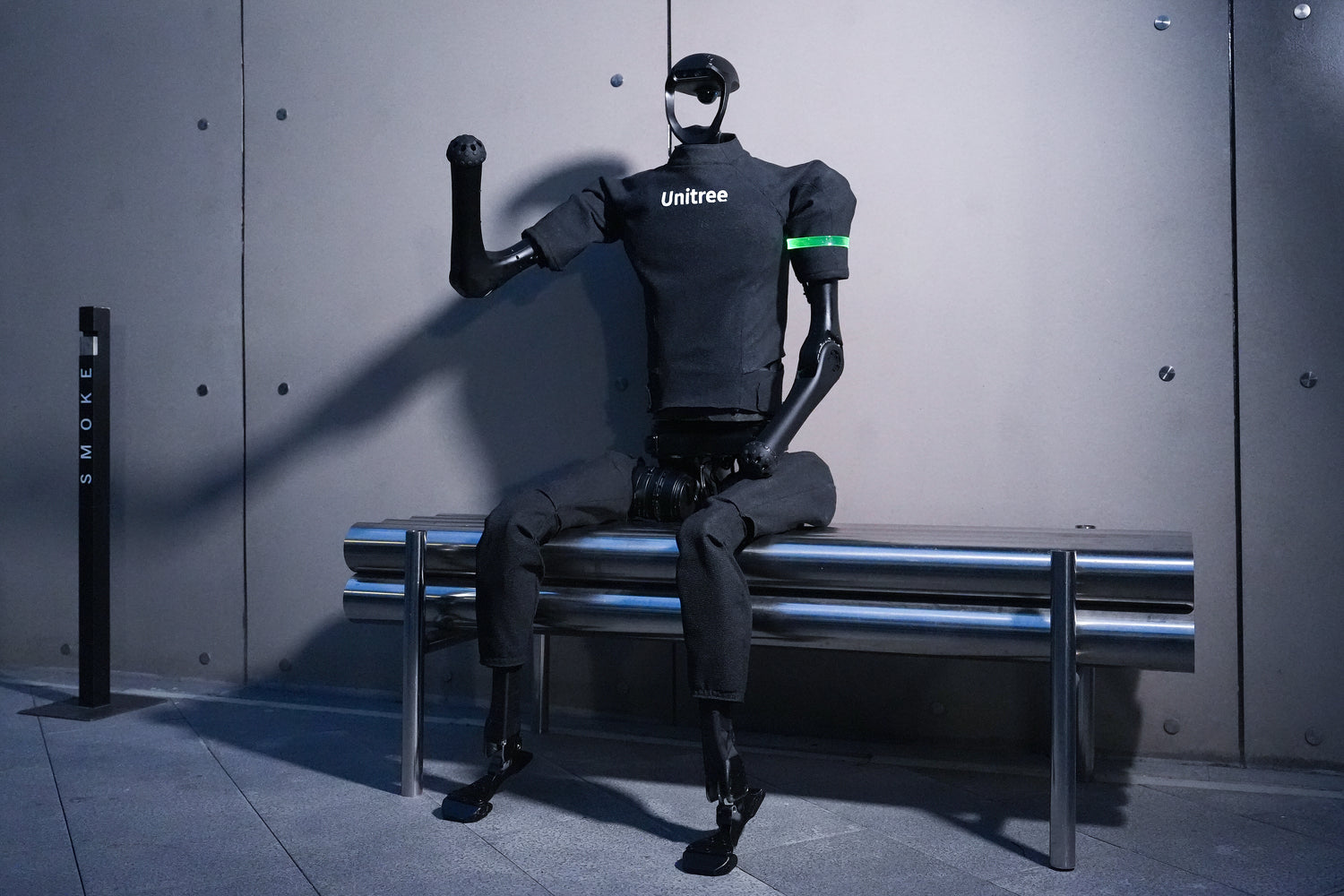
Humanoider Unitree H1 Roboter sitzt auf Metallbank in moderner Umgebung im Innenbereich

Evolution of robotics

While classic robots execute rigid motion paths, humanoid robots actively interact with their environment. They recognize objects, understand movement sequences, and adapt their behavior to the situation. With deep learning algorithms, 3D vision, and natural balance, they open up new dimensions of human-robot collaboration.

Schedule an appointment

Free initial consultation
Book appointment directly online
Select a suitable time for a non-binding initial consultation directly.
Open Calendly in a new tab

Frequently asked questions

What is a humanoid robot?

A humanoid robot is a human-like robot with a torso, arms, legs, sensors, and AI-supported motion control. Humanoid robots can walk, balance, grasp, interact with their environment, and perform tasks in human-designed settings. They are primarily used in industry, research, education, service, development, and pilot projects.

What are humanoid robots used for in companies?

Humanoid robots are used in companies for assembly, material supply, quality assurance, packaging, picking, research, showrooms, trade fairs, and technical pilot projects. They are particularly suitable for tasks where mobility, gripping, AI perception, interaction, and the use of existing human infrastructure are important.

What distinguishes humanoid robots from traditional industrial robots?

Humanoid robots differ from classic industrial robots in their human-like design, mobile agility, and flexible interaction with their surroundings. While classic industrial robots are often stationary and optimized for fixed movement paths, humanoid robots can walk, balance, grasp objects, react to changes, and test various tasks in dynamic environments.

Which humanoid robots are available at Terra Robotics?

Terra Robotics offers various humanoid robots for industry, research, education, service, and presentation. These include, among others, the Unitree G1, Unitree G1-EDU, Unitree H1/H1-2, Unitree H2, Walker S2, Walker Tienkung, and Dobot ATOM Max. The models differ in size, agility, degrees of freedom, gripping functions, SDK access, research focus, and area of application.

Which humanoid robot is suitable for research and development?

For research and development, humanoid robots with an open SDK, good documentation, sensor access, teleoperation, simulation capabilities, and flexible programming are particularly suitable. Models such as the Unitree G1, Unitree G1-EDU, or Dobot ATOM Max are interesting for AI development, mobile manipulation, grasping research, human-robot interaction, embodied AI, and robotics education.

Humanoid robots for industry, research & education

Humanoid robots combine human-like mobility with AI-driven perception and manipulation. They walk, balance, grasp, and interact in real-world environments. Companies and institutes are using humanoid robotics to explore tasks in production, logistics, service, and education, testing safety and ergonomic limits, and trialing HRI scenarios. This page consolidates definition, areas of application, purchasing advice, and procurement methods so that you can evaluate whether and how to buy, rent, or lease humanoid robots.

Definition: What is a humanoid robot?

A humanoid robot is a bipedal platform with a torso and arms, the degrees of freedom of which resemble the human body. Active balance with whole-body control allows for walking, climbing stairs, and stumble recovery. Sensor technology consisting of cameras, IMU, as well as force and torque sensors is supplemented by LiDAR or hand cameras, depending on the task. Grippers or multi-fingered hands enable simple assembly steps, tool guidance, and mobile manipulation. A software stack comprising locomotion controllers, perception, planners, teleoperation, and SDK/API forms the basis for custom apps. Compared to service robots, humanoid robots offer more freedom of movement; compared to classic industrial robots, they score points with mobility, though they are often limited in terms of precision and payload.

Areas of application: Industry, research, service, household

In industry & logistics, humanoid systems support visual inspection, light material handling (KLT, tools), the operation of standardized controls, and emergency assistance. The advantage lies in the use of existing infrastructure such as stairs, doors, and shelves, without the need for modifications. Limitations arise due to lower payloads compared to AMR or robotic arm cells, necessary safety clearances, and costs. For repetitive heavy-duty tasks, specialized industrial robots or service robots remain more efficient.

In research & education, platforms such as the Unitree G1 and G1-EDU serve as a testbed for mobile manipulation, grasping under uncertainty, multimodal perception, and HRI studies. Simulation environments (e.g., Gazebo/Isaac), ROS packages, teleoperation via VR or exo-glove, and open SDKs accelerate prototyping and teaching. For institutes looking to buy humanoid robots, access to raw data and example skills is just as important as documentation and community support.

In service & public spaces, human-like robots handle guidance, conduct dialogues, provide directions, or demonstrate technology in showrooms, museums, and at trade fairs. Combined with marketing or reception robots, they create HMI experiences that strengthen the brand, recruiting, and employer branding.

In the household, fully capable humanoid household robots remain a future prospect. Today, demos focusing on tidying up, grasping, simple kitchen/household tasks, and telepresence dominate. For cleaning, security, or transport, specialized systems remain more efficient. Anyone looking to buy humanoid robots should realistically evaluate the limits of application and maintenance requirements.

Purchasing advice: Mechanics, sensor technology, software, safety

The mechanics determine range and dynamics: relevant key figures include degrees of freedom in the legs and arms, top speed, step height, hand type (gripper, three or five fingers), payload capacity of the hand and torso, as well as repeatability during grasping. Protection ratings against dust and moisture define the scope of suitability for workshops or laboratories.

Regarding sensor technology & AI, the IMU, joint force sensing, stereo/depth cameras, and optional LiDAR form the foundation for robust locomotion. Check for low-light suitability, rolling/global shutter effects, latencies in recognition, on-device AI versus edge/cloud, and person detection with contact-force-based limits for mixed operation.

The software stack should offer an open SDK, ROS packages, simulation models, example demos, and clear update cycles. Teleoperation accelerates skill development and data acquisition; APIs and topics for sensor/actuator data are essential for research and integration. The license model, access to raw data, and quality of documentation significantly influence time-to-first-result.

Safety & compliance are central. Define zones, emergency stops, logging, test routines, and role-based permissions. Documented risk analyses are mandatory, especially regarding hand contact. In public spaces, additional requirements apply regarding escape routes, accessibility, and data protection concerning cameras. These criteria are also relevant if you are planning to buy humanoid robots.

Overview and comparison of models

The spectrum ranges from compact research platforms to larger, agile systems for pilot applications. The Unitree H1/H1-2 stands for dynamic locomotion and balance, the Unitree G1 for compact mobile manipulation, and the G1-EDU variant for teaching with an open SDK. Compare locomotion (speed, stairs, recovery), manipulation (DoF, gripping precision, tool adapter), energy profile (runtime, charging time, hot-swap), and software (SDK/ROS, example skills, sim models). Service factors such as spare parts, SLA, training, and documentation ensure operational reliability. Those wishing to buy humanoid robots will find a manufacturer-neutral starting point in the product grid.

Integration, training & operation

A viable start begins with a site survey and safety concept for paths, obstacles, zones, and audience areas. Subsequently, teams define concrete skills: which grips, which dialogues, which tools. Teleoperation and data collection accelerate training; grippers and balance are iteratively fine-tuned. In pilot operation, shifts run with supervision and KPI tracking regarding success rates, interventions, and cycle times. The rollout includes software updates, wear-and-tear checks, joint calibration, and sensor cleaning. For teleoperation, network requirements and fallbacks must be planned; documented interventions help automate policies later.

Costs & procurement: Buying, renting, leasing

Procurement depends on the objective and timeframe. Buying is suitable for laboratories, technology centers, and long-term roadmaps. Renting or leasing fits POCs, events, exhibitions, or pilot production. Total Cost of Ownership (TCO) includes hardware, spare parts, batteries, service, training, software licenses, engineering time, and safety as well as integration efforts. For marketing and recruiting missions, additional showroom costs for transport, setup/dismantling, and support arise. A sound decision compares TCO with benefits such as saved prototype time, gained data, risk reduction, and employer branding. Anyone looking to buy humanoid robots should weigh these factors against humanoid robot prices and project timelines.

History, development, and future of humanoid robotics

The history of humanoid robots ranges from early mechanics to today's AI-supported systems. Progress in lightweight construction, actuators, sensors, and learning-based controllers has accelerated the development of humanoid robots. The future of humanoid robots lies in scalable production, standardized hands and tools, energy-efficient actuators, and practical safety standards. In the short term, research, showcases, and light industrial tasks dominate; the range of applications will grow in the medium to long term as costs, robustness, and certification mature.