

Efficient material flows
Autonomous transport shortens distances and keeps material flows moving reliably.


Autonomous transport and industrial robots automate material flows, reduce internal travel distances, and support recurring processes in production, warehousing, and intralogistics.


Warehouse

Logistics
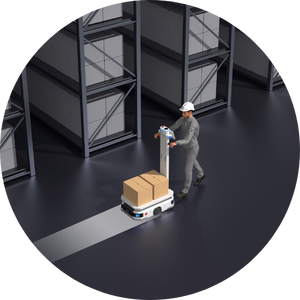
Production
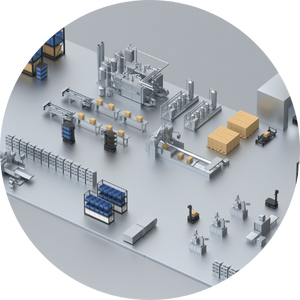
Administration

The AI-powered robot scrubber effortlessly handles even larger messes.
 For every type of dirt
 AI waste detection
 24/7 continuous operation
 Quick adaptation to changing environments
Autonomous pallet robot for intelligent material flows in warehousing, production, and intralogistics.
 Up to 2,000 kg load capacity
 AI pallet detection
 Pallet pickup in 20 sec.
 Up to 12 hours of battery life
Cleans large hard floor areas autonomously by sweeping, scrubbing, and edge cleaning.
 Large-scale cleaning
 Sweeping & Scrubbing
 Sweeping & Scrubbing
 Edge cleaning
Humanoid service robot series for reception, information, and interactive assistance
Fully autonomous
 Interactive customer engagement
 Autonomous navigation
AI gestures and speech
Autonomous navigation
AI gestures and speech
High-performance 10 kg cobot with long reach for palletizing, handling, and machine tending.
 10 kg
10 kg
 1300 mm
 IP54
24 I/O
IP54
24 I/O
Industrial delivery robot for autonomous transport in warehousing, logistics, and production.
Multi-route navigation
 Automatic obstacle protection
 Up to 300 kg payload
Real-time fleet management
Up to 300 kg payload
Real-time fleet management
Large-area scrubber for industrial facilities and warehouses with high performance and precision.
 High area coverage
Long battery life
High area coverage
Long battery life
 Rugged industrial design
Precise navigation
Rugged industrial design
Precise navigation
Autonomous heavy-duty robot for precise, efficient material logistics.
600 kg load capacity
Autonomous transport
Smart Navigation
Precise positioning
The intelligent 4-in-1 cleaning robot that autonomously vacuums, mops, sweeps, and scrubs.
Versatile cleaning
Automatic charging
Multi-surface capable
Mobile water tank
Heavy-duty robots for efficient material transport with flexible automation.
Diverse attachments
24/7 continuous operation
Omnidirectional perception
300 kg load capacity
The PUDU CC1 Pro is an intelligent 4-in-1 cleaning robot with AI-powered precision.
AI stain analysis
 Automatic water refill
Real-time heatmap
Automatic water refill
Real-time heatmap
 Multi-surface cleaning
Industrial sweeping robot with 3D LiDAR, 45 L container, and up to 5 hours of runtime.
3D LiDAR navigation
45 L waste bin
Runtime up to 5 hours
 750 mm cleaning width
6-axis desktop cobot for practical automation scenarios in education and research.
 6-axis
450 mm
0.75 kg
6-axis
450 mm
0.75 kg
 Bildung
5-kg cobot with an 850 mm reach and IP54, optimized for retail, hospitality, and service robotics.
5 kg
850 mm
IP54
Collision stop
AMR transport robots, heavy-duty robots, cobots, autonomous cleaning robots, and mobile service robots for material flow are particularly suitable for industry and logistics. They support warehousing, production, goods receiving, shipping, order picking, replenishment, and industrial cleaning. Terra Robotics helps select suitable robotics solutions for intralogistics, production supply, warehouses, and industrial automation.
Robots make intralogistics more efficient by automating repetitive transport tasks between goods receiving, storage, production, testing stations, packing stations, and shipping. AMR transport robots reduce empty runs, relieve employees, and ensure predictable material flows. Through digital orders, defined transfer points, and fleet management, internal processes become more transparent, faster, and more scalable.
AMR transport robots take on tasks in warehouses and production such as material transport, replenishment, order picking support, line supply, pallet or cart movement, and transport between workstations. Models such as the PUDU T300, PUDU T600, or OrionStar CarryBot are suitable for defined transport processes, high repetition rates, and automated handovers in industrial and logistics environments.
AMRs are autonomous mobile robots that can navigate flexibly and dynamically avoid obstacles. AGVs usually follow more defined routes or markings and are suitable for standardized transport paths. Cobots are collaborative robot arms that support tasks such as handling, palletizing, machine loading, or assembly. For industry and logistics, the right solution depends on the process, payload, environment, and integration goal.
Yes, many industrial and logistics robots can be introduced gradually during ongoing operations. To do this, processes, routes, bottlenecks, transfer points, safety zones, and priorities are first analyzed. This is followed by a site survey, mapping, pilot operation, and training. In this way, transport, cleaning, or handling processes can be automated without having to rebuild the entire infrastructure immediately.
Robots in industry and logistics can be safely deployed in mixed traffic if sensors, safety zones, speed, emergency stops, travel paths, and priorities are properly configured. Modern AMRs use LiDAR, cameras, scanners, and obstacle detection to identify people, forklifts, pallets, and racks. Before rollout, risk analysis, traffic routes, restricted zones, and employee training should be mandatorily planned.
Yes, many logistics robots can be integrated into WMS, ERP, MES, or fleet management systems via interfaces. This allows transport orders to be transferred digitally, status information to be reported back, and priorities to be managed automatically. Relevant aspects include interfaces, order logic, transfer points, charging status, route planning, user rights, and coordination with existing IT and production processes.
Cleaning robots play an important role in industrial and warehouse facilities because they can clean large areas in a predictable, documentable, and consistent manner. Models such as the Gausium Scrubber 75, Gausium Beetle Pro, PUDU MT1, or PUDU CC1 Pro are suitable for sweeping, vacuuming, mopping, or scrubbing, depending on the surface and level of soiling. This relieves the burden on cleaning teams and ensures that industrial floor surfaces remain usable and safe in the long term.
The use of robots is particularly worthwhile when companies have recurring transport tasks, long travel distances, staff shortages, high area performance requirements, shift operations, safety risks, or bottlenecks in storage and production. The decisive factors are process frequency, payload, travel routes, time savings, error reduction, service effort, and scalability. Terra Robotics can help to realistically evaluate TCO, ROI, and the appropriate robotics solution.
Yes, robots for industry and logistics can be purchased, rented, or leased. Purchasing is suitable for long-term automation projects with stable utilization. Renting is sensible for pilot projects, test installations, or temporary spikes. Leasing allows for predictable costs and preserves liquidity. Terra Robotics provides support with selection, feasibility studies, commissioning, training, maintenance, and scaling.
Logistics robots and mobile robots for intralogistics increase throughput, safety, and predictability. AMR transport robots, picking and replenishment robots, as well as cleaning robots for warehouses standardize transport, supply lines, ensure cleanliness, and document performance. Companies reduce empty travel, bottlenecks, and manual risks without needing to rebuild their infrastructure.
Defined routes and priorities prevent traffic jams, empty runs, and ad-hoc paths. Safety scanners, emergency stops, and zone profiles mitigate hazardous points in mixed traffic. Fleet managers coordinate trips, capacity utilization, and charging status, display KPIs such as order lead time, schedule adherence, and area performance, and enable scaling from pilot to multi-shift operation according to the AMR principle.
AMRs handle material transport between the receiving area, inspection station, and buffer. Warehouse robots close the gaps between gates, packing stations, and shipping lanes, transport stackers or dollies to consolidation zones, and secure ramp areas via restricted zones. The result is shorter paths, fewer standstills, and traceable handovers.
Picking robots accompany picking teams as mobile handover points, hold KLT containers ergonomically, drive independently to the handover point based on fill level, and call up follow-up orders. For milkrun processes, AMRs supply shelves with pallets or KLTs, while zone and route planning define right-of-way for time-critical orders and relieve congestion on main axes.
Industrial transport robots supply lines, collect finished goods, and connect storage, pre-assembly, and assembly areas. Autonomous mobile robots use existing paths, doors, and, if necessary, elevators/auto-doors. With trailers or tops like shelves, trays, or compartments, they form a flexible system for KLTs, Euroboxes, or special carriers. Examples such as the T300 or CarryBot stand for high payloads, multi-route navigation, and fleet control.
Mobile platforms with camera or scanner modules take over counting runs, visual inspections, and photo documentation. Repeatable routes ensure constant perspectives and reliable comparisons over weeks and months, which noticeably reduces the pressure during end-of-year peaks.
Industrial cleaning robots and warehouse floor cleaning robots keep main aisles, picking zones, and intermediate storage areas clean during defined windows. Scrubbing and sweeping systems like the Gausium Scrubber 75 or Beetle Pro ensure area coverage, while the CC1 and MT1 cover side areas or adjacent office spaces. Predictable hygiene, fewer slips, and documented runs increase operational safety.
The starting point is payload, container dimensions, and topology: aisle widths, turning radii, intersections, inclines, and ramps. Zones for encounters with forklifts, buffers, and docking points define the traffic regime. For navigation, LiDAR/VSLAM, driving accuracy in mixed traffic, zone profiles for speed and approach, front and side safety scanners, emergency stops, and acoustic and optical signals are key. Also important is the restart behavior after blockages and behavior in narrow areas.
Value is created through data flows: orders from WMS or ERP, API-based status messages, receipts, and return-path logic. Elevator integration enables multi-floor routes; auto-doors accelerate passage through gates. The fleet manager prioritizes urgent orders, balances charging stops, and provides log files for audit and optimization.
Dust, humidity, temperature fluctuations, and transitions such as concrete to grating require robust drives, appropriate IP protection, and sufficient ground clearance. For outdoor access to ramps, traction and weather resistance are important; during off-hours, quiet noise profiles are relevant for production and storage.
For multi-shift operation, auto-docking, intermediate charging, and swappable batteries are crucial. Service SLAs, spare parts availability, and clear roles between shop floor and IT ensure availability. Documented cleaning and maintenance intervals for pads, brushes, wheels, and filters keep performance constant.
In AMR transport, platforms like the OrionStar CarryBot or PUDU T300 feature multi-route navigation, up to 300 kg payload, and variable tops. In industrial cleaning, the Gausium Scrubber 75, Beetle Pro, as well as PUDU MT1 and CC1 combine scrubbing, sweeping, and mopping depending on the zone. Key comparison factors include payload or area performance, sensor technology and navigation methods, integration with WMS/ERP and elevator/auto-doors, runtime and charging strategy, safety features, noise profile, and service packages.
The business case is based on travel time and repetition rate. Transport benefits from minutes saved per trip multiplied by frequency and cost per minute, including reduced damage. Cleaning gains via area performance per hour and available time windows, while automated receipts reduce misallocations. KPIs such as order lead time, empty run rate, interventions per 100 trips, and area performance make progress measurable. With each additional AMR, the ROI improves as capacity utilization increases.
A reliable rollout begins with a site survey and safety plan for paths, intersections, and zones. This is followed by a pilot cell that makes one line productive and reveals bottlenecks. Integration connects the WMS/ERP, elevator, and auto-door and reports status to control centers. Training covers start and stop, emergency stop, incident handling, daily checks, and log interpretation. Scaling expands the fleet, refines profiles per shift, establishes preventive maintenance, and cyclically reviews KPIs.
Buying is suitable for long-term operation with stable routes and clear capacity utilization. Renting fits proof-of-concept, conversion, and peak phases. Leasing creates predictable OPEX and allows for technology refreshes. We provide TCO scenarios including hardware, service, wear and tear, training, and integration efforts so that the decision for industry & logistics is fact-based.


