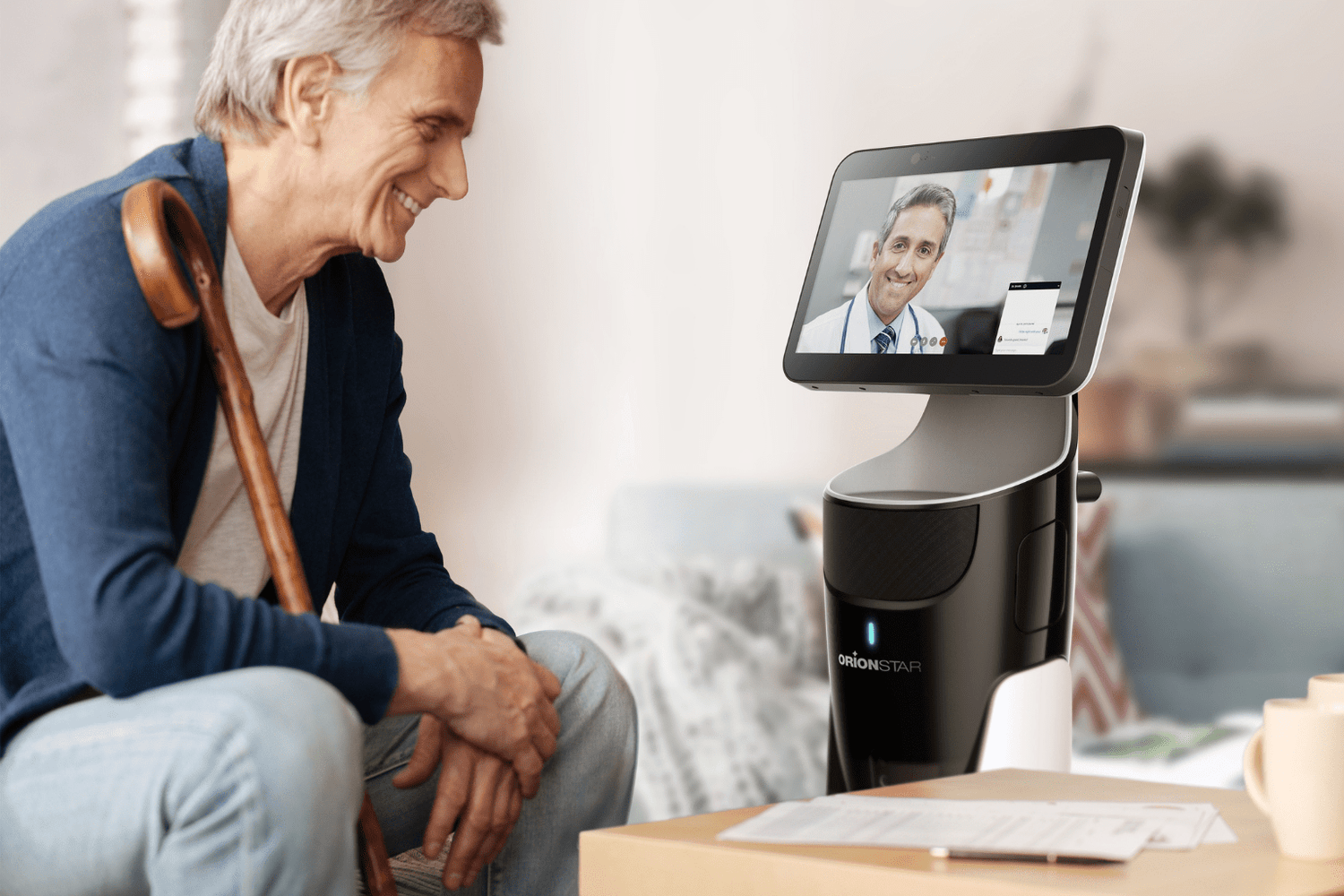
Reception robots digitize recurring tasks related to greeting, information, and visitor guidance. They can address guests, provide information on a display, answer questions via voice or touch functions, and assist visitors with orientation within defined areas. This makes modern reception robots particularly suitable for companies, hotels, clinics, medical practices, showrooms, educational institutions, and other buildings with regular public traffic.
Terra Robotics offers various reception and information robots from OrionStar for this purpose. Key models include the OrionStar GreetingBot Nova, GreetingBot Mini, and LuckiBot Plus. These systems prioritize different aspects of size, display, voice interaction, visitor guidance, and marketing functions.
What can a reception robot handle?
A reception robot does not replace a personal reception. Its strength lies primarily in frequently recurring information and orientation tasks.
Visitors can, for example, be greeted and informed about contact persons, rooms, opening hours, events, or important points of interest. In larger areas, a suitable robot can additionally guide visitors to previously defined locations.
This creates a digital contact point alongside the traditional reception, providing information consistently. At the same time, employees can focus more on individual requests where personal contact or professional judgment is necessary.
Depending on the project, reception robots can also be combined with digital visitor or check-in processes. Which functions are actually possible depends on the robot model, software, available interfaces, and the visitor management system used.
OrionStar GreetingBot Nova for a professional reception
The OrionStar GreetingBot Nova is the central reception solution in the Terra Robotics portfolio. Internally, the model is designed for greeting, visitor information, guiding, and interactive communication.
A 14-inch FHD display is used to show information and digital content. Additionally, the platform supports voice interaction and multilingual communication. For navigation and orientation within suitable indoor areas, the GreetingBot Nova uses 3D LiDAR, among other technologies.
This makes the robot particularly suitable for corporate foyers, hotels, larger reception areas, showrooms, clinics, and other locations where visitors regularly need to be informed or directed.
GreetingBot Mini for compact reception areas
Not every reception area offers enough space for a larger robot. The OrionStar GreetingBot Mini has been positioned as a more compact reception and information solution.
With a net weight of around 21 kg and a footprint of approximately 41 × 41 cm, it requires significantly less space. Despite this, it features a 14-inch display as well as functions for voice, information, promotion, and visitor guidance.
This makes the GreetingBot Mini especially suitable for smaller corporate foyers, hotels, retail spaces, exhibition areas, and compact information points.
For companies, this means: the choice of a reception robot does not have to be based solely on the number of functions. Especially in smaller entrances, dimensions, movement space, and visitor frequency can be more decisive.
LuckiBot Plus for reception and digital signage
The OrionStar LuckiBot Plus connects reception robotics more strongly with marketing and mobile digital signage. The system possesses a large 27-inch advertising display as well as an additional touch display.
Internally, the LuckiBot Plus is classified for promotion, reception, Q&A, guiding, and mobile digital signage.
This makes the model particularly interesting for companies that want to not only inform visitors but also present products, brand messages, or current offers at the same time.
Typical locations include showrooms, shopping centers, hotels, trade fairs, and larger corporate foyers. If the focus is exclusively on advertising and promotion, further solutions can be found in the marketing robot section.
Reception robots for offices and corporate foyers
In the office, many recurring questions arise: Where is a meeting room? Where is reception? Which floor or area is relevant?
An information robot can provide such basic information and assist visitors with orientation within defined areas.
Especially in larger corporate headquarters, administrative buildings, or locations with changing external guests, a digital reception can create additional capacity. At the same time, personal reception remains available for individual questions and special concerns.
Reception robots for hotels and the hospitality industry
Hotels also benefit from digital information points. In the lobby, guests can receive information about hotel areas, events, gastronomy, or other services.
A reception robot can also assist with orientation to elevators, conference rooms, or other defined destinations. For transport and room service tasks, however, specialized service robots are the more suitable product group.
In this way, different robotic systems can be deployed clearly according to their task: reception robots inform and provide orientation, while service robots handle defined delivery and transport routes.
Further solutions can be found in the Gastronomy & Hotel field of application.
Reception robots for clinics and medical practices
In larger medical facilities, orientation for patients and visitors can be a challenge. Entrances, waiting areas, wards, and various departments must be found quickly.
Reception robots can provide supplementary information here and assist visitors with orientation within approved areas. Recurring questions, in particular, can be handled digitally.
In this process, data protection, accessibility, routing, and the specific environment should be considered during project planning. Medical advice or nursing tasks are expressly not part of a reception robot's scope of duties.
Further application possibilities are shown on the Medical Practice & Clinic page.
Visitor guidance and autonomous navigation
For a reception robot to navigate independently, the environment is mapped before commissioning. Subsequently, depending on the system, routes, destinations, stopping points, and, if necessary, restricted zones are defined.
Sensors such as LiDAR and cameras support environmental perception and obstacle detection. Nevertheless, the real building situation determines whether an area is suitable for autonomous visitor guidance.
Narrow passages, high-traffic areas, stairs, doors, or floor changes must be considered during planning. Elevator or door integrations should not be assumed automatically but should be technically checked for every robot model and building.
Language, display, and digital content
A fundamental difference between classic information screens and reception robots is interaction.
Depending on the model, visitors can communicate with the system via touchscreen or voice. Content can be used, for example, for company information, orientation, events, or current notices.
According to internal product data, the GreetingBot Nova supports more than 30 languages. The LuckiBot Plus also offers multilingual interaction.
Which languages and interaction functions make sense for a specific project should be determined based on the actual visitor structure.
Selecting the right reception robot
When selecting, companies should first define the specific use case. Should the robot mainly greet, answer questions, guide visitors, or additionally present advertising content?
For a professional and interactive reception, the GreetingBot Nova is a particularly suitable platform. In case of limited space, the GreetingBot Mini may be more sensible. If marketing, large-format display content, and reception are to be combined, the LuckiBot Plus offers additional possibilities.
Visitor frequency, available space, desired interaction, volume, navigation, and existing digital systems should also be included in the selection process.
Buying and professionally implementing reception robots
Anyone wishing to purchase a reception robot should therefore not just compare individual technical specifications. It is crucial how well the system fits the actual visitor process and the existing infrastructure.
Terra Robotics provides support with selection, site analysis, mapping, setup, and commissioning. For training and subsequent operation, additional services such as the Terra Academy can be relevant.
In addition to a classic purchase, financing or Robot as a Service may be options depending on the project.
This allows reception robotics to be deployed precisely where they create concrete added value: as a digital visitor reception, interactive information point, or mobile orientation aid—tailored to the company, the building, and actual requirements.