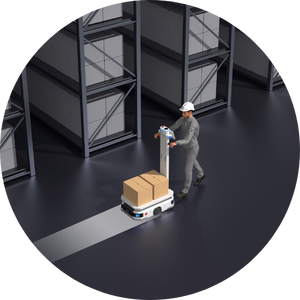
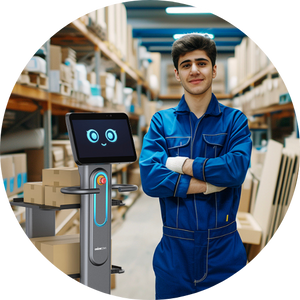
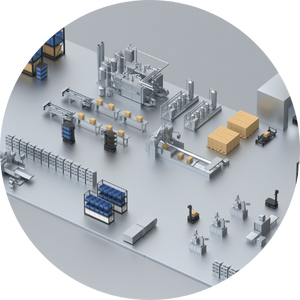
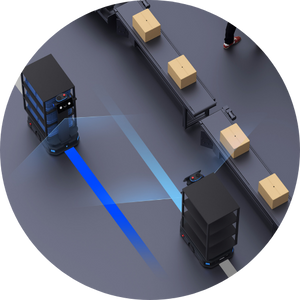
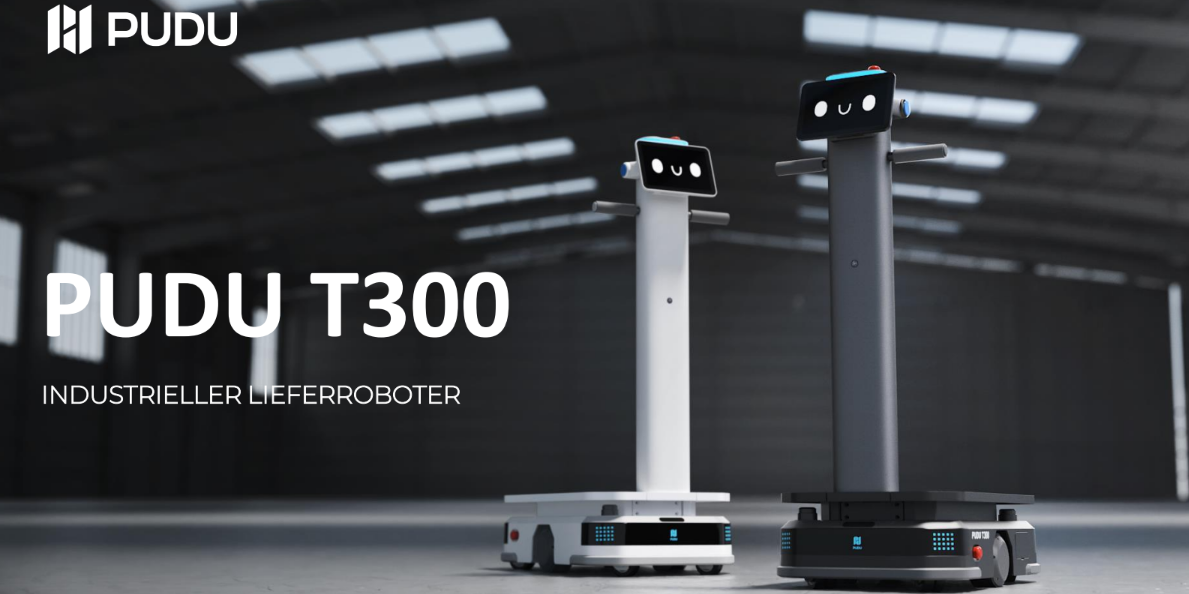
The PUDU T300 delivery robot is a professional autonomous transport robot for companies looking to make internal material flows more efficient, predictable, and ergonomic. It was specifically developed for industrial and commercial indoor areas where goods, components, tools, containers, or materials must be moved regularly between defined work areas. This makes the T300 particularly suitable for production, warehouses, logistics centers, shipping areas, assembly supply, workshops, industrial halls, and modern intralogistics processes.
Unlike classic service robots for gastronomy or hospitality, the PUDU T300 is clearly designed for material transport, factory logistics, and heavy loads. With a maximum payload of up to 300 kg, it bridges the gap between manual transport carts, traditional picking carts, and larger automated guided vehicle systems. It can take over recurring transport tasks, reduce travel distances, and relieve employees of physically demanding routine activities. As a result, internal routes become more predictable, processes more transparent, and material flows more stable.
Especially in production and logistics environments, many recurring movements occur every day: components must be brought to lines, tools moved between areas, semi-finished goods transported, or containers delivered from the warehouse to production. The PUDU T300 addresses exactly this. It supports defined transport processes and can help deliver material where it is needed—without employees having to cover every distance manually.
Why the PUDU T300 is compelling in intralogistics
In many companies, internal transport is an underestimated cost and time factor. Employees walk long distances, material is pushed manually, bottlenecks arise due to missing parts, and production areas wait for supplies. This is precisely where an autonomous delivery robot like the PUDU T300 can help. It takes over recurring trips, supports standardized transfer points, and can structure material flows more evenly.
The greatest benefit lies not in replacing individual employees, but in making better use of valuable working time. Skilled workers can focus more on assembly, picking, quality inspection, process control, or customer orders while the robot handles defined transport routes. Especially in the case of long distances, heavy loads, or regularly recurring material movements, the T300 can be a sensible addition to existing logistics.
The PUDU T300 is particularly interesting for companies with lean management, just-in-time, or Kanban processes. It can help organize material replenishment more structurally and approach transfer points more reliably. This creates greater predictability in the internal flow of goods. A prerequisite is a clean process analysis: Which goods are being moved? Which routes are repeated? Where do waiting times arise? Which loads must be transported? Which transfer points are sensible?
Strong payload for heavy and recurring transports
The PUDU T300 is designed for high transport performance. With a maximum payload of up to 300 kg, it is suitable for significantly heavier tasks than classic service or delivery robots. As a result, it can move not only small parts but also heavier containers, workpieces, components, tools, or material carriers. For companies with recurring internal transport, this offers a clear advantage: trips can be bundled, manual strain reduced, and material routes standardized.
The machine measures 835 × 500 × 1350 mm and weighs around 65 kg in the standard mode. Thanks to its comparatively slim design, the T300 remains flexibly deployable even in narrower indoor areas. The minimum passage width is approximately 60 cm. This allows it to be used in many production, warehouse, and workshop environments, provided the floor, paths, and safety clearances are suitable.
Actual performance always depends on the specific application. Transported goods, center of gravity, loading, floor conditions, travel speed, turning radii, and transfer points influence real-world operation. Therefore, before introduction, one should check which loads are transported regularly, how they are secured, and whether standard, shelf, lifting, or towing applications best fit the process.
Flexible operating modes for different logistics processes
The PUDU T300 supports various application modes and can thus be adapted to different material flow scenarios. In the automatic delivery mode, the robot can approach defined destination points and transport goods between areas. This is suitable, for example, for supplying production lines, transporting containers between storage and assembly, or connecting picking and shipping.
In follow mode, the T300 can support a defined sequence in which the robot accompanies employees or transport processes. This is particularly interesting if material supply, picking, or mobile work processes are to be organized more flexibly. In power-assist mode, the robot provides electrical support for manual movements. This can be helpful if direct manual control or support is required in certain situations.
In addition, the PUDU T300 can be used with different superstructures or transport solutions, depending on the equipment and application. These include, for example, standard operation, shelf applications, lifting solutions, or towing applications. Which configuration is sensible depends on the transport goods, transfer points, process structure, and the requirements of the area. For a professional introduction, it should therefore be decided on a project-specific basis which variant offers the best operational benefit.
Navigation with VSLAM+ and LiDAR SLAM
A central strength of the PUDU T300 is its navigation. The robot uses a combination of VSLAM+ and LiDAR SLAM to orient itself in furnished indoor areas and travel along defined routes. This navigation enables use in dynamic environments where layouts, work areas, or material zones may change.
This flexibility is particularly important in production and storage. Machines are moved, shelves are changed, pallets are parked temporarily, walkways are blocked, or workplaces are adjusted seasonally. The T300 is designed to work in such environments with defined maps and destination points. Changes in the production line or layout can be taken into account accordingly without necessarily requiring extensive structural adjustments.
Despite modern navigation, the deployment should be planned realistically. The PUDU T300 is designed for indoor areas with level ground. Fluid-covered, heavily soiled, very uneven, or otherwise unsuitable floors should be avoided or checked in advance. Bottlenecks, ramps, thresholds, pedestrian traffic, and intersections must also be taken into account in the planning. The more cleanly the area, paths, and transfer points are prepared, the more reliably the robot can be integrated into everyday work.
Safety in the industrial environment
The PUDU T300 was developed for use in professional work environments. It has several safety components, including LiDAR sensors, depth cameras, collision protection sensors, and emergency stop switches. This sensor system supports perception of the surroundings and helps the robot detect obstacles, people, or objects in its path.
For industrial applications, it is particularly relevant that the T300 can also detect low or hanging obstacles and react to safety markings on the floor. This is important in factories, warehouses, and logistics areas because people, machines, pallets, transport carts, and shelf systems often share the same space there. The robot can adapt its driving style to the surroundings and thus contributes to a controlled human-robot operation.
However, safety is not created by sensors alone. Decisive factors are clear traffic routes, defined rules, trained personnel, and clean integration into existing safety concepts. Before productive use, areas, walkways, intersections, transfer points, and emergency procedures should be checked. This ensures the T300 is not just technically installed, but safely integrated into the real operational workflow.
Mobility in confined spaces
An important advantage of the PUDU T300 is its maneuverability. With a minimum passage width of about 60 cm, the robot can also be used in narrower areas, provided the environment is suitable for it. This makes it interesting for dense production layouts, warehouse aisles, workshop areas, or spaces where there is no room for large automated guided vehicle systems.
The T300 can overcome thresholds of up to 20 mm and gaps or grooves of up to 35 mm. This makes it suitable for many typical indoor areas in industry and logistics. Nevertheless, floor conditions should be checked in advance, as extreme unevenness, liquids, loose obstacles, or unsuitable transitions can influence operation.
For existing companies, this mobility is an important factor. Not every company can completely rebuild its space to introduce automation. The PUDU T300 offers a flexible option here for companies that want to automate existing processes without immediately introducing a large, permanently installed transport system.
Battery life, charging, and shift operation
The PUDU T300 is designed for long deployment windows in professional operation. The runtime depends on load, driving profile, speed, stops, floor conditions, and the deployment scenario. As a guideline: up to 12 hours of runtime is possible without a load; at full load, the runtime is correspondingly lower. The charging time is about 2 hours from 0 to 90%. In addition, depending on the setup, the robot supports automatic charging and the use of replaceable batteries.
In practice, it is not just the pure runtime that is decisive, but the correct deployment planning. In some companies, one robot is sufficient for defined trips per shift. In other scenarios, intermediate charging, replacement batteries, or multiple robots can make sense. Especially in multi-shift operation, it should be checked in advance how many trips per hour are required, when charging windows occur, and whether automatic charging processes can be integrated into the workflow.
Serious planning avoids blanket promises. The T300 can support very high availability if processes, charging cycles, and tasks are neatly coordinated. However, whether continuous operation over long periods is realistic always depends on the specific project.
IoT functions and integration into operations
The PUDU T300 supports various IoT and control functions that are important for modern intralogistics. These include, among others, E-Gate control, elevator control, pager functions, and management via PUDU Link. These functions can help to better integrate the robot into existing operating environments and control transport tasks more flexibly.
In practice, this means: The robot can be used not only locally on the device but also more strongly integrated into digital workflows. Employees can initiate transport orders, manage destinations, or incorporate the robot into defined process chains. In larger facilities, the connection to gates, elevators, or other infrastructure points can also become relevant. Whether and how these functions can be used should be checked on a project-specific basis.
For companies with growing automation, this expandability is an important advantage. The T300 can serve as an entry point into autonomous intralogistics and later be incorporated into more complex processes. This creates a scalable solution that can grow with the company's requirements.
Areas of application: Production, warehouse, logistics, and assembly
Industry and manufacturing
In manufacturing, the PUDU T300 can transport materials, components, or tools between the warehouse, pre-assembly, production line, and transfer points. In doing so, it supports continuous material supply and can help to reduce waiting times in production.
Warehouse and inventory management
In the warehouse, the T300 can move containers, cartons, or components between shelves, picking stations, packing stations, and shipping areas. Especially with recurring routes, the robot can contribute to reducing manual routine activities and structuring workflows.
Logistics centers and hubs
In logistics centers, the PUDU T300 can connect different functional areas. It can transport goods between goods receipt, sorting, interim storage, packing area, and shipping. This makes it suitable for companies with a high volume of material flow and clearly defined transfer points.
Assembly supply
In assembly areas, the robot can deliver components, tools, or material carriers to production islands. This supports structured supply directly at the workplace and can reduce manual material trips.
In-plant transport
For larger sites, the T300 is suitable for recurring courier and transport trips within defined indoor areas. Especially on long routes between departments, storage zones, or production areas, it can relieve employees and save time.
Economic efficiency and process benefits
The economic efficiency of the PUDU T300 arises from the combination of reduced travel distances, higher process stability, less manual strain, and more predictable material flows. Especially in industry and logistics, not every saving is immediately visible as a direct reduction in personnel costs. Frequently, the benefit lies in the fact that employees spend less time on transport routes and can concentrate more on value-adding activities.
For a well-founded assessment, companies should check how many transports take place daily, which loads are moved, which routes are repeated particularly frequently, and where bottlenecks arise. Waiting times at lines, unnecessary searching times, manual pushing distances, and physical strain should also be included. The more clearly these factors are recorded, the better the benefit of the T300 can be evaluated.
The robot is particularly sensible where transport tasks are regular, predictable, and standardizable. If material flows are chaotic, highly variable, or not clearly defined, the process should be structured first. The best ROI is achieved when the T300 is integrated into a well-thought-out logistics concept.
Service, implementation, and introduction with Terra-Robotics
An autonomous transport robot only unfolds its benefit when the area, process, and technology match. Before introduction, transport routes should be analyzed, destination points defined, loads checked, transfer points determined, and employees trained. Safety zones, traffic routes, charging planning, and responsibilities should also be clearly regulated before productive use.
Terra-Robotics provides support with consulting, implementation, training, and initial installation. As a result, the PUDU T300 is not just viewed as a single device, but as part of a functioning automation project. This is particularly important in industry and logistics, where operational safety, process stability, and acceptance within the team are decisive.
A sensible start can be made with a clearly delimited use case, for example, material replenishment for a line, transport between storage and assembly, or recurring trips in the shipping area. After the first deployments, routes, destination points, and tasks can be further optimized. In this way, a robust automation solution for internal material flow is created step by step.
Conclusion: PUDU T300 as a strong delivery robot for modern intralogistics
The PUDU T300 delivery robot is a professional solution for companies that want to automate heavy and recurring material transports indoors. With up to 300 kg payload, VSLAM+ and LiDAR SLAM, flexible operating modes, compact design, high maneuverability, safety functions, and optional IoT integration, it is particularly suitable for production, warehousing, logistics, assembly, and internal plant transport.
The T300 is not a classic service robot for simple deliveries, but a robust autonomous transport robot for demanding intralogistics processes. Correctly planned and introduced, it can stabilize material flows, relieve employees, reduce travel distances, and make internal processes more efficient. For companies that want to modernize their logistics and integrate automated transport flexibly into existing structures, the PUDU T300 is a strong solution for the next step toward smart factory logistics.