

Relieve the burden on nursing staff
Robots take over routines, your staff has more time for patients.


Care and healthcare facilities face major challenges every day. Lack of time, staff shortages, and increasing pressure to perform. Our intelligent service robots support medical staff with everyday tasks. Efficient, reliable, and around the clock.


Hospital
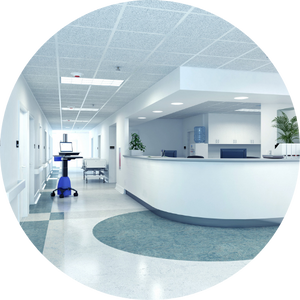
Nursing home

Rehabilitation center

Day clinic

Senior Center

ikitbot ONE S55, a 6-in-1 cleaning robot, 55 dB quiet, with AI navigation.
 6-in-1 cleaning
 55 dB Quiet
 AI obstacle avoidance
 Easy maintenance
Powerful scrubbing and polishing performance with AI stain detection and autonomous navigation.
 25 kg contact pressure
 Scouring & Polishing
 AI stain detection
 Post-cleaning
The intelligent 4-in-1 cleaning robot that autonomously vacuums, mops, sweeps, and scrubs.
Versatile cleaning
 Automatic charging
 Multi-surface capable
 Mobile water tank
Compact 4-in-1 cleaning robot for sweeping, vacuuming, scrubbing, and dusting.
4 cleaning modes
Very quiet <65 dB
 Runtime up to 14 hours
 Edge cleaning 0 mm
Service robot with display for the catering industry, hotels, and other sectors.
 Touchscreen interaction
 Obstacle avoidance
VSLAM technology
AI food recognition
Obstacle avoidance
VSLAM technology
AI food recognition
Autodoor Bot Pro opens doors automatically and optimizes workflows in hotels and the catering industry.
Fan robot
 Automatic Door Navigation
Robust & low-maintenance
Automatic Door Navigation
Robust & low-maintenance
 Plug and Play
Intelligent, high-capacity delivery robot for catering, hotels, and nursing homes.
 400+ meals per day
Customizable trays
400+ meals per day
Customizable trays
 Interactive advertising
Car navigation
Interactive advertising
Car navigation
Autonomous delivery robot for floor-to-floor and in-house transport.
Closed compartments
 Cloud & Elevator Control
 Multiple verification
 Comprehensive IoT integration
The PUDU CC1 Pro is an intelligent 4-in-1 cleaning robot with AI-powered precision.
AI stain analysis
 Automatic water refill
 Real-time heatmap
 Multi-surface cleaning
For nursing, hospitals, and healthcare facilities, delivery robots, compartment robots, reception robots, and cleaning robots are particularly suitable. They take over non-medical routine tasks such as meal transport, laundry transport, material transport, wayfinding, visitor information, and scheduled cleaning. Terra Robotics provides support in selecting suitable robots for hospitals, nursing homes, rehab centers, day clinics, or senior centers.
Service robots relieve nursing and medical staff by taking over repetitive walking tasks and physically demanding routines. These include the transport of food, laundry, consumables, non-refrigerated medication, or medical aids between storage, the kitchen, the ward, and patient areas. This leaves more time for direct care, nursing, communication, and medically relevant tasks.
In hospitals, robots can take on tasks in ward logistics, food transport, laundry transport, supply management, reception, guidance, and floor cleaning. Delivery robots with closed compartments transport goods securely to defined drop-off points. Reception robots provide information to visitors and patients. Cleaning robots clean hallways, waiting areas, and ancillary rooms in a schedulable and documented manner.
Yes, robots can be used to provide support in nursing homes and senior centers. They deliver meals, laundry, beverages, or assistive devices, accompany residents and visitors to common areas, display information, and clean suitable surfaces. It is important to understand that the robot is not intended to replace nursing staff, but rather to take over non-medical routines, thereby creating more time for human care.
Service robots in healthcare should feature smooth, easy-to-clean surfaces, low-touch operation, defined transfer zones, and clear hygiene processes. Enclosed compartments can protect sensitive items better than open trays. Cleaning robots can document floor cleaning and follow established cycles. UVC or disinfection functions are only useful where the space, safety concept, and hygiene clearance are appropriate.
Yes, service robots can transport food, laundry, consumables, medical aids, and appropriate medications in clinics and care facilities without special cooling or security requirements. For sensitive items, compartment robots with enclosed compartments, PIN or badge authorization, and logged handovers are advisable. Before implementation, transported goods, responsibilities, hygiene rules, and approval processes should be clearly defined.
Depending on the model, service robots navigate hallways, stations, entrance areas, and elevators using LiDAR, 3D vision, VSLAM, cameras, and sensor technology. Before deployment, maps, routes, stop points, restricted zones, speed zones, and priorities are configured. For multi-floor operation, elevator integration, door releases, network coverage, emergency stops, acoustic signals, and safety zones must be verified.
For robots in clinics and care facilities, data protection, role-based access rights, camera and microphone functions, log data, access protection, and IT approvals are particularly important. It should be clearly regulated which data is collected, stored, and analyzed. In addition, the security concept, emergency stop, travel zones, hygiene rules, patient environment, accessibility, and responsibilities must be checked before rollout.
The introduction of a service robot in a hospital or nursing home begins with an analysis of processes, areas, transit routes, handover points, and hygiene requirements. This is followed by a site survey, mapping, configuration, pilot operation, training, and a gradual rollout. Employees learn how to start, stop, use the emergency stop, load, unload, change zones, clean, and perform simple troubleshooting.
Yes, service robots for care, hospital, and healthcare facilities can be purchased, rented, or leased. Purchase is suitable for permanent processes with clear routes and stable utilization. Rental makes sense for pilot wards, test phases, or temporary relief. Leasing creates predictable costs. Terra Robotics provides support with selection, TCO analysis, commissioning, training, service, and maintenance.
Service robots take over non-medical routine tasks in clinics, nursing homes, and rehabilitation facilities. They travel along defined routes, deliver meals, laundry, or supplies, guide visitors, and clean surfaces in a planned and documented manner. This relieves the burden on teams, stabilizes processes, and improves hygiene workflows. On this page, you will find the most important use cases, selection criteria, and models for hospital service robots, nursing service robots, and hospital cleaning robots.
Robotics reduces travel distances and shifts transport and cleaning tasks into fixed time windows. Nursing staff gain time for direct patient care, while low-contact handovers and clearly defined zones increase quality. Routes, priorities, and schedules ensure supply even during staff shortages. Fleets can be scaled across multiple wards, and the robot-to-elevator integration enables floor-to-floor operation. Safety logics with graduated speeds, emergency stops, and role-based access rights ensure controlled mixed operation.
A hospital delivery robot with closed compartments reliably transports trays, non-refrigerated medications, laundry, or consumables between the kitchen, storage, and wards. PINs or badges authorize the handover; hospital compartment robots log pick-up and delivery points and travel autonomously using elevators and automatic doors.
A hospital reception robot greets visitors, provides directions, and informs them about wait times or visiting rules. Multilingual dialogues relieve staff at the front desk and noticeably reduce follow-up questions. Precise hospital wayfinding guides people from the main entrance to the outpatient clinic, incorporates spatial data, and can be adjusted in real-time to daily operational changes.
Hospital cleaning robots work on a wet or damp basis, document hospital floor cleaning with maps and timestamps, and maintain quiet movement profiles in waiting zones. Restricted areas protect intensive care or operating room sections. Additionally, hygiene robots with UVC are used provided the room is unoccupied and the local hygiene concept allows for it. A hospital UVC disinfection robot then supports surface disinfection with reproducible, logged cycles.
In nursing homes, nursing service robots support non-medical patient care. They deliver meals, laundry, and assistive devices, escort residents to common areas, and play announcements in waiting zones. Nursing home service robots adapt to daily structures and utilize quiet movement profiles. The frequently searched term "nursing robot" refers to systems for caregiving actions. Our solutions automate transport, reception, and cleaning and do not replace nursing staff. They create capacity where time is scarce.
Choose between compartment systems for secure handovers and tray or shelf robots for open transport. Crucial factors include load capacity, compartment dimensions, stability during cornering, and the number of stops per tour. Safety-relevant contents require restricted zones and clear role-based access rights. For cleaning, the suitability of the methods for your floor types as well as the verifiability of results in reporting are key.
LiDAR, 3D vision, and VSLAM ensure movement in corridors, airlocks, and elevators. Check the hospital robot-to-elevator integration including calling, confirmation, and door release. Auto-door interfaces, restricted zones, night profiles, and acoustic signals reduce operational disruptions. Maps can be versioned, routes per ward fine-tuned, and priorities dynamically adjusted when emergencies take precedence.
Smooth surfaces, easy-to-clean compartments, and low-contact handovers are standard. Dashboards provide tours, timestamps, and delivery reports for audits. Camera and microphone usage is clearly regulated, protocols are stored in an encrypted manner, and protected via role-based access. In this way, hospital service robots and hospital cleaning robots equally meet the requirements of hygiene, IT, and data protection.
A proven workflow leads from site survey to mapping and pilot, through to rollout. Training covers start and stop procedures, emergency stops, filling and emptying, zone changes, and hygiene checks. Service contracts ensure response times, spare parts, and preventive maintenance. During ongoing operation, fleet managers help with prioritization, while reports make bottlenecks visible so that routes can be improved step-by-step.
The product portfolio ranges from delivery robots with closed compartments for floor-to-floor and in-house transport, to serving and shelf robots for open tasks, and cleaning robots for corridors, waiting areas, kitchens, and back-of-house. Compare capacity, compartment or tray layout, battery life, integration with elevators and auto-doors, noise levels, hygiene features, reporting, and service packages. Selection is based on ward type, scheduling, night operation, and existing infrastructure.
Purchasing is suitable for facilities with stable, long-term operation and clear routes. Renting reduces risk during pilot phases, construction periods, or seasonal peaks. Leasing creates predictable Opex with technology refreshes. We create robust TCO scenarios including hardware, service, wear and tear, training, and integration costs so that the decision for nursing or hospital service robots is fact-based.
Brief answers regarding benefits, hygiene, integration, infrastructure, and control can be found in the FAQ accordion at the end of the page. Upon request, we will plan routes, roles, and reports together so that your project gets off to a secure start and can succeed in everyday clinical life.


