
![About [highlight] Unitree [/highlight]](http://terra-robotics.de/cdn/shop/files/Unitree_Hersteller_Alle_Produkte.png?v=1760362956&width=1600)
About Unitree
Unitree Robotics stands for innovation in humanoid robotics worldwide.
With AI-driven movements, impressive dynamics, and precise control, Unitree is setting new standards in research, industry, and education.


Humanoid performance robot in human size for research, industry and impressive tech shows.
 Humanoid design
 High load capacity
 Dynamic movements
 EDU version
The Unitree G1 impresses with precise control, agile movement, and powerful performance.
 Bimanual manipulation
 Force sensing
 3D Vision
 Open SDK
Compact humanoid research robot for teaching, AI development, and hands-on robotics projects.
26–40 degrees of freedom
 Humanoid locomotion
 SDK & Development
 For research & teaching
Intelligent robotic dog with 4D LiDAR for autonomous navigation
Ultra-wide angle
AI mode
Autonomous following
 OTA updates
The Unitree H1 stands for impressive freedom of movement, stability, and intelligent performance.
 Dynamic mobility
Torque control
3D Sensor Technology
Dynamic mobility
Torque control
3D Sensor Technology
 Whole Body Control
Development platform with open SDK for research & teaching
 Fully programmable
 SDK access
 Open architecture
 Research-ready
The Unitree G1-Edu combines adaptive learning capabilities with precise control and smart design.
Research & Education
Open-Source AI
Flexible programming
Practice-oriented
All-terrain with wheels & legs. Versatile robot dog
 All-Terrain
 Hybrid drive
Flexible movement
Hybrid drive
Flexible movement
 Expandable
Hybrid development platform (wheel & leg) for research
 Dual mode
SDK-compatible
Expandable
Innovative
Dual mode
SDK-compatible
Expandable
Innovative
Industrial robotic dog with speeds of up to 6 m/s and high payload capacity
 Maximum speed
High load
Maximum speed
High load
 Durable
 Robust Design
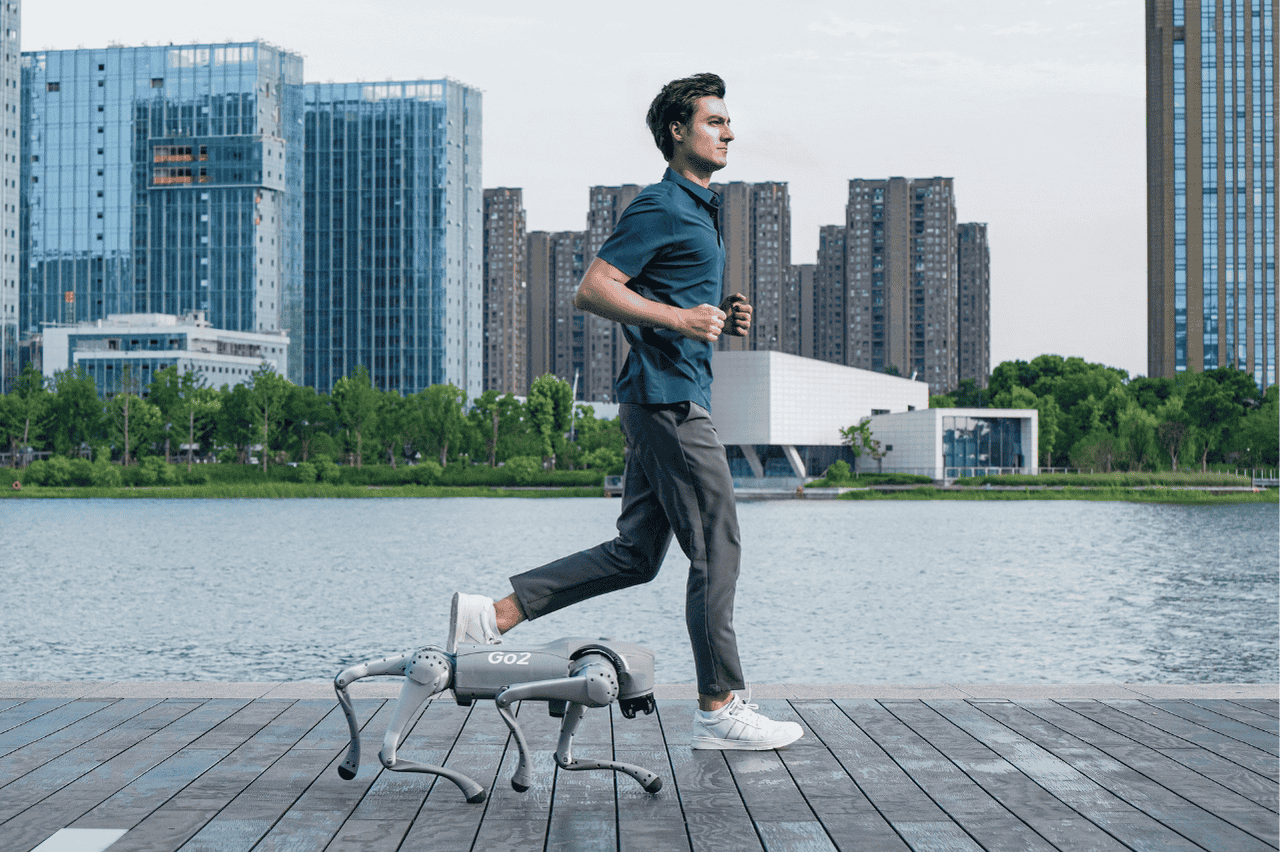
Unitree combines decades of engineering experience with innovative AI. The humanoid robots use state-of-the-art sensor fusion, deep learning algorithms, and self-learning motion control to adapt to new environments. The result: maximum precision, stability, and efficiency with minimal energy consumption.
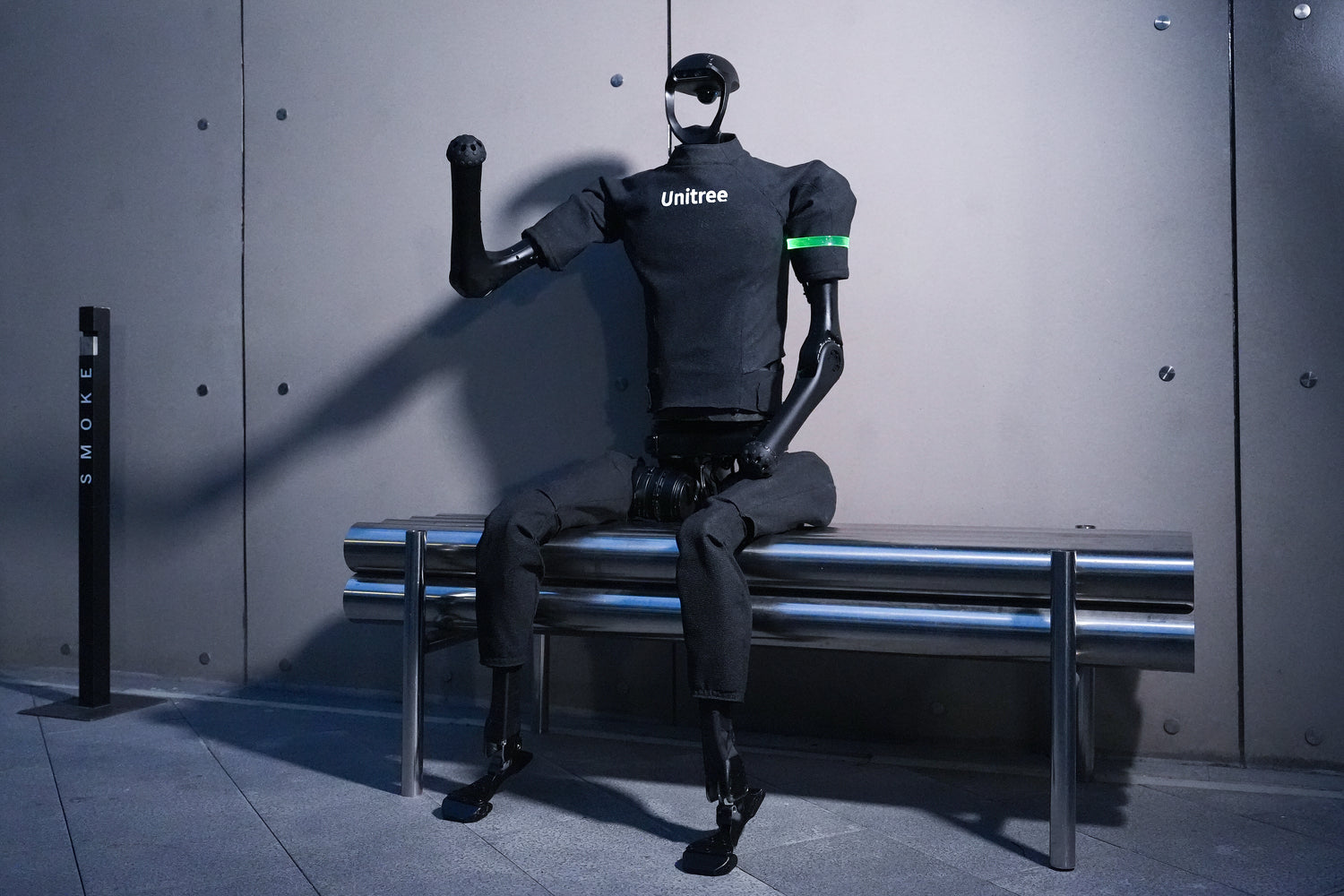
Unitree Robotics is a pioneer in the development of humanoid robots. With a clear focus on motion intelligence, sensor technology, and AI control, Unitree develops state-of-the-art robotic systems that combine human dynamics with machine precision. The H1, H1-2, G1, and G1-Edu models are designed for maximum performance, balance, and reaction speed – ideal for industry, research, and university education.

Unitree robots are used in numerous industries – from industrial manufacturing and research to security and educational applications. Thanks to their balance, movement precision, and learning ability, they are ideal for tasks that require human interaction, fine motor skills, or analysis.

By combining state-of-the-art actuator technology, real-time AI, and innovative sensor systems, Unitree develops humanoid robots that move dynamically, safely, and autonomously. Whether in industry, the laboratory, or research, these systems react precisely to complex scenarios while operating with impressive efficiency.
Unitree Robotics is a manufacturer of advanced humanoid robots and quadrupedal robot dogs. Unitree's robotic systems are used in research, industry, education, development, inspection, and technical pilot projects. Terra Robotics supports companies, universities, and research institutions with the selection, procurement, commissioning, training, and technical support for Unitree robots.
Terra Robotics offers various Unitree robots for humanoid robotics, research, education, inspection, and industry. These include, among others, Unitree H2, Unitree G1, Unitree Go2, Unitree H1/H1-2, Unitree Go2-EDU, Unitree G1-EDU, Unitree Go2-W, Unitree Go2-W-EDU, and Unitree B2. The models differ in size, agility, sensor technology, SDK access, payload, terrain capability, and field of application.
The Unitree G1, Unitree G1-EDU, Unitree Go2-EDU, and Unitree Go2-W-EDU are particularly suitable for research and development. These Unitree robots are of interest for programming, AI projects, robotics research, sensor technology, autonomous navigation, human-robot interaction, and development environments. Open SDK access, programmability, data access, sensor technology, and appropriate technical support are important factors in this regard.
Depending on the application, the Unitree H2, Unitree G1, Unitree H1/H1-2, Unitree B2, and Unitree Go2-W are suitable for industrial and technical pilot projects. Humanoid Unitree robots are relevant for research, demonstration, manipulation, movement testing, and future industrial projects. Four-legged Unitree robot dogs are particularly suitable for inspection, terrain, security patrols, research, and hard-to-reach areas.
Unitree G1 is a compact humanoid robot focused on research, development, 3D vision, bimanual manipulation, and SDK access. Unitree H1/H1-2 is designed more for dynamic mobility, stability, and whole-body control. Unitree H2 is a human-sized high-performance humanoid robot for research, industry, and impressive technology demonstrations. The right choice depends on your project goals, budget, development requirements, and deployment environment.
The Unitree Go2 robotic dog is suitable for research, teaching, demonstrations, autonomous navigation, inspection, and technical development projects. It can be used with 4D LiDAR, AI modes, autonomous following, and sensors for dynamic environments. The Unitree Go2 is particularly interesting for universities, laboratories, development teams, and companies that want to test quadrupedal robotics in a practical setting.
Unitree Go2 is a versatile robot dog for research, demonstration, and autonomous navigation. Unitree Go2-EDU is more focused on programming, SDK access, research, and education. Unitree Go2-W combines legs and wheels for flexible movement on various surfaces. Unitree B2 is a more robust industrial robot dog with high speed, high payload, and a stronger focus on professional inspection and industrial applications.
Companies, universities, and research institutions purchase Unitree robots from Terra Robotics when they require not just hardware, but a suitable robotics solution complete with consulting, training, commissioning, and technical support. Terra Robotics provides assistance with model selection, deployment planning, accessories, project initiation, safety issues, and long-term support for Unitree robots.
When purchasing a Unitree robot, you should evaluate the area of application, model variant, sensors, SDK access, programmability, payload, battery life, terrain capability, safety requirements, accessories, service, spare parts, and training needs. For research, data and development access are crucial, while industrial applications prioritize robustness, safety, support, integration, and a clear project plan.
Yes, Unitree robots can be purchased, rented, or leased depending on the project goal. Purchasing is suitable for long-term research, development, industrial projects, and strategic robotics roadmaps. Rental is practical for testing, trade fairs, events, feasibility studies, or short-term projects. Leasing offers predictable costs for companies and educational institutions that wish to use Unitree robotics over the long term.
Unitree Robotics develops humanoid robots and quadruped robot systems for research, development, education, and professional applications. The portfolio ranges from compact development platforms and dynamic humanoid robots to robust robotic dogs for inspection and industrial projects. As a result, Unitree is suitable for universities and research institutions as well as for companies that want to practically test modern robotics, embodied AI, and autonomous systems.
A major focus is on dynamic movement, precise joint control, and the integration of sensor technology, software, and mechanical platforms. Depending on the model, various development access levels, sensor packages, and expansion options are available. For example, Unitree robots can be used for AI research, autonomous navigation, motion planning, human-robot interaction, or technical pilot projects.
With models such as the Unitree G1, H1, H2, and R1, Unitree offers various platforms for humanoid robotics. They differ in terms of size, mobility, computing platform, manipulation capabilities, and development focus.
The Unitree G1 is particularly interesting for research, development, and AI projects. Its humanoid design allows for the investigation of topics such as balance, locomotion, bimanual manipulation, and perception. Development variants are especially relevant for universities, robotics labs, and companies that want to test their own algorithms on real hardware.
For projects requiring human-like size, the Unitree H-series provides more powerful platforms for motion research, whole-body control, and industrial prototypes. The Unitree H2 extends this approach with a modern humanoid platform for research, education, AI development, and technology demonstrations.
Selecting a humanoid robot should not be based solely on size or maximum performance. The decisive factor is the task that is actually to be investigated or automated.
The Unitree G1 is particularly suitable as a compact development platform for robotics, AI, and research. The Unitree H-series is geared more toward applications where dynamic whole-body movements, high stability, and humanoid mobility are the primary focus. The H2 expands the portfolio with a platform on a human scale, offering interesting opportunities for research, service prototyping, showcases, and future industrial applications.
For companies and research institutions, it is therefore worthwhile to systematically compare factors such as development access, desired sensor technology, manipulation capability, range of motion, and safety requirements before procurement.
In addition to humanoid robots, Unitree is particularly well-known for its quadruped robotic dogs. Quadruped robots can move on surfaces and in environments that are more difficult for traditional mobile platforms with wheels to navigate.
The Unitree Go2 is a versatile platform for research, education, autonomous navigation, and demonstrations. Unitree lists 4D LiDAR, wireless connectivity, and various sensor and development options for the Go2, among other features. This allows the robotic dog to be used both as an entry-level platform for quadruped robotics and for more demanding development projects.
Variants such as the Go2-EDU and Go2-W expand this approach for research and special mobility requirements. The combination of legs and wheels on the Go2-W, for example, can be interesting when both efficient rolling on flat surfaces and flexible movement in more complex areas are required.
For professional industrial applications, Unitree offers more powerful quadruped platforms. The Unitree B2 is more focused on industrial inspection, technical infrastructure, and challenging operational environments.
Quadruped industrial robots can offer advantages where regular inspection rounds are carried out or where areas are difficult for employees to access. Typical development and pilot projects involve, for example, plant inspection, data collection, security patrols, or the automated investigation of technical infrastructure.
Unitree itself positions its professional quadruped systems for, among other things, inspection tasks and environments involving dangerous, repetitive, or difficult-to-access activities.
A particularly relevant field of application is research and education. Unitree provides its own developer documentation and SDKs for several humanoid and quadruped platforms, including the G1, H1, H2, R1, Go2, and B2.
This allows universities and development teams to use real robotic platforms for topics such as autonomous navigation, computer vision, reinforcement learning, motion control, and human-robot interaction. Unlike pure simulation, students and researchers experience the interaction of mechanics, sensor technology, software, latency, and real environmental conditions firsthand.
Especially for degree programs in robotics, computer science, artificial intelligence, mechatronics, and automation, Unitree robots can therefore represent a practical supplement to traditional laboratory setups.
With the increasing importance of Embodied AI, the connection between artificial intelligence and physical interaction is moving more into focus. An AI model in a robot must not only process information but also derive movements and actions in a real environment from it.
Humanoid Unitree robots enable exactly these types of research questions: How does a robot maintain its balance? How does it react to changes in its environment? How can perception, motion planning, and manipulation be combined? Quadruped systems supplement this research with topics such as terrain mobility, autonomous inspection, and robust navigation.
Those who want to compare different humanoid platforms can find further systems and technical differences in our humanoid robot comparison.
Which Unitree robot is suitable depends heavily on the planned project. For university research, SDK access and programmability may be decisive. For industrial pilot projects, however, robustness, sensor technology, safety concepts, and integration into existing processes are of greater priority.
Terra Robotics supports companies, universities, and research institutions in selecting suitable Unitree platforms as well as with procurement, commissioning, training, and technical project planning. Depending on the application, Unitree robots can be purchased, financed, or deployed for specific projects and tests.
Whether it is a humanoid robot, robotic dog, Embodied AI platform, research robot, or industrial inspection system – Unitree offers a broad robotics portfolio for organizations that want to not only demonstrate but practically research and further develop modern autonomous systems.


