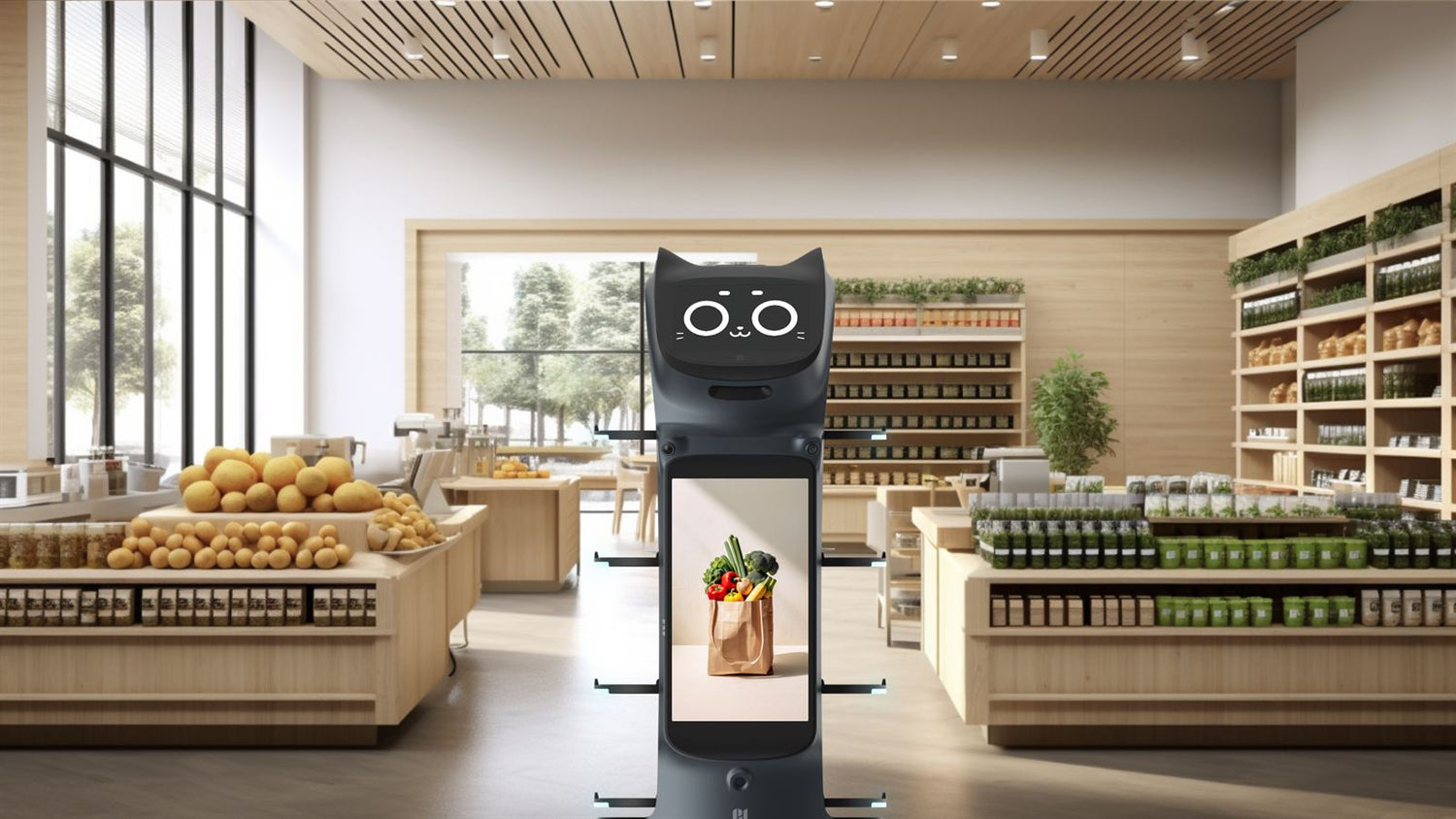
Marketing robots combine autonomous robotics with displays, digital content, and interactive features. They can move independently across suitable surfaces and bring advertising messages, product information, or guidance directly to customers and visitors. This creates a mobile alternative or supplement to traditional digital signage displays, posters, and stationary information points.
Marketing robots are particularly interesting in supermarkets and retail, at trade fairs and events, in shopping centers, as well as in hotels, showrooms, and reception areas. Depending on the model, large advertising displays, touchscreens, voice functions, visitor guidance, or additional transport options are available.
Terra Robotics offers various models for this from PUDU Robotics and OrionStar, which place different emphases on marketing, service, and visitor information.
Mobile digital signage instead of static advertising space
Traditional digital signage systems remain in a fixed location. A marketing robot, on the other hand, can present digital content while moving within defined areas.
Advertising, product information, promotions, or event notices can thus be made visible at different points on a sales floor or in a building. Depending on the robot model, touch interaction, voice output, or autonomous visitor guidance can also be used.
This makes marketing robots particularly interesting where high visitor frequency meets changing campaigns. Supermarkets can present current promotions, shopping centers can point out offers or events, and showrooms can showcase new products directly in the space.
The deployment should always suit the environment. Display size, volume, travel paths, visitor traffic, and desired interaction play an important role in the selection.
OrionStar LuckiBot Plus for marketing and digital signage
The OrionStar LuckiBot Plus is one of the most marketing-oriented robots in the Terra Robotics portfolio. It combines service, information, and reception functions with a large 27-inch advertising display.
Internally, the model is classified for promotion, reception, Q&A, guiding, and mobile digital signage. Additionally, a touch display and multilingual interaction options are available.
This makes the LuckiBot Plus particularly suitable for shopping centers, retail spaces, hotels, foyers, showrooms, and trade fairs when visibility and customer communication are more important than high transport capacity.
Companies can use the robot, for example, to present campaign content, new products, or brand messages directly in public areas.
PUDU KettyBot Pro for promotion and customer engagement
The PUDU KettyBot Pro combines marketing with traditional service functions. The compact system features an 18.5-inch advertising display and is internally intended for gastronomy, retail, trade fairs, hotels, and reception areas.
This makes the KettyBot Pro particularly suitable for companies that want to use a mobile advertising medium for light service or transport tasks at the same time.
In retail, for example, it can present promotional content on the display while simultaneously navigating to defined areas. At events or in hotels, the system can combine digital information and promotion with visitor interaction.
Especially in more densely structured areas, its comparatively compact design is also an advantage.
Marketing robots in retail and supermarkets
The retail sector is one of the most important areas of application for mobile marketing robotics. Here, promotions often need to be visible exactly where customers are actually located.
Marketing robots can present campaigns on the sales floor, draw attention to promotional areas, or provide product information digitally. Thanks to autonomous movement, content can be positioned at different points within the market.
This does not automatically replace traditional signage or stationary displays. Instead, it creates an additional, mobile contact point within the customer journey.
This can be particularly interesting for product launches, seasonal promotions, promotional weeks, or products that require explanation.
Marketing robots for trade fairs, events, and roadshows
At trade fairs, companies are in constant competition for attention. A mobile robot with a display and interaction options can create an additional visual focal point here.
For example, the robot can present brand content, greet visitors, or lead them to specific areas of a booth. QR codes, videos, or references to product demonstrations can also be played out via suitable display content.
It is important not to view marketing robotics merely as a show effect. Before deployment, clear goals should be defined: Should the robot primarily generate attention, inform, guide visitors, or lead people to a specific contact point?
Especially for roadshows and recurring events, a flexibly configurable marketing robot can subsequently be used for different campaigns.
Combining marketing and service
Some marketing robots take on traditional service tasks in addition to advertising.
The PUDU BellaBot Pro, for example, combines transport capacity with display and customer communication. Internally, the system is classified in particular for gastronomy, hotel, retail, and events when service and visible customer communication are to be combined.
The OrionStar LuckiBot Pro also combines delivery functions with a display and is assigned to both service & delivery as well as marketing & POS.
Those who primarily want to automate transport or serving processes will find other models on the service robots page. The marketing robot page, on the other hand, deliberately places the focus on displays, promotion, and customer interaction.
Marketing robots for reception and visitor information
The boundaries between marketing and reception robots are fluid. A robot in the foyer can simultaneously greet visitors, present company information, and act as a digital brand ambassador.
In showrooms, for example, products can be introduced or visitors can be guided to specific exhibition areas. In hotels, information about offers, events, or services can be presented.
However, if there is a clear focus on reception, information, and orientation, a specialized reception robot is often more sensible. Marketing robots are primarily suitable when visual communication and promotion are in the foreground.
Planning content and campaigns correctly
The impact of a marketing robot depends not only on the device but crucially on the content on the display.
Texts should be legible from a distance, videos should be short and visually unambiguous, and calls to action must be clearly recognizable. For changing promotions, structured content planning is recommended so that content can be updated regularly.
The robot's route should also match the campaign. An advertising robot that moves outside of relevant visitor flows generates little additional benefit.
Therefore, positions, travel paths, stop points, content, and deployment times should be considered together during the planning stage.
Choosing the right marketing robot
Several factors are decisive when selecting a device: display size, desired interaction, space availability, visitor frequency, travel paths, and any additional service functions required.
The OrionStar LuckiBot Plus offers a strong focus on a large display, marketing, and reception. The PUDU KettyBot Pro combines compact dimensions with promotion and service. BellaBot Pro and LuckiBot Pro, on the other hand, are more suitable for applications where marketing is to be combined with transport.
Manufacturer, software, and content management should also be taken into account. An overview of other robot manufacturers helps in classifying different platforms.
Buying, renting, or flexibly deploying marketing robots
For long-term use in retail, hotels, or showrooms, purchasing a marketing robot can make sense. For trade fairs, events, or time-limited campaigns, flexible operating models may be more interesting.
Depending on the project, financing options or Robot as a Service are available in addition to purchase.
Terra Robotics supports companies with the selection, mapping, setup, and commissioning of the appropriate robot. This allows marketing robotics to be used in a targeted manner as a mobile advertising medium, interactive information point, or digital brand ambassador – tailored to the location, target group, and campaign.