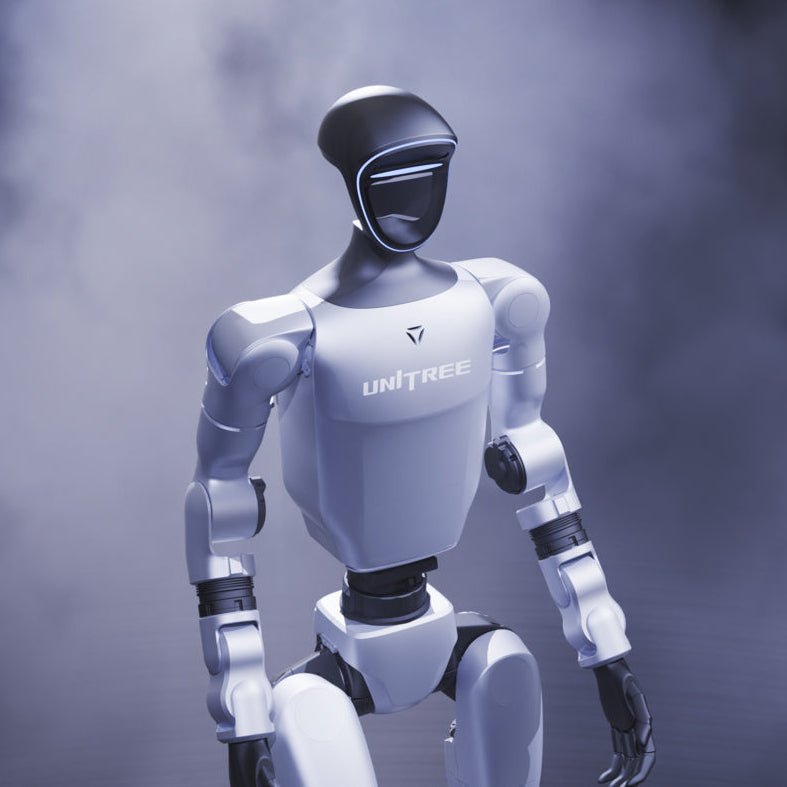
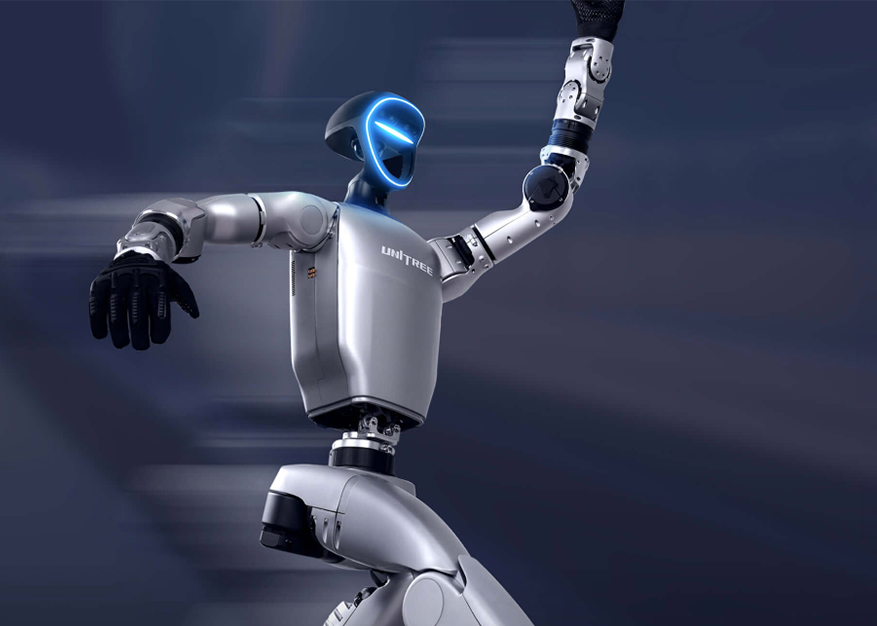
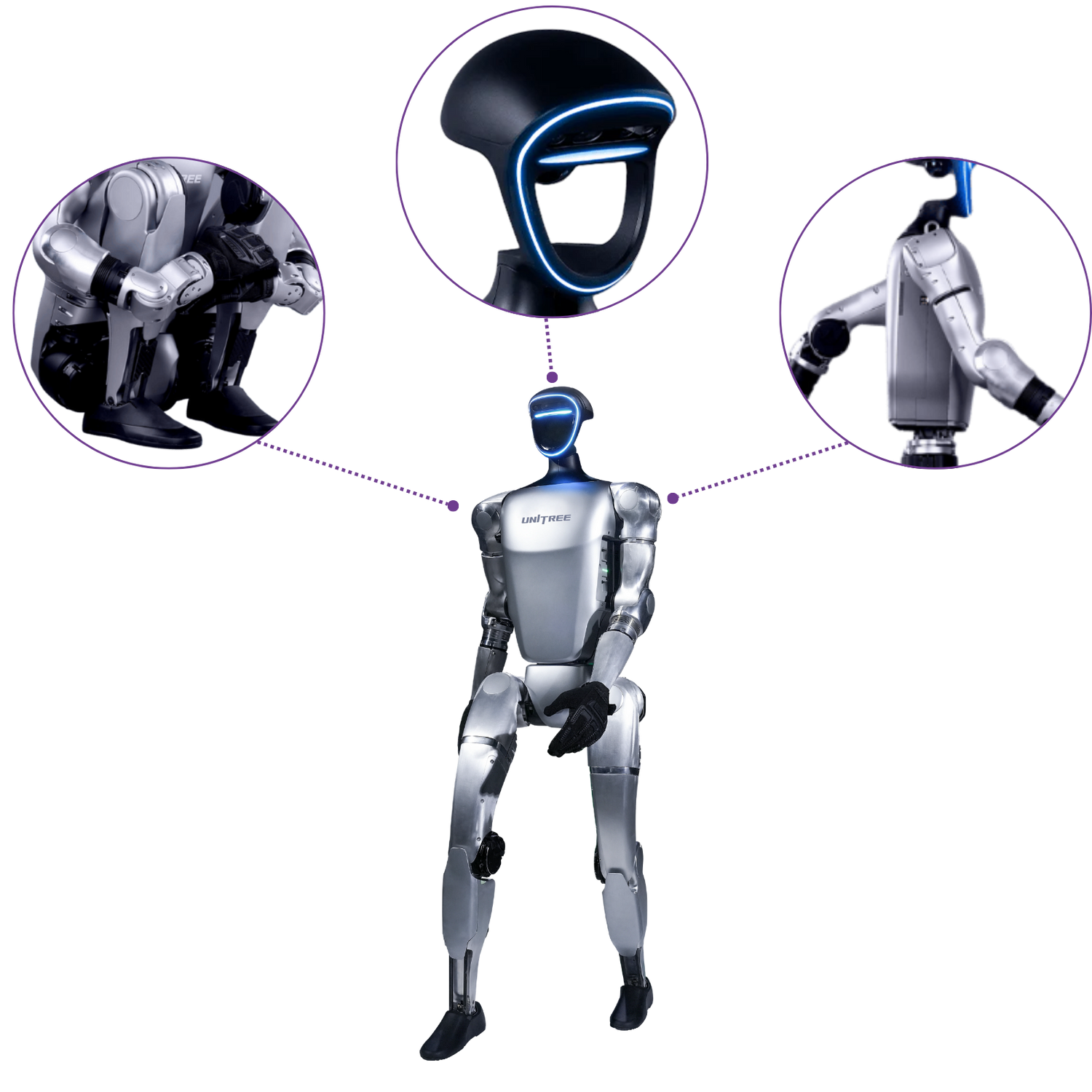
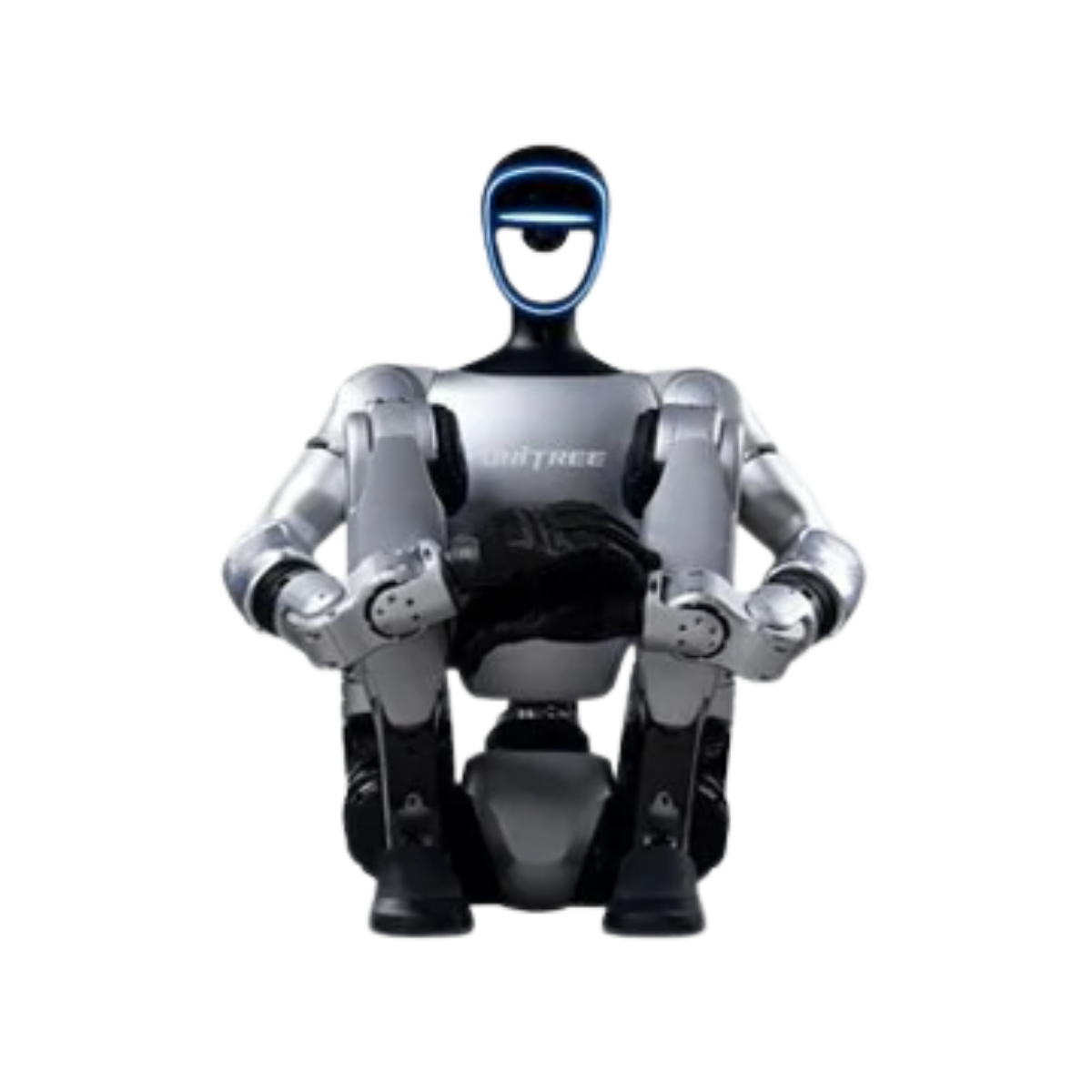
The Unitree G1 Basic is a humanoid robot designed for teams looking to test humanoid robotics in practice, collect data, and validate software in the real world. As a compact, agile platform, the G1 Basic is particularly well-suited for robotics research, AI development, and technical education because it combines movement, perception, and manipulation into one system. For those wishing to purchase a humanoid robot to explore Embodied AI, sensor fusion, or autonomous navigation on a real system, the Unitree G1 Basic provides a practical foundation for reproducible experiments.
Unlike purely demonstrative systems, the focus of the G1 Basic is on feasibility in everyday laboratory work: defined movement sequences, stable walking and standing phases, and sensor technology that reliably maps environments. As a result, humanoid AI robotics can not only be presented but also systematically developed, measured, and improved.
Technical specifications: Dimensions, sensors, and performance metrics at a glance
For project planning, operational scenarios, and comparability, clear specifications are crucial. The Unitree G1 Basic provides these with its compact dimensions and practical performance values:
- Dimensions: 1270 × 480 × 380 mm
- Weight: approx. 35 kg
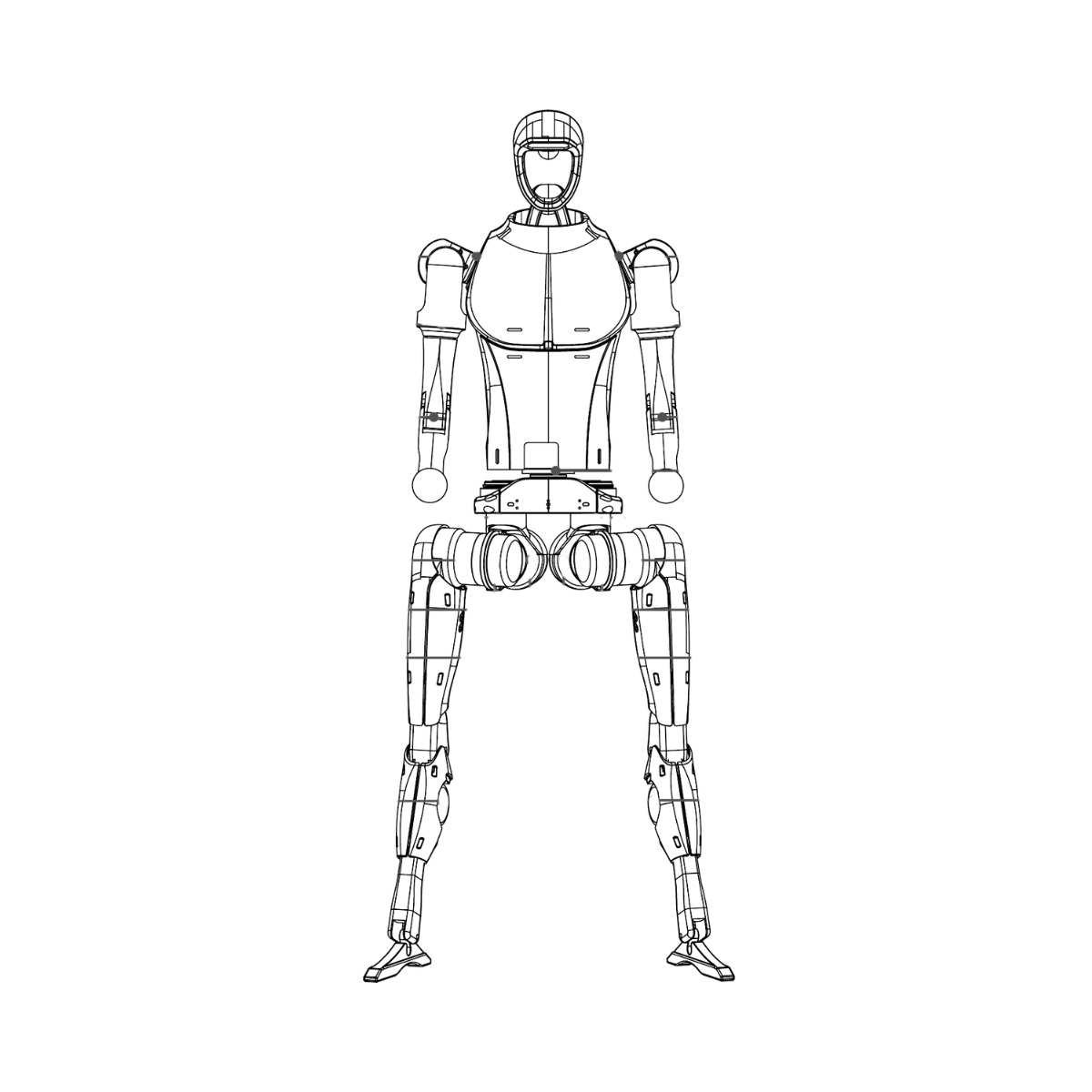
- Degrees of Freedom (DOF): 23
- Max. running speed: 1.8 m/s
- Max. jump / hop: approx. 0.65 m
- Battery: approx. 2.4 kWh
- Runtime: approx. 2.5–3.5 hours (depending on load)
- Charging time: approx. 1.5 hours
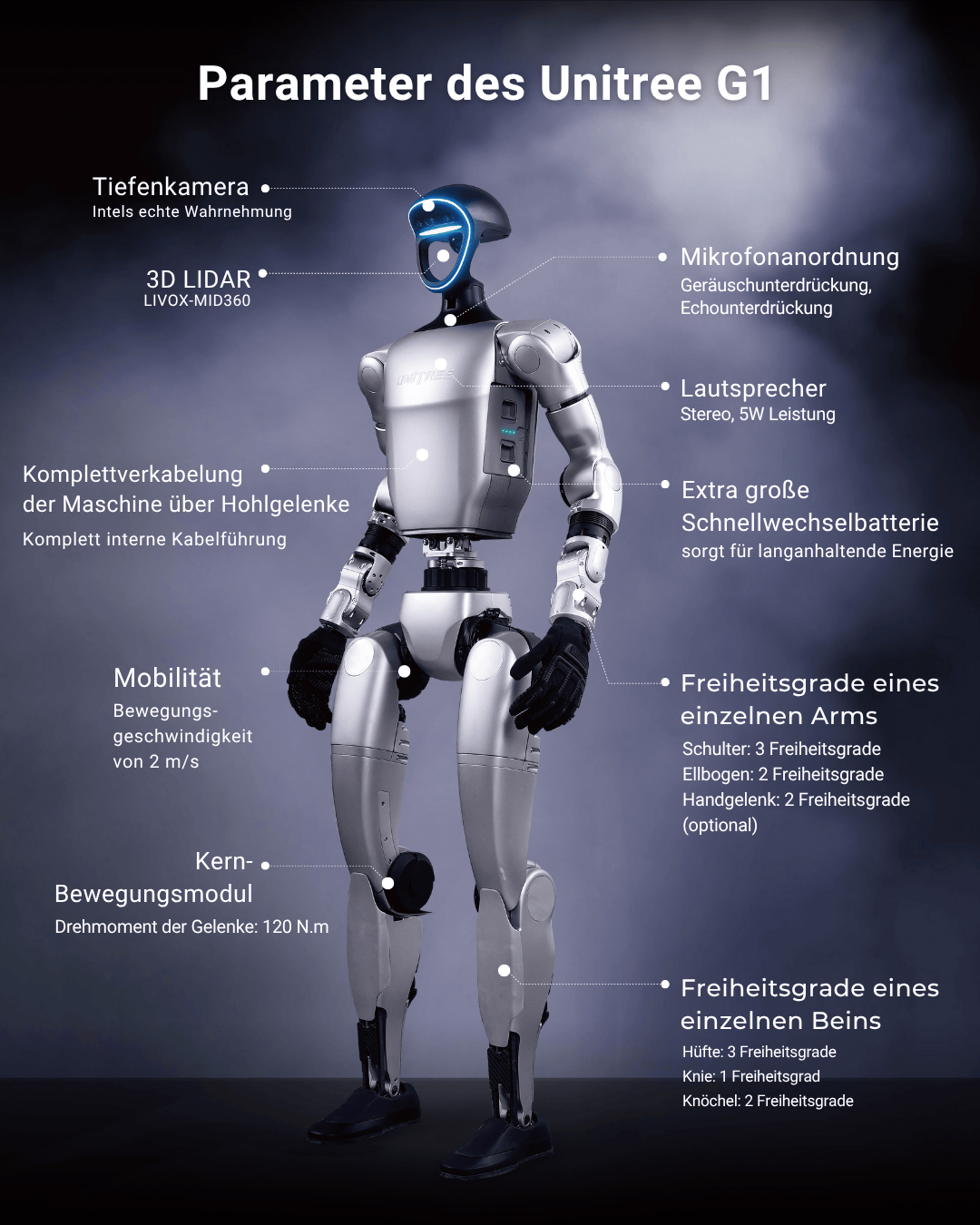
- Sensors: 3D-LiDAR, depth camera, IMU
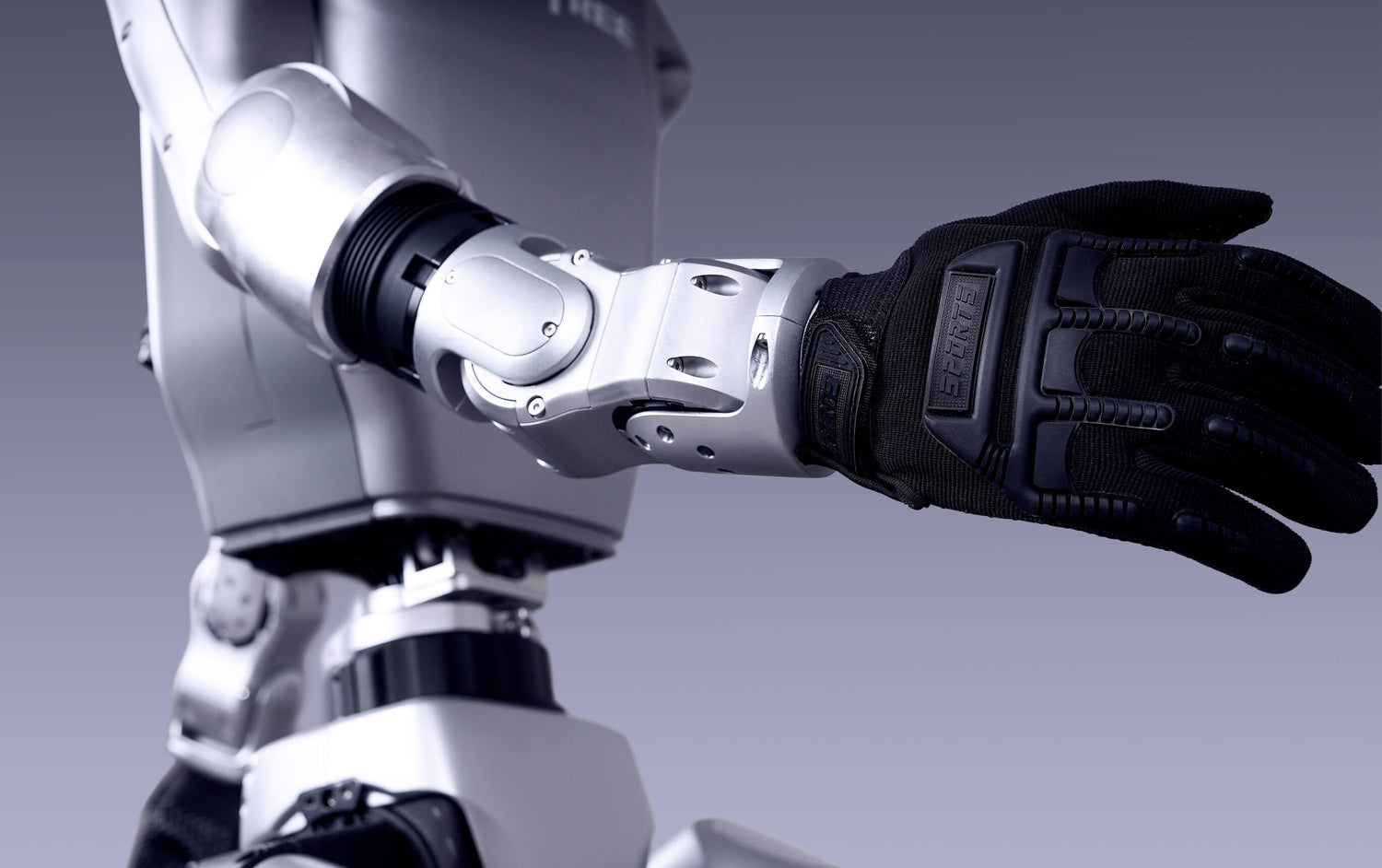
- Manipulation: two 3-finger force-position hands
- Computing platform: Onboard 8-core CPU (expandable)
- Protection class: IP54 (standard)
- Temperature range: −10 °C to +45 °C
Precise movement with AI control: Balance, locomotion, and dynamics
A key advantage of humanoid robotics is the ability to operate in human-centric environments: paths, transitions, small obstacles, and variable ground conditions. The Unitree G1 Basic relies on AI-assisted motion control, which enables fluid sequences and stable body control. The 23 joint axes are designed so that movements not only "work" but are repeatable—a decisive factor for robotics testing, benchmarking, and algorithmic advancement.
Stability and adaptive balance for real test environments
In experiments involving gait design, whole-body control, or disturbance robustness, the key is how controllably the robot reacts to changes. The G1 Basic supports adaptive balance and automatic center-of-gravity adjustment, allowing scenarios such as uneven surfaces, changes in direction, or stop-and-go behavior to be investigated in a practical manner. This is particularly valuable for research areas such as reinforcement learning, imitation learning, or model predictive control, where small parameter changes are intended to have measurable effects.
Perception & environmental sensing: 3D-LiDAR, depth camera, and IMU
Modern humanoid robotics hinges on perception. The Unitree G1 Basic combines 3D-LiDAR, a depth camera, and an IMU to capture position, movement, and the environment in real time. This makes the platform particularly well-suited for projects involving autonomous navigation, obstacle avoidance, mapping, and robust localization.
Navigation, mapping, and sensor fusion in humanoid robotics
For research and development, it is not just "results" that are crucial, but data quality and evaluability. The combination of depth information, LiDAR geometry, and inertial measurement supports typical sensor fusion workflows, such as stable state estimation or dynamic environmental mapping. This allows humanoid robotics to be tested realistically in the lab—including changing distances, moving objects, and varying lighting or visibility conditions.
Manipulation with 3-finger force-position hands: Grasping, positioning, and interaction
For many use cases, the next step after navigation is manipulation. The Unitree G1 Basic features two 3-finger hands with a force-position approach. This allows for experiments where grasping is not just "closed" or "open," but involves controlled contact: holding, re-grasping, placing, or slight adjustment of objects.
Mobile manipulation and grasp planning in practical tests
In research scenarios such as contact-rich manipulation, visual servoing, or grasp planning under uncertainty, the ability to vary grasp points and coordinate the movement of the entire body is especially important. The humanoid robot can serve as a platform for testing the interplay between perception, trajectory planning, and hand-body coordination.
Open development platform: SDKs, interfaces, and expandable computing power
For many teams, it is not just the hardware that is decisive, but the potential for development: How quickly can your own programs be integrated? How well does the system fit into existing AI pipelines and robotics workflows? The Unitree G1 Basic is positioned as a development platform and supports SDKs as well as open interfaces for custom control logic, data acquisition, and experiments. The onboard 8-core CPU (expandable) also provides a basis for local processing, prototypical inference, and stable control loops without requiring a fully external infrastructure from the start.
Reproducible tests, logging, and iterative optimization
Anyone wanting to develop humanoid robotics needs iteration: hypothesis → test → measurement → improvement. The G1 Basic is suitable for this because it can be used for quick demos as well as structured test series—such as recurring scenarios for gait stability, navigation, or grasping behavior.
Everyday operation: Battery life, IP54, and temperature range
Availability is essential for laboratory and pilot operation. With a runtime of approximately 2.5 to 3.5 hours (depending on load) and a charging time of approximately 1.5 hours, the Unitree G1 Basic is easy to plan into typical test days. The IP54 rating (standard) and the temperature range of −10 °C to +45 °C support additional deployment scenarios, such as in workshops, halls, or controlled outdoor areas.