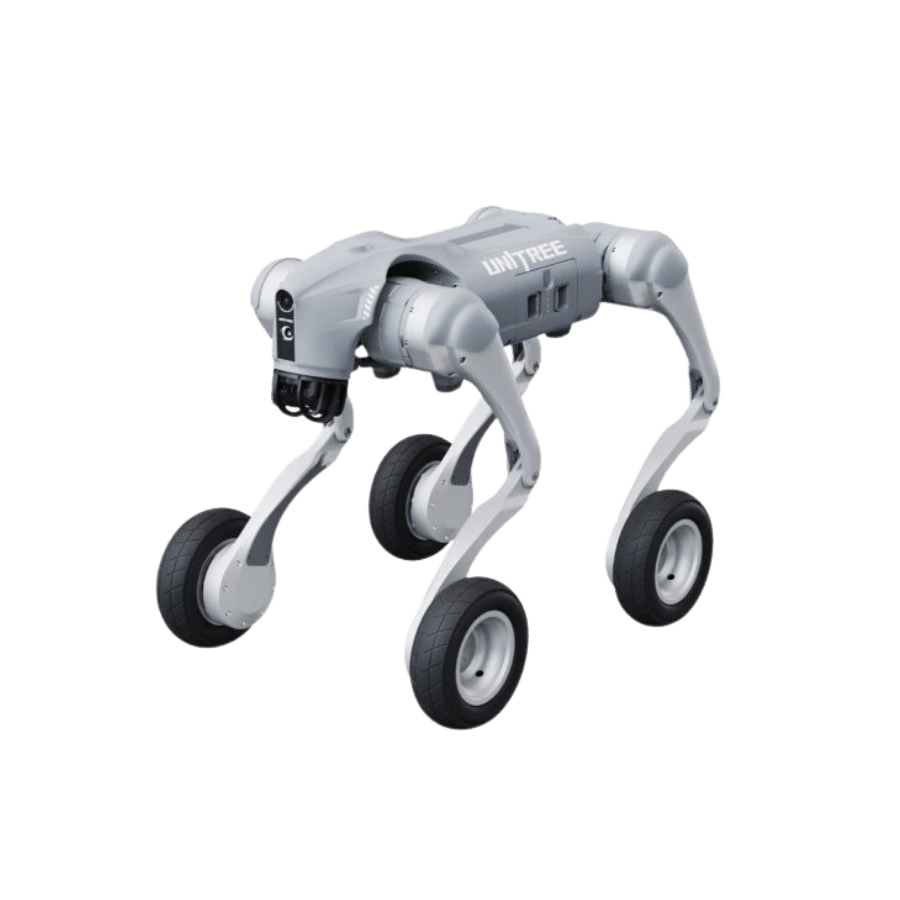
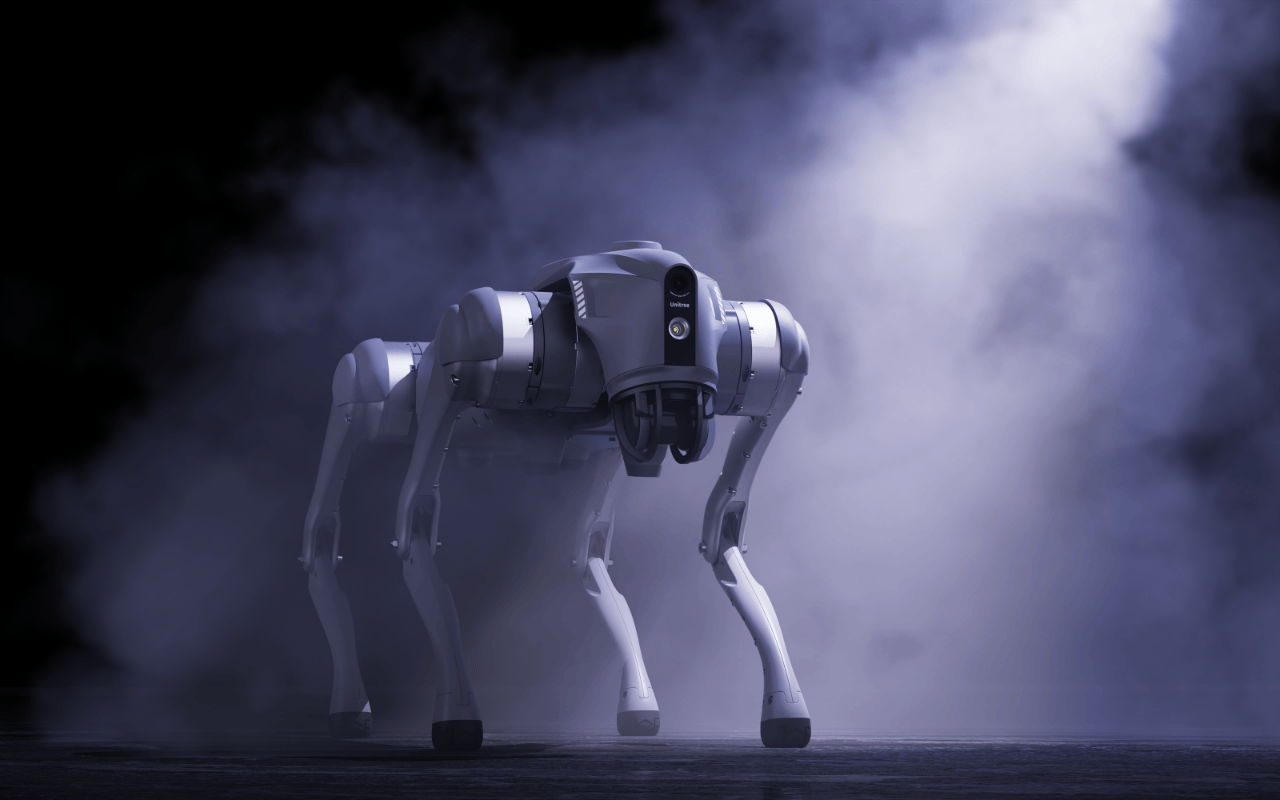
The Unitree Go2W is a wheeled robotic dog that combines the advantages of a quadrupedal robot with efficient rolling operation. This creates a hybrid mobility platform that rolls quickly and energy-efficiently on flat surfaces while remaining stable in more demanding situations. The Go2W is of particular interest to companies and research teams looking for reliable autonomous navigation, inspection, or security routes in real-world environments – such as industrial halls, company premises, large indoor areas, or mixed indoor-outdoor scenarios.
Positioned as the “Go2-W,” the system sits between a classic quadruped and a mobile wheeled robot: it is compact, agile, and designed for autonomous movement logic.
The practical advantage: Rolling, climbing, and overcoming obstacles
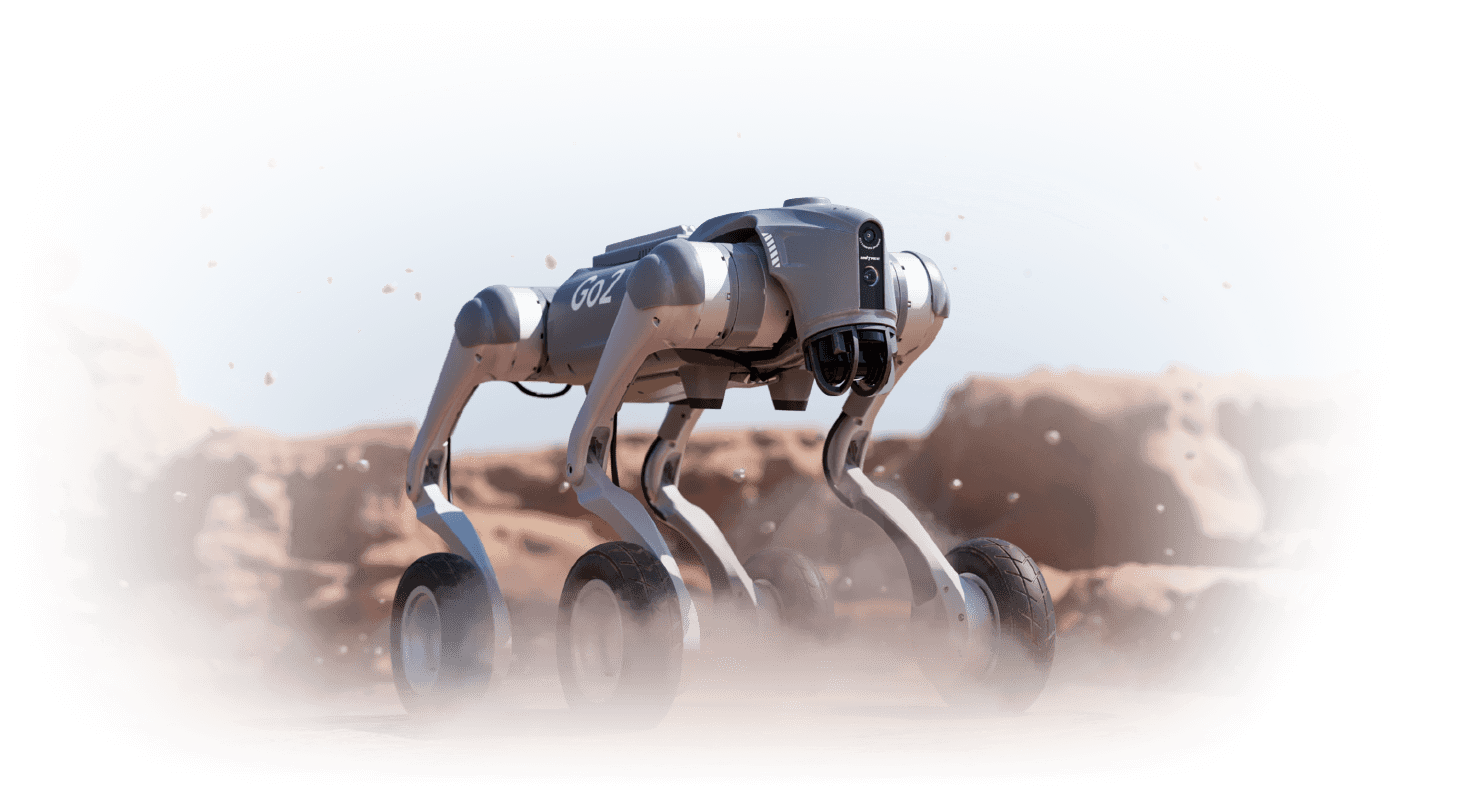
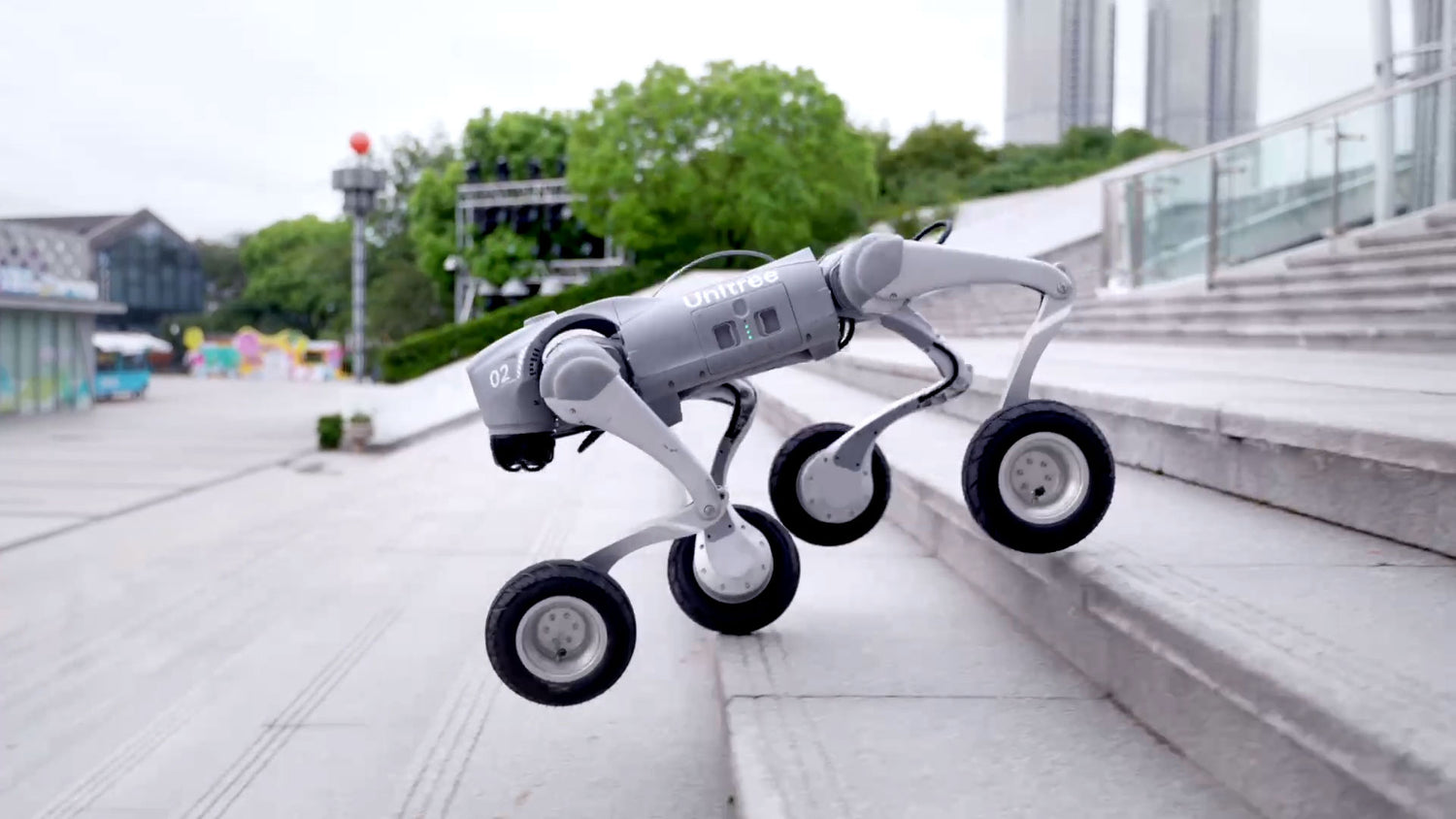
A key added value of a wheel-leg-based robotic dog is the combination of range and terrain capability. On smooth or semi-level routes, the rolling principle can improve efficiency and stability, while the leg layout allows for additional control during transitions, at edges, and on uneven ground. The Go2W is designed for “all-terrain” use and can overcome obstacles up to approximately 70 cm in size as well as tackle inclines of up to around 35°.
Typical fields of application for a wheeled robotic dog
- Inspection and rounds in industry & logistics (e.g., halls, facilities, large areas)
- Security and patrol tasks (routes, checkpoints, escorting)
- Research and development (mobile autonomy, perception, SLAM, AI control)
- Tech demos and showroom applications (stable navigation, autonomous movement sequences)
Technical data: Dimensions, weight, speed, and payload
Clear specifications are essential for planning and real-world operation. The Unitree Go2W has a compact design, making it easy to transport and quick to deploy in test environments:
- Dimensions (standing): approx. 70 × 43 × 50 cm
- Weight (with battery): approx. 18 kg
- Speed: 0 to approx. 2.5 m/s
- Payload: approx. 3 kg
- Max. “climb/drop” height: up to approx. 70 cm
- Max. incline angle: approx. 35°
- Tires: 7-inch pneumatic tires
- Basic computing power: 8-core high-performance CPU
- Maximum torque (largest joint actuator): approx. 45 N·m
This allows the Go2W to be effectively positioned for search terms such as “Unitree Go2W specifications,” “robotic dog 2.5 m/s,” “robotic dog 18 kg,” “robotic dog payload,” “robotic dog 45 Nm,” or “robotic dog climbing ability.”
Perception and autonomous navigation: LiDAR, camera, obstacle avoidance, and SLAM
In autonomous operation, perception is the decisive factor. The Go2W relies on LiDAR-based environmental sensing and camera sensor technology to detect obstacles and dynamically adjust movements. The product documentation also describes an AI-supported motion control system that reacts in real-time to obstacles and changes in terrain.
An important building block for professional applications is SLAM (Simultaneous Localization and Mapping). This enables the robot to create digital maps, continuously update its position and surroundings, and autonomously optimize route guidance.
Relevant application scenarios for SLAM and mapping
- Autonomous inspection routes with stable repeatability
- Navigation in changing layouts (e.g., warehouses, exhibition spaces, workshops)
- Tests for sensor fusion, localization, and obstacle logic
- Data recording for AI training and evaluation (embodied AI / mobile autonomy)
Control, app functions, and OTA updates: quickly adjustable during operation
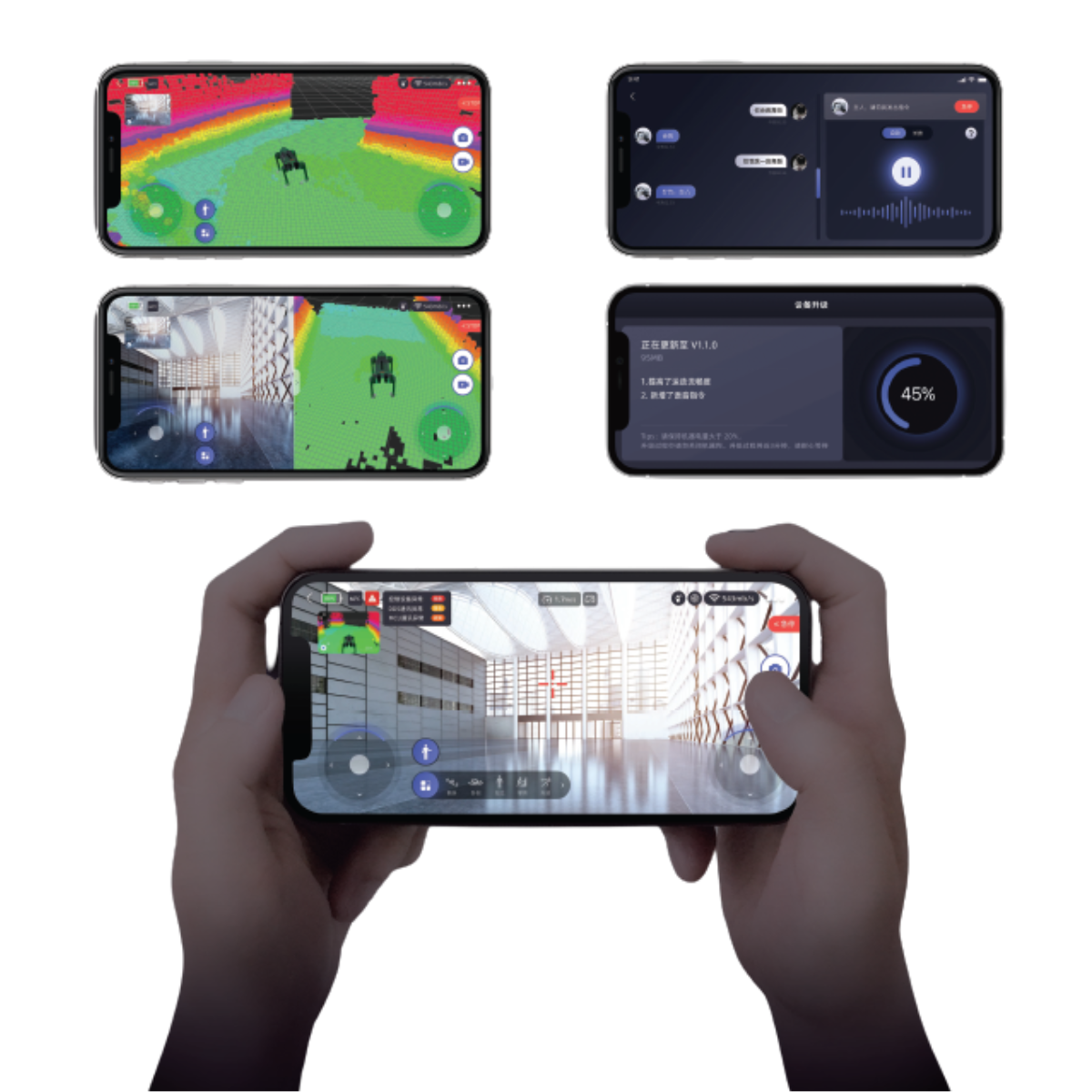
Ease of use and maintainability are critical for daily operations. The Go2W supports app operation and OTA updates, allowing functions and improvements to be updated via software.
Additionally, manual control, front lighting, and connectivity via Wi-Fi 6, 4G, and Bluetooth are mentioned—relevant for remote operation, large areas, and flexible setups.
For interaction, voice functions and AI/speech interaction via the app are included, making the Go2W additionally interesting for showroom and assistance scenarios.
Development platform: SDK, API, ROS, and additional computing power for AI projects
In addition to professional use, the Go2W is positioned as an open platform for robotics research and secondary development. Freely accessible SDKs, API interfaces, and ROS integration are described for implementing custom algorithms, sensor modules, and movement patterns.
Depending on the version, additional computing power is provided via a Jetson Orin NX module (100 TOPS), which is particularly relevant for AI inference, sensor fusion, and complex autonomy pipelines.
This makes the Go2W a good fit for search terms such as “ROS robotic dog,” “robotic dog SDK,” “robotics API,” “Jetson Orin NX robotics,” “100 TOPS robotics,” or “AI robotic dog development platform.”
Battery, runtime, and charging: plannable for test days and mobile missions
Energy planning plays a major role during operation—especially for inspection runs and longer test series. The Go2-W features a long-endurance battery (15,000 mAh) with a typical runtime of approximately 1.5 to 3 hours and fast charging (33.6 V / 9 A).
This allows the Go2W to be easily integrated into practical workflows: short charging windows, multiple test blocks per day, and clear operating times for repeatable experiments.