Skip to product information
1 of 5

SKU: 51027 | HAN: Go2W-U2 | GTIN: 2112345678917

Unitree

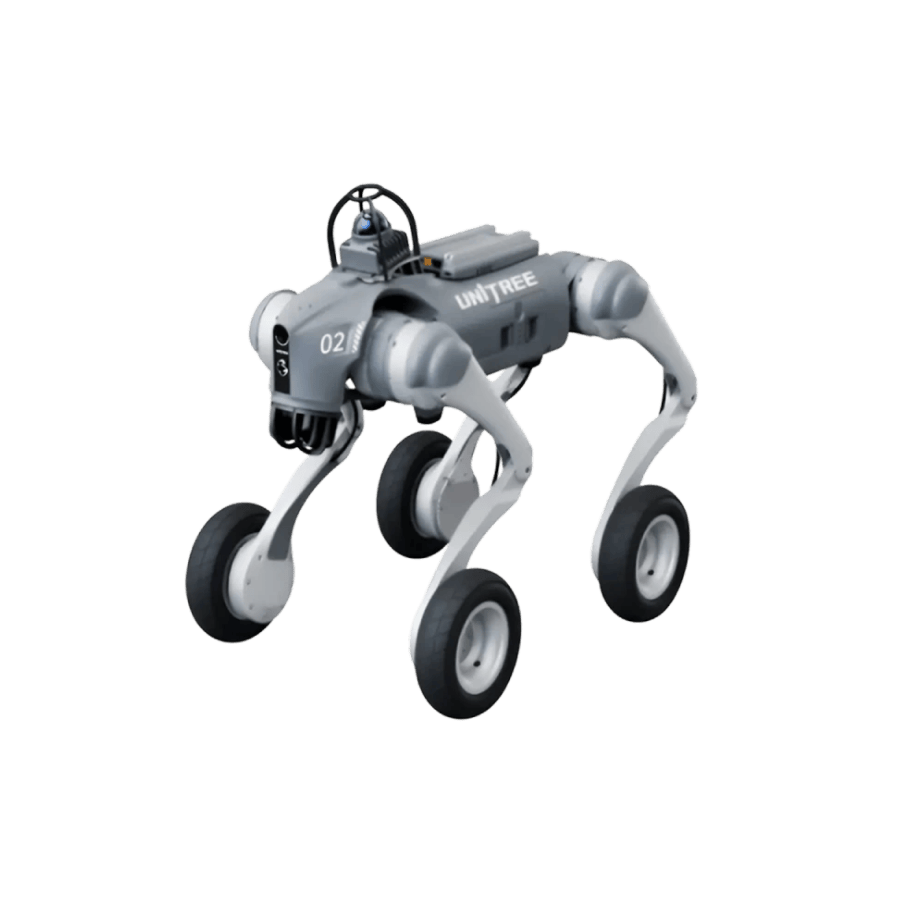
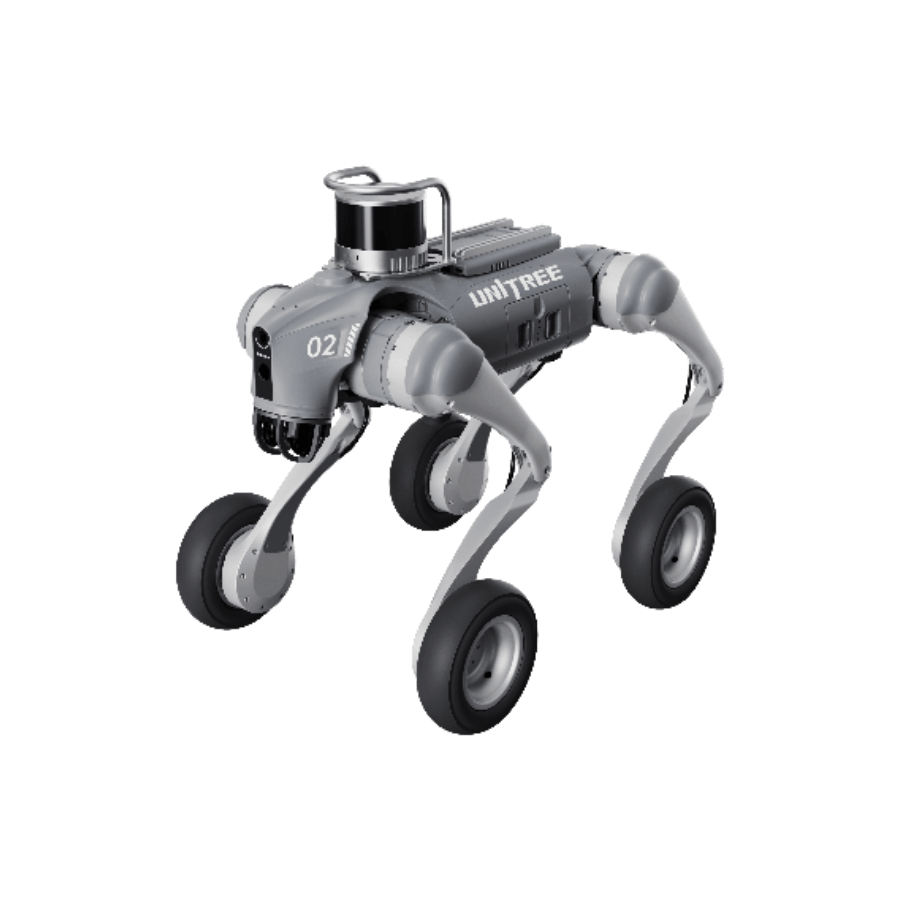
Unitree Go2W EDU Robot Dog

Unitree Go2W EDU Robot Dog

RRP
Regular price €17.000,00 EUR
Regular price €17.000,00 EUR Sale price €17.000,00 EUR
Sale Sold out

excl. VAT

Leasing enquiry

Company details

Contact person

Downloads & Documents

Product Safety Information

Hangzhou Yushu Technology Co., Ltd.
https://www.unitree.com/
sales_zty@unitree.com

Building 1, No. 88 Dongliu Road 88
Room 306, Hangzhou
China

View full details

Pricing Models

Select the appropriate model

Compare options clearly, quickly, and without the fine print. Our recommendation is highlighted.

Leasing

from 10.33 per day

Flexible financing

Inclusive

  • Implementation consulting
  • Flexible terms available
  • Personalized leasing consultation
  • Liquidity is maintained
  • Including technical support
  • Maintenance contract available as an add-on
  • Training for your team
  • On-site installation available
  • Predictable monthly installments
  • Minimum contract period 3 years
Our recommendation

Purchase

€17.000

Lowest price

Inclusive

  • Implementation consulting
  • Personal contact person
  • Robot becomes your property
  • Technical support available
  • Staff training
  • Maintenance contract available as an add-on
  • Manufacturer's warranty
  • Short delivery times

Project Request

Price on request

Flexible terms

Inclusive

  • Implementation consulting
  • Full service mandatory
  • Personal consultation included
  • Flexible Payment Models
  • Technical support available
  • Planning security for projects
  • On-site staff training
  • Short delivery times
  • Efficiency increase
  • Scalable

ㅤ

Product details

Switch between the tabs to view content.

Areas of application
Unitree Go2W EDU hybrid robot dog conducting a technical inspection of a power facility.

Energy Facilities & Technical Inspection

Efficient long-range monitoring of critical infrastructure, providing precise inspection data through advanced sensor technology and hybrid mobility.

Unitree Go2W EDU research platform for the development of AI and robotics in R&D labs.

Research & Development

The ultimate hardware platform for robotics research, offering full control over motion algorithms and real-time AI integration.

Autonomous Unitree Go2W EDU for efficient outdoor terrain inspection and data acquisition.

Site Inspection & Data Collection

Rapid analysis of outdoor areas and uneven surfaces, combining the speed of wheels with the obstacle-traversing capabilities of a quadruped.

Unitree Go2W EDU robot dog for automated industrial inspection and maintenance monitoring.

Industrial Inspection & Maintenance

Automated inspection of complex manufacturing environments optimizes maintenance intervals through precise, repeatable inspection routes.

Unitree Go2W EDU hybrid transport robot for logistics inspection and warehouse security monitoring.

Warehouse & Logistics Inspection

Intelligent inventory and security monitoring for large warehouse areas, navigating highly efficiently and autonomously through dynamic logistics centers.

Unitree Go2W EDU conducting autonomous security patrols to monitor expansive factory grounds.

Factory Premises & Security Patrol

Smooth and responsive monitoring of sensitive areas, increasing security through continuous presence and modern object detection.

  • Go2W Edu Plus

    (40-100 TOPS computing)

  • Go2 Edu Plus-Mid

    (Mid-360 LiDAR)

  • Go2 Edu Plus-XT

    (XT16 LiDAR)

Product Specification

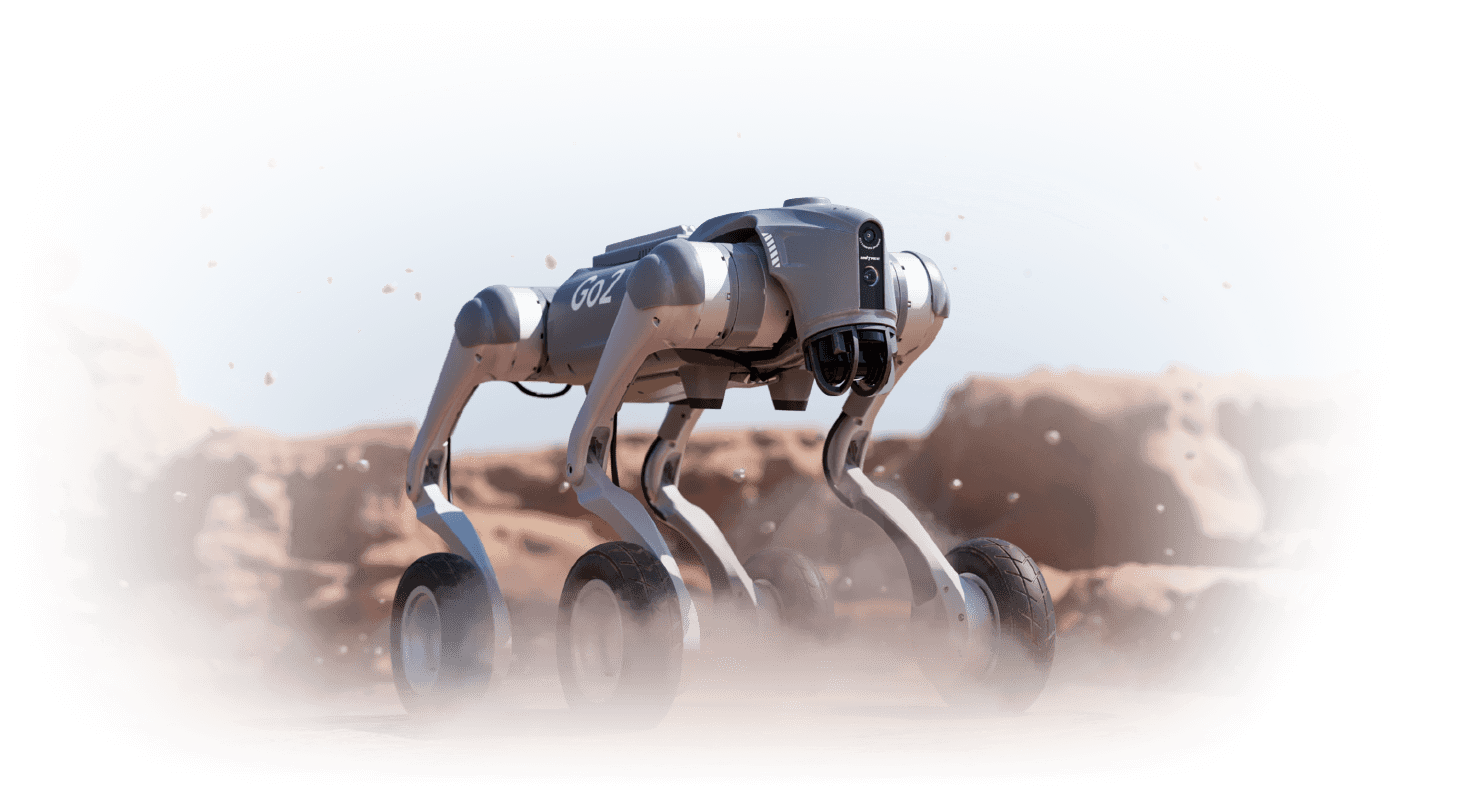
Unitree Go2W Roboterhund fährt mit vier Rädern durch staubiges Gelände für Inspektionsaufgaben

Unitree Go2W EDU Plus

Dimensions: 540 × 440 × 617 mm
Weight: 53 kg
Scrubbing width: 330 mm
Gradeability (cleaning): 5.2%
Max. travel speed: 0.8 m/s
Minimum passage width: 600 mm
Minimum turning radius: 750 mm
Battery: 40 Ah LiFePO₄ (24 V)
Runtime: 4 – 4.5 h (scrubbing)
Charging time: approx. 2 h
Sensors: 6× LiDAR & 1 camera (advanced 360° detection)
Computing module: NVIDIA Jetson Orin NX (100 TOPS)

Unitree Go2W EDU Plus-Mid

Dimensions: 540 × 440 × 617 mm
Weight: 53 kg
Scrubbing width: 330 mm
Gradeability (cleaning): 5.2%
Max. travel speed: 0.8 m/s
Minimum passage width: 600 mm
Minimum turning circle: 750 mm
Battery: 40 Ah LiFePO₄ (24 V)
Runtime: 4 – 4.5 h (scrubbing)
Charging time: approx. 2 h
Sensor system: 6× LiDAR (Mid-360 3D LiDAR) & 1 camera
Computing module: NVIDIA Jetson Orin NX (100 TOPS)

Unitree Go2W EDU Plus-XT

Dimensions: 540 × 440 × 617 mm

Weight: 53 kg

Scrubbing width: 330 mm

Gradient (cleaning): 5.2%

Max. travel speed: 0.8 m/s

Minimum passage width: 600 mm

Minimum turning circle: 750 mm

Battery: 40 Ah LiFePO₄ (24 V)

Runtime: 4 – 4.5 h (scrubbing)

Charging time: approx. 2 h

Sensors: 6× LiDAR (Hesai XT16) & 1 camera

Computing module: NVIDIA Jetson Orin NX (100 TOPS)

Intelligent mobility with AI support

The Unitree Go2W combines state-of-the-art AI-powered motion control with precise sensor technology. Through its 6 LiDAR sensors and a depth camera, the robot dog detects its surroundings in real time and reacts dynamically to obstacles or changes in terrain. Thanks to the Unitree AI engine, the Go2W moves fluidly, safely, and autonomously – both on flat surfaces and in complex indoor environments. The EDU variants (Plus, Mid, XT) offer additional computing power through the integrated Jetson Orin NX module (100 TOPS), making them ideal for research, AI development, and university applications.

Autonomous Navigation & Environmental Perception

With its high-resolution 3D environment detection, the Go2W enables precise and stable navigation – whether in a laboratory, showroom, or industrial environment. The integrated SLAM system (Simultaneous Localization and Mapping) creates digital maps in real time and permanently optimizes route guidance. The EDU Plus-Mid and EDU Plus-XT variants are additionally equipped with Mid-360 LiDAR and Hesai XT16 LiDAR, respectively – for even greater range, level of detail, and object detection at a research and robotics level.

Advanced Research & Secondary Development

The Go2W is more than a robotic dog – it is an open platform for robotics research and AI training. Through freely accessible SDKs, API interfaces, and ROS integration, developers can implement their own algorithms, sensor modules, and movement patterns. The EDU series is specifically aimed at universities, laboratories, and companies looking to test and expand machine learning models, sensor fusion, or autonomous movement logic. With its modular architecture, the Go2W thus provides the perfect foundation for robotics prototyping, AI research, and simulation environments.

Precise. Intelligent. Autonomous.

The Unitree Go2W combines powerful AI navigation, precise LiDAR detection, and flexible motion control in a compact, adaptive robot dog. Whether in the standard or EDU version, the Go2W offers maximum stability, efficiency, and adaptability for research, industry, and education.

Frequently Asked Questions

For which application areas is the Unitree Go2W EDU robot dog suitable?

The Unitree Go2W EDU robot dog is suitable for research, teaching, robotics development, autonomous navigation, AI training, industrial inspection, energy facilities, terrain inspection, warehouse and logistics inspection, and security patrols on factory premises. Terra Robotics positions the Go2W EDU specifically for users who require a programmable robot dog with wheels for real-world test environments, data collection, and mobile robotics projects.

What is the Unitree Go2W EDU?

The Unitree Go2W EDU is a hybrid robot dog from Unitree that combines quadrupedal agility with efficient wheeled mobility. The EDU version is designed as an open research and development platform and is suitable for universities, laboratories, and companies that want to test their own algorithms, sensor setups, ROS workflows, and AI-powered motion logic.

What is the difference between the Unitree Go2W EDU and the Unitree Go2W Standard?

The Unitree Go2W EDU is aimed more at research, teaching, and secondary development than the standard version. It focuses on open interfaces, ROS integration, SDK and API usage, additional computing power, and expanded sensor options. This makes the Go2W EDU particularly suitable when the goal is not just to demonstrate, but to actively develop, measure, program, and test.

Which versions of the Unitree Go2W EDU does Terra Robotics offer?

Terra Robotics offers the Unitree Go2W EDU in the EDU Plus, EDU Plus-Mid, and EDU Plus-XT variants. The variants differ primarily in their sensor systems and LiDAR configurations. EDU Plus is suitable for AI and robotics development with extended 360° coverage, EDU Plus-Mid adds Mid-360 3D-LiDAR, and EDU Plus-XT relies on Hesai XT16 LiDAR for more demanding research and perception tasks.

Why is the wheel-leg concept of the Unitree Go2W EDU interesting for mobile robotics?

The wheel-leg concept of the Unitree Go2W EDU is interesting because the robot dog can roll efficiently on flat surfaces while remaining stable thanks to its quadrupedal structure when navigating transitions, edges, ramps, or uneven terrain. This makes the hybrid robot dog suitable for long corridors, laboratories, showrooms, industrial areas, outdoor perimeters, and practical indoor-outdoor scenarios.

Unitree Go2W EDU: Wheeled robot dog for research, autonomous navigation, and AI robotics

The Unitree Go2W EDU is a wheeled robotic dog that combines the advantages of a four-legged robot (quadruped) with efficient rolling mobility. This creates a hybrid platform that moves quickly and energy-efficiently on flat surfaces while remaining stable during transitions, at edges, and on changing terrain. For universities, laboratories, and development teams, the Go2W EDU is particularly interesting when autonomous robotics is to be implemented not just as a demonstration, but as a reproducible development project—including data acquisition, sensor fusion, navigation, mapping, and AI-supported motion logic.

Compared to classic robotic dogs, the Go2W EDU series is aimed more strongly at open development: testing one's own algorithms, expanding sensor setups, integrating ROS workflows, and iteratively improving experiments. Anyone looking for a robotic dog for research, teaching, or prototyping will find here a platform that works both in indoor labs and in real-world environments—from showrooms to industrial sites.

Hybrid mobility in practice: rolling on straightaways, control at obstacles

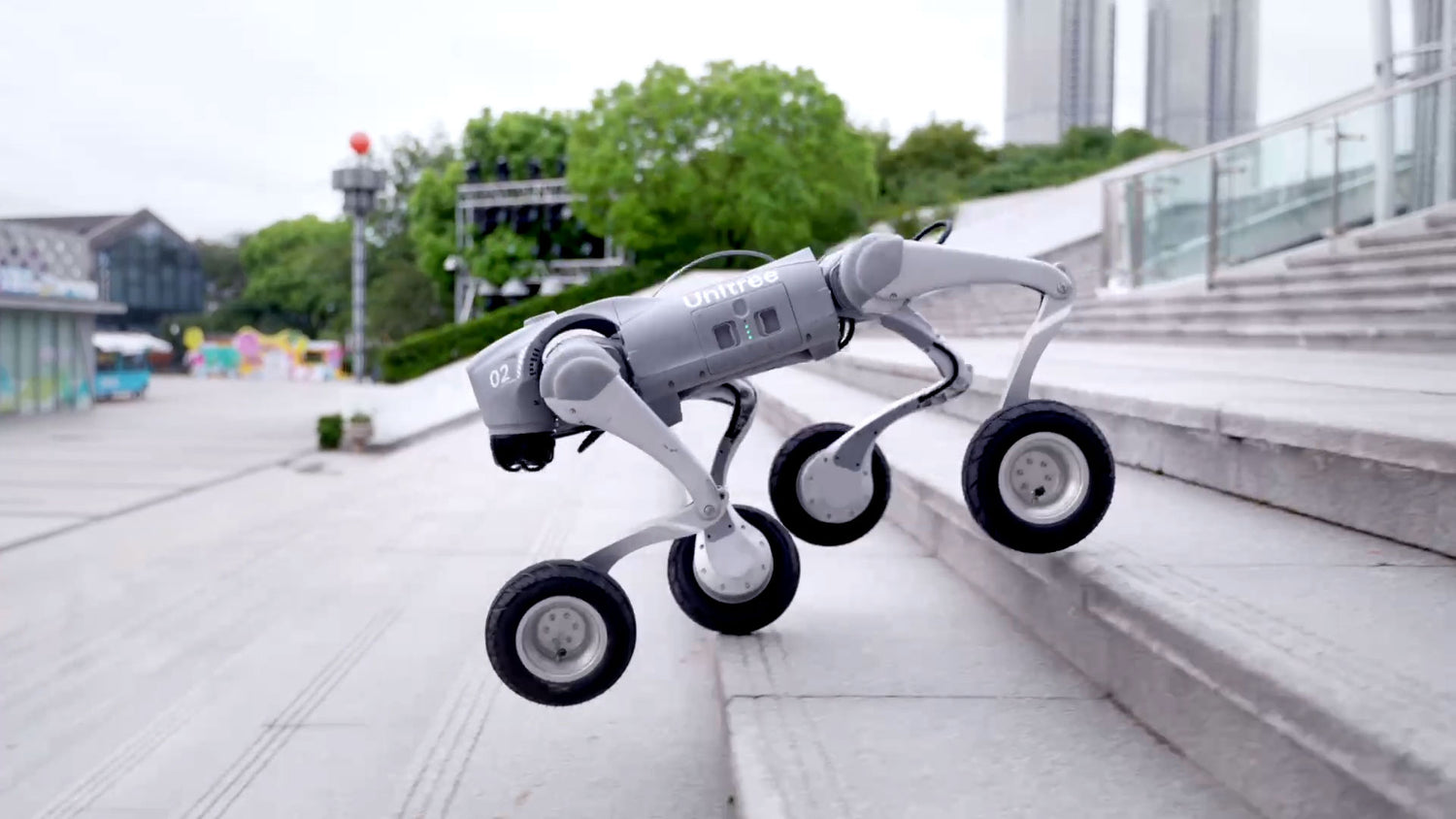
A robotic dog with a wheel-leg concept is particularly useful when distances need to be covered efficiently, but the environment is not perfectly "wheeled-robot friendly." On smooth floors, in long corridors, or across hall areas, the Go2W EDU can roll stably, while the leg layout provides additional freedom of movement for transitions and difficult passages. This makes the Go2W EDU suitable for mixed scenarios: indoor-outdoor thresholds, curbs, ramps, uneven floors, or changing surfaces such as asphalt, concrete, and paving.

Efficiency and safety in real-world deployment profiles

For inspection routes and security applications, constant driving profiles, precise obstacle detection, and reliable response are key. In practice, this means: less "stop-and-go," fewer manual corrections, and more stable motion sequences. Especially in large areas—warehouses, workshops, trade fair halls, campuses—the combination of rolling mobility and everyday obstacle logic is a real advantage for mobile robotics, as it unites range and robustness in one system.

Typical application fields for the Go2W EDU

  • Inspection and monitoring: recurring rounds, facility checks, condition monitoring
  • Research & development: autonomous navigation, SLAM, sensor fusion, embodied AI, sim-to-real
  • Security routes and patrol: defined checkpoints, autonomous routes, accompaniment functions
  • Teaching and training: robotics projects, programming courses, ROS integration, AI experiment series

Perception & autonomy: LiDAR environmental sensing, depth camera, and SLAM

For autonomous robotics, perception is crucial. The Unitree Go2W EDU is designed for precise environmental awareness and combines LiDAR-based sensing with additional camera sensors. The goal: detect obstacles early, plan safe trajectories, and react to changes in real-time. This is particularly relevant in dynamic environments where people, objects, or paths vary.

SLAM and mapping for reproducible routes

A practical advantage for research and industry is SLAM (Simultaneous Localization and Mapping): the robot can create maps, continuously update positions, and keep route guidance stable. For laboratory and pilot operation, this means: repeatable runs, comparable measurement results, and clean evaluation of your algorithms. Typical development tasks—waypoints, zone logic, obstacle avoidance, route optimization—can thus be mapped in controllable scenarios and expanded step by step.

Data foundation for sensor fusion and AI models

Anyone developing AI robotics seriously needs data that does not only exist "in simulation." With LiDAR and camera data, you can generate real-world datasets, validate models, and test robustness under genuine conditions: different lighting, new obstacles, various surfaces, or changing environmental structures. This is precisely where the Go2W EDU provides the added value of a mobile development platform—because autonomous navigation, obstacle logic, and motion control can be viewed as an overall system.

EDU versions: Plus, Plus-Mid, and Plus-XT for different research requirements

The Go2W EDU series is typically offered in several versions to cover different requirements for sensor technology and computing power. At its core, the platform remains identical, while the EDU variants offer additional possibilities for demanding robotics projects.

More computing power for AI and autonomy

For demanding pipelines—such as local inference, sensor fusion, semantic maps, or complex decision logic—additional computing power is crucial. The EDU variants are designed for exactly these requirements and enable a setup that is not immediately dependent on external infrastructure. This is particularly relevant for research into mobile autonomy, AI-supported navigation, and real-time perception.

LiDAR options for higher detail

Depending on the version, different LiDAR configurations are used to increase range, level of detail, and object detection. This allows projects to be scaled: from an introduction to SLAM and navigation to advanced research with higher sensor resolution and more robust environmental models. For search terms like "LiDAR robotic dog," "3D environmental sensing," "mapping robot," and "SLAM robotic dog," this aspect is often the deciding factor for purchase.

Development platform: SDK, API, ROS, and custom motion logic

The most important EDU advantage is openness for development. The Unitree Go2W EDU is aimed at teams that want to use their own software stacks and algorithms—from simple control programs to extensive robotics architectures. Through SDK and API interfaces, you can implement motion patterns, sensor modules, and behavioral logic. In typical development projects, this means: clear state models, logging, test scenarios, and iterative optimization instead of one-time demonstrations.

ROS integration for teaching and research

ROS is a central standard in research and training because it enables modular development, reusable components, and clean system architecture. With ROS-native integration, the Go2W EDU can be incorporated into existing workflows: navigation stacks, mapping modules, data recording, teleoperation, and experiments with AI policies. For teaching and student projects, this is particularly helpful because teams can work in parallel on perception, planning, and control without the platform becoming a dead end.

Expandability for demanding AI projects

As projects grow, demands for computing power, streaming, remote operation, or additional sensors increase. The Go2W EDU is designed for modular expandability so that the system can adapt to more complex research projects. This keeps the platform usable in the long term—for prototyping, AI training, simulation environments, and the validation of real autonomy workflows.

Key data for practice: compact, mobile, software-up-to-date

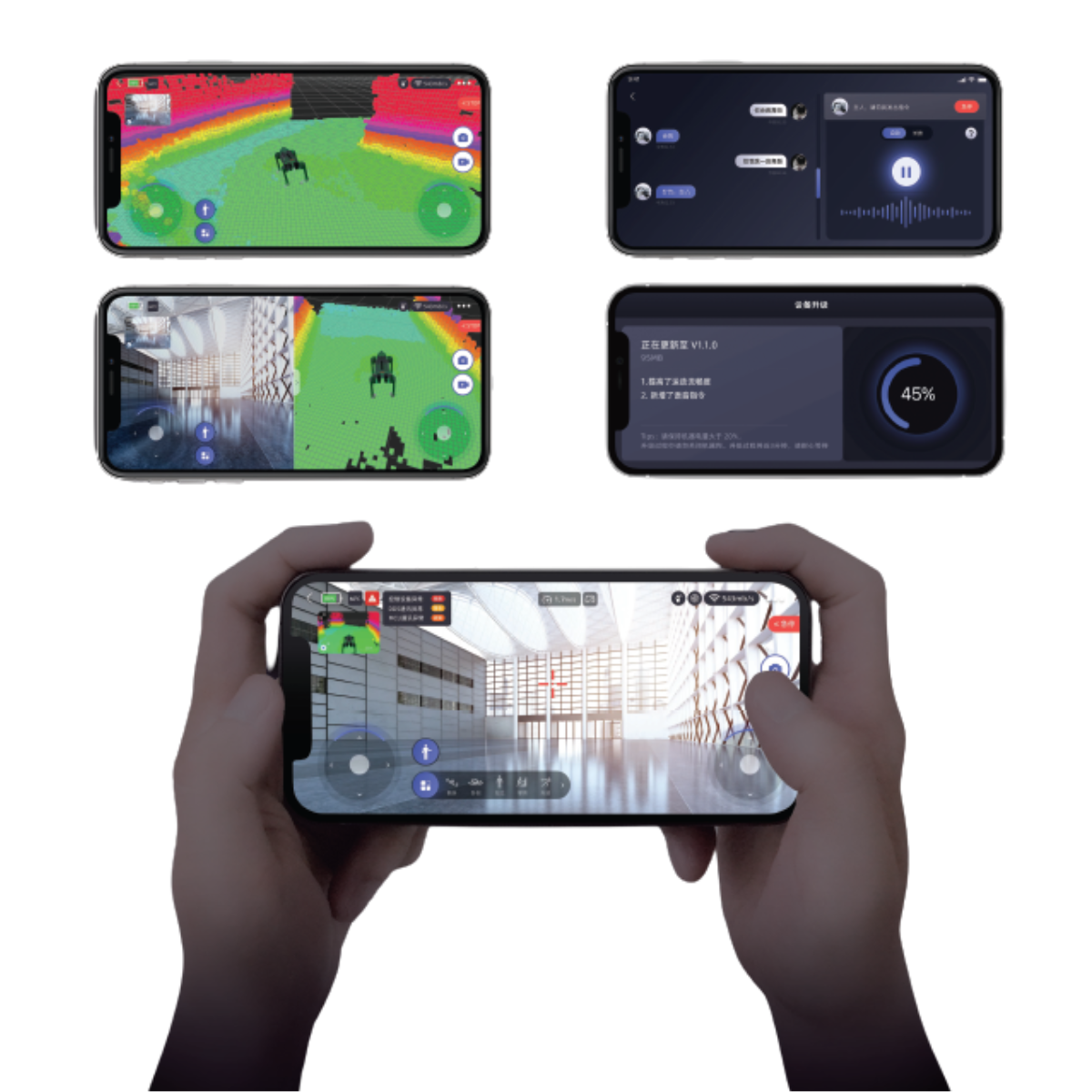
For deployment planning, basic specs count: transport, speed, payload, runtime, and maintainability. As a rolling hybrid platform, the Go2W is designed for stable driving profiles on flat surfaces while simultaneously supporting everyday obstacle scenarios. App operation, OTA updates, and modern connectivity (e.g., Wi-Fi, mobile options, and Bluetooth) are also standard, ensuring the robotic dog remains flexibly controllable during operation and software improvements can be continuously installed.

This is especially important in teaching and research: a robotic dog should not just "work once," but be permanently operable so that projects can run stably over weeks and semesters. The Go2W EDU supports exactly this logic: a robust mobility base that can be combined with autonomy and development functions, moving your AI and robotics projects measurably forward.