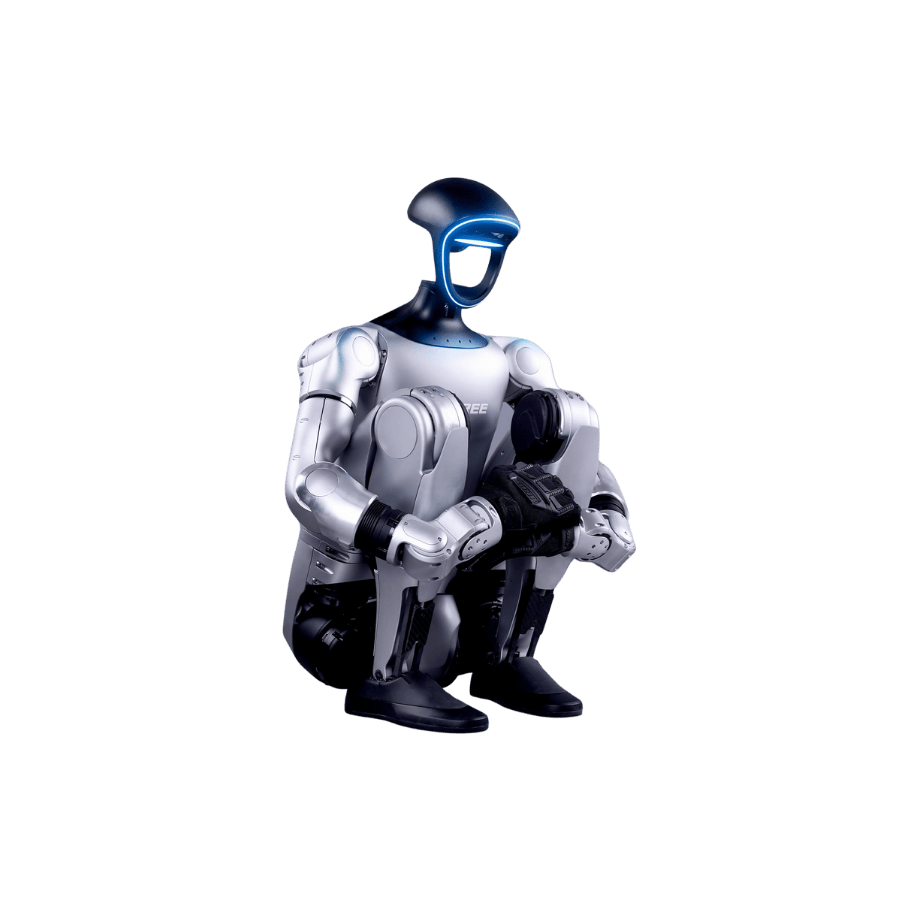
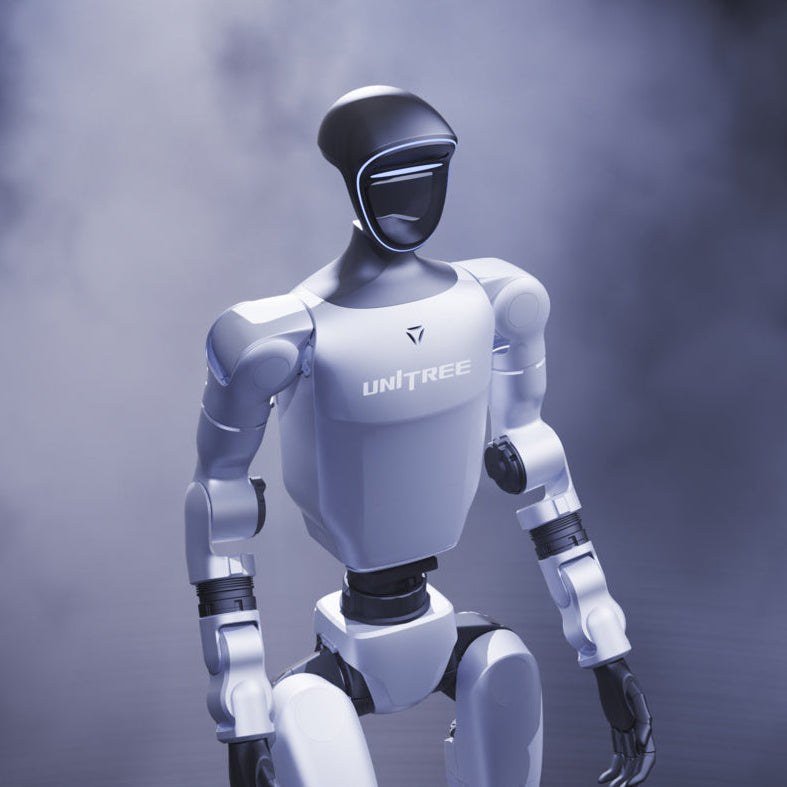
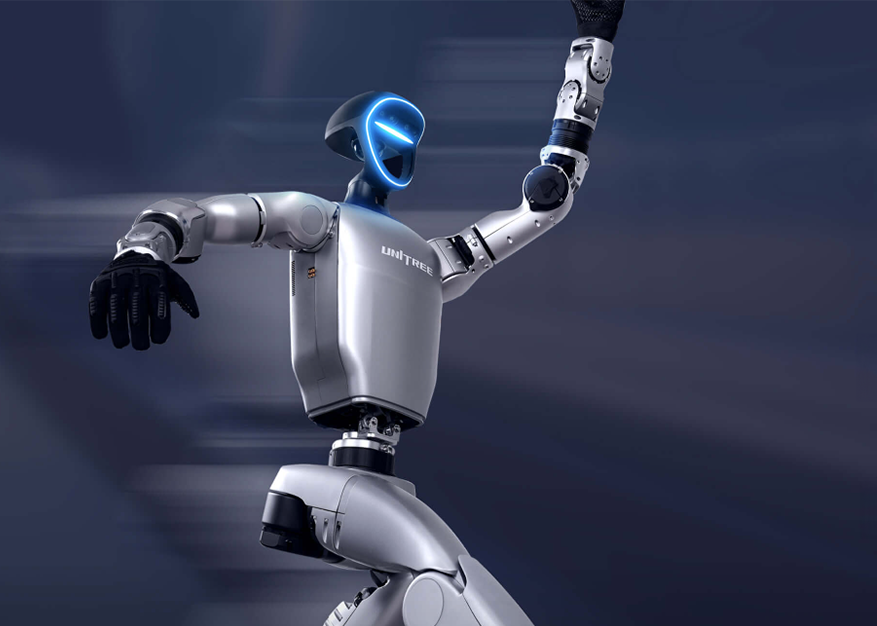
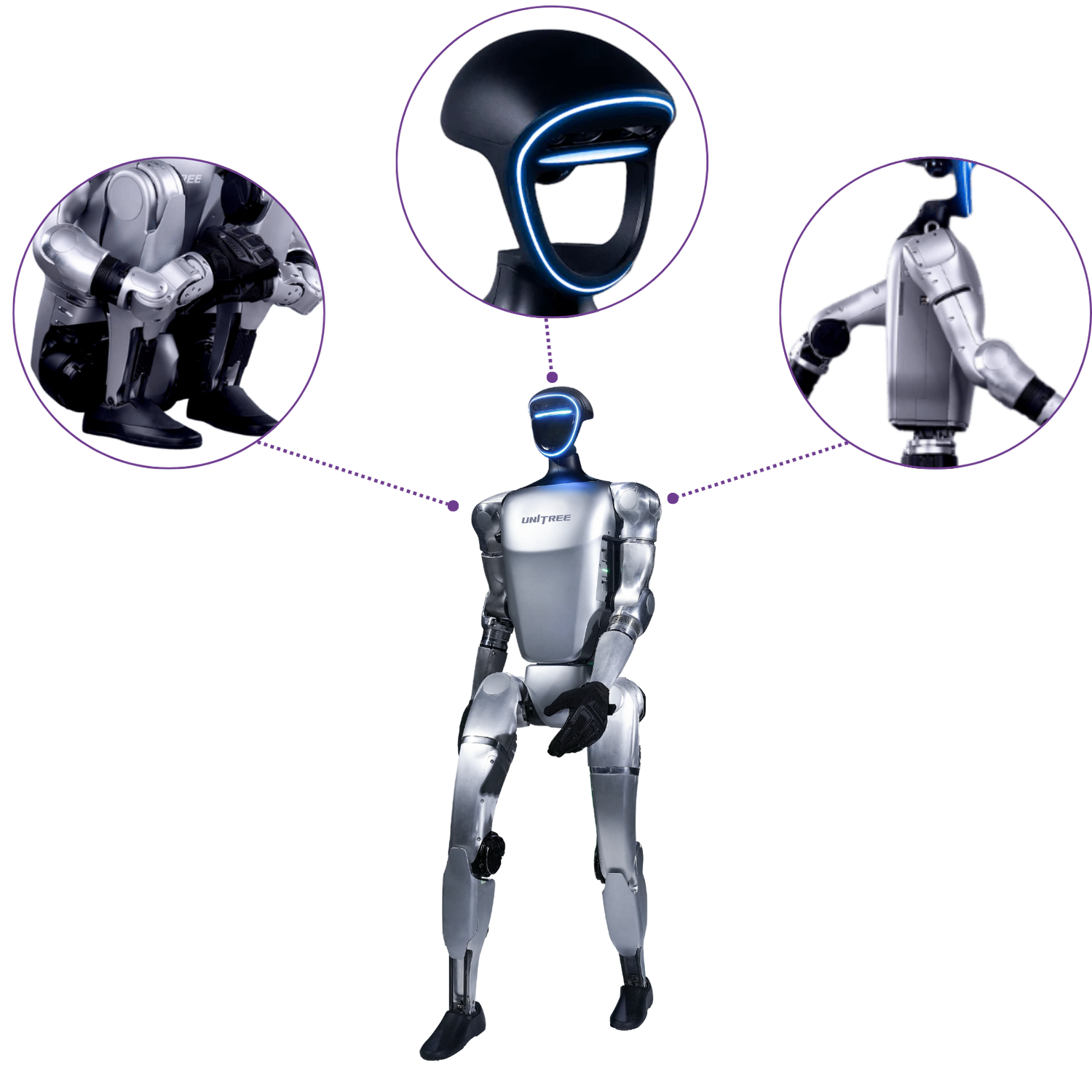
The Unitree G1 EDU is a humanoid robot specifically designed for education, academic research, and applied development. The focus is not just on demonstrating human-like movements, but on the ability to reproducibly test algorithms, perception, and control. This makes the G1 EDU a suitable robotics development platform for universities, institutes, schools, innovation labs, and teams looking to validate Embodied AI, autonomous navigation, or human-robot interaction in real-world environments.
Those looking to purchase a humanoid robot to build robotics software in a practical way will especially benefit from the EDU orientation: a focus on open interfaces, ROS integration, and a setup that can be used for curricula, project work, and structured series of experiments. This turns humanoid robotics into a measurable learning and research tool – instead of a mere show object.
Technical specifications that matter for planning and project work
For teaching and research, it is important that dimensions, performance values, and sensors can be clearly planned. The Unitree G1 EDU combines a compact design with practice-oriented equipment:
- Dimensions: 1270 × 480 × 380 mm
- Weight: approx. 35 kg
- Degrees of Freedom (DOF): 23
- Max. running speed: 1.8 m/s
- Max. jump height: approx. 0.65 m
- Battery: 2.4 kWh
- Runtime: 2.5–3.5 hours (depending on load and operation)
- Charging time: approx. 1.5 hours
- Sensors: 3D LiDAR, depth camera, IMU
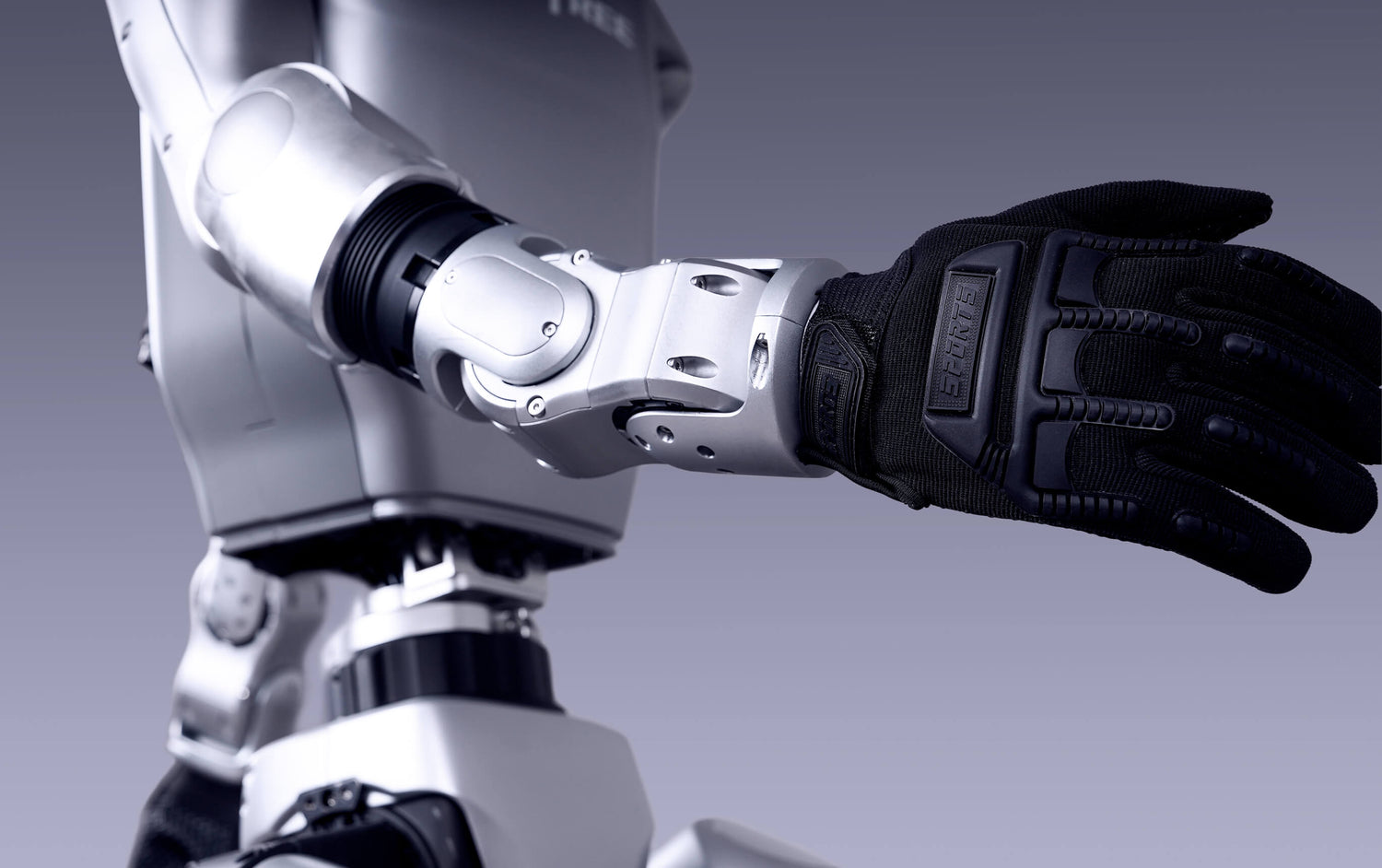
- Manipulation: two 3-finger force-position hands
- Computing platform: Onboard 8-core CPU (option for AI expansion, e.g., Jetson Orin NX)
- Protection: IP54 (standard)
- Temperature range: −10 °C to +45 °C
Motion intelligence in practice: locomotion, balance, and reaction behavior
Humanoid robotics is particularly exciting where environments are built for humans: narrow paths, different floor surfaces, work surfaces, changing obstacles, and dynamic situations. The Unitree G1 EDU uses AI-based motion control to enable realistic, fluid movement sequences. The 23 joint axes (DOF) are crucial for finely tuning body posture, gait, and balance – an important factor for gait optimization, whole-body control, and resilient benchmarking.
For teaching and research, repeatability is key: only when identical test runs with comparable results are possible can improvements be clearly measured. The G1 EDU is therefore suitable for experiments involving stability, disturbance robustness, and adaptive behavior – for example, when changing speed, starting and stopping, or changing direction. With speeds of up to 1.8 m/s and dynamic movement options, you can also map realistic scenarios without having to rely exclusively on simulation.
Perception and sensor fusion: 3D LiDAR, depth camera, and IMU for real environments
Modern AI robotics stands or falls with perception. The Unitree G1 EDU combines 3D LiDAR, a depth camera, and IMU sensors to capture the environment and self-motion in real time. This is particularly relevant for autonomous navigation, obstacle avoidance, mapping, and robust localization. In learning and research projects, this allows for the practical handling of typical pipeline topics: sensor fusion, state estimation, object detection, distance measurement, and model stability under changing light and environmental conditions.
In dynamic research environments, the truly interesting problems often arise: moving people, variable objects, partially obscured structures, or changing scenes. This is exactly where a humanoid robot with reliable environment detection is valuable, because the gap between "works in the lab" and "works in everyday life" can be made visible early on. This increases the quality of datasets, improves the significance of experiments, and accelerates iterative optimization.
Manipulation and grasping: 3-finger hands with a force-position approach
Many projects evolve from navigation to mobile manipulation. The Unitree G1 EDU features two 3-finger force-position hands, which make grasping and handling scenarios significantly more realistic than simple grippers. This allows tasks such as picking up, putting down, repositioning, and positioning to be investigated under real contact conditions. This is relevant for research and teaching because grasping is rarely perfect: objects vary, friction differs, and small deviations must be compensated for by control, perception, and planning.
In this way, the G1 EDU can serve as a humanoid platform for grasp planning, visual servoing, contact models, or "contact-rich" manipulation. This is also an advantage for practical training content: students not only learn the principle but see directly how force, position, timing, and posture are related.
Open development platform: ROS integration, SDK, and AI expansion
The central EDU added value lies in its development capability. The Unitree G1 EDU is positioned as an open platform for research and education and supports ROS integration as well as SDK-based development. This allows the robot to be integrated into existing robotics workflows: from data acquisition and logging to component architecture and tests in a sim-to-real setup. For teaching projects, this means that groups can work on different focus areas (e.g., perception, navigation, manipulation) without the system becoming a dead end.
With the onboard 8-core CPU and the option for AI expansion (e.g., Jetson Orin NX), modern AI requirements can also be better addressed: local inference, edge compute scenarios, or latency-critical control.
Operation in daily teaching and research: runtime, protection, and operational windows
In everyday life, predictability and availability count. With 2.5 to 3.5 hours of runtime (depending on load) and about 1.5 hours of charging time, the Unitree G1 EDU can be easily integrated into typical lab days, seminars, and block courses. The IP54 protection class (standard) supports use in practical environments such as workshops, halls, or test areas, while the temperature range of −10 °C to +45 °C offers additional scope for controlled outdoor tests or varying climate conditions. These are important criteria for everyone who wants to not just test humanoid robotics in the short term, but anchor it sustainably in training or research.