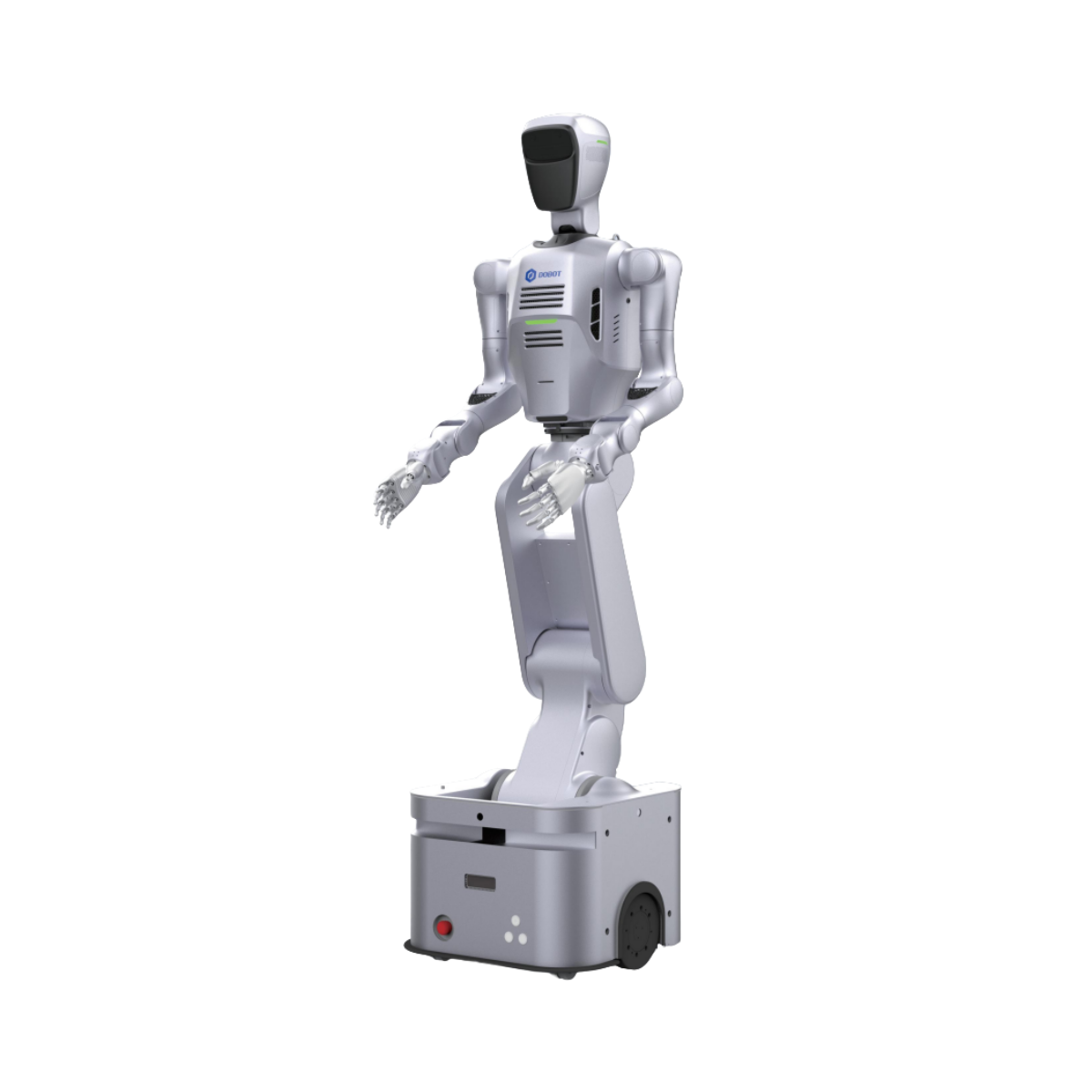
The DOBOT ATOM-W is a wheeled humanoid robotics platform for mobile manipulation, embodied AI, and flexible automation projects. Instead of bipedal walking, the system relies on a stable chassis, combining this mobility with two precise 7-axis robotic arms, a movable waist, and comprehensive visual perception. This allows the robot to navigate between workstations, locate objects, and perform various gripping, transport, or handover tasks. For companies, universities, and research institutions, this creates a platform that integrates autonomous navigation, dual-arm manipulation, and AI development into one system.
Wheeled humanoid for mobile work processes
The wheel-based design makes the DOBOT ATOM-W particularly interesting for structured indoor environments such as production halls, laboratories, development centers, and logistics areas. The mobile base utilizes LiDAR navigation, reaches up to 1.5 m/s according to the data sheet, and with a width of approximately 500 mm, is also designed for comparatively narrow traffic paths. Unlike a stationary industrial robot, the mobile humanoid is not bound to a single robot cell. It can travel to different stations and take on new tasks at each one.
Typical scenarios range from material supply and kitting to sorting and the handover of workpieces. You can find a comprehensive overview of suitable processes on our page regarding Assembly and Handling. There, you can learn when mobile manipulation platforms, humanoid robots, or classic cobots are sensible for pick-and-place, machine tending, and high-mix production.
Precise dual-arm manipulation with seven axes per arm
The DOBOT ATOM-W features two 7-axis robotic arms. Each arm offers a specified reach of approximately 600 mm without an end-effector, a nominal payload of 3.5 kg, and a repeatability of ±0.05 mm. The additional axis compared to classic 6-axis robots expands the range of motion and facilitates working from different angles. Together with the four-axis waist, the robot can flexibly align its upper body and increase the usable workspace.
This kinematics supports tasks such as gripping, reorienting, inserting, placing, or coordinated work with both arms. Depending on the chosen configuration, grippers, dexterous robot hands, force-torque sensors, or additional cameras can be added. A standardized gripper can be particularly efficient for recurring components, while robot hands allow more flexibility for changing shapes and human-like handling operations.
Visual perception for navigation and object localization
For autonomous tasks, the robot must not only move and grip but also reliably perceive its environment. The platform includes a depth camera and an HD binocular camera on the head. Additionally, a 360-degree microphone array and two speakers are available for acoustic interaction. Optional depth cameras on the hands or waist can expand near-field detection and more accurately capture objects directly in the gripping area.
This sensor architecture forms the foundation for spatial orientation, object recognition, and the preparation of gripping movements. In a real-world application, however, lighting, reflective surfaces, obscured components, container geometries, and possible collision contours must be taken into account. A cleanly planned proof of concept shows whether the camera setup, gripping strategy, and work environment interact reliably under realistic conditions.
Embodied AI, VLA, and Robot Learning
The ATOM-W is designed not only as a mobile automation platform but also for embodied AI and robot learning projects. An integrated computing platform with an Intel i9 processor and a powerful GPU provides resources for image processing and AI models. The vision-language-action concept combines visual perception, task descriptions, and physical robot actions into end-to-end sequences.
For research teams, the support of VR-assisted teleoperation, data acquisition, and custom software development is also relevant. Human-demonstrated movements can serve as training data to study manipulation sequences or to further develop proprietary models. Using the SDK, application-specific functions and process logic can be built. Further research platforms and selection criteria can be found on our topic page Humanoid Robots for Industry, Research, and Education.
Use in industry, laboratories, and research
In industry, the DOBOT ATOM-W is particularly suitable for pilot projects and flexible tasks involving multiple stations, changing components, or human-designed workspaces. Conceivable applications include material transport, kitting, component sorting, assembly, light installation, inspection tasks, or the operation of standardized elements. For high-cycle times, heavy loads, or completely constant processes, specialized systems may be more economical. The added value of the ATOM-W lies primarily in the combination of different capabilities within a single mobile platform.
In laboratories and universities, the system enables work on navigation, computer vision, manipulation, teleoperation, human-robot interaction, and AI-supported task planning. Information on suitable learning, development, and research environments can be found on our page Robots for Schools and Universities.
When is the ATOM-W superior to a classic cobot?
A classic cobot is often the better choice when a clearly defined task is performed continuously at a fixed station. The ATOM-W becomes particularly interesting when mobility, dual-arm work, changing deployment locations, and AI-based perception are to be combined. For example, it can pick up material from a shelf, transport it to an assembly station, and perform a further manipulation task there.
This makes the mobile humanoid platform primarily suitable for flexible pilot cells, research scenarios, and processes that cannot be economically represented by several individual special machines. Further DOBOT cobots, desktop robots, and automation solutions can be found on our DOBOT Manufacturer Page.
Integration, safety, and project planning
Before purchasing the DOBOT ATOM-W, the area of application, object weight, gripping points, station layout, travel paths, charging or docking concept, communication interfaces, and safety requirements should be defined. Camera use, data protection, emergency stops, speeds, and distances to people must also be included in the risk assessment. The actual achievable process performance also depends on the end-effector, software, sensors, and the quality of available training and process data.
Terra Robotics provides support in selecting the appropriate configuration, the technical assessment of the use case, and the planning of a proof of concept. For a concrete feasibility check, you can describe your project directly via our inquiry form for robotics projects.