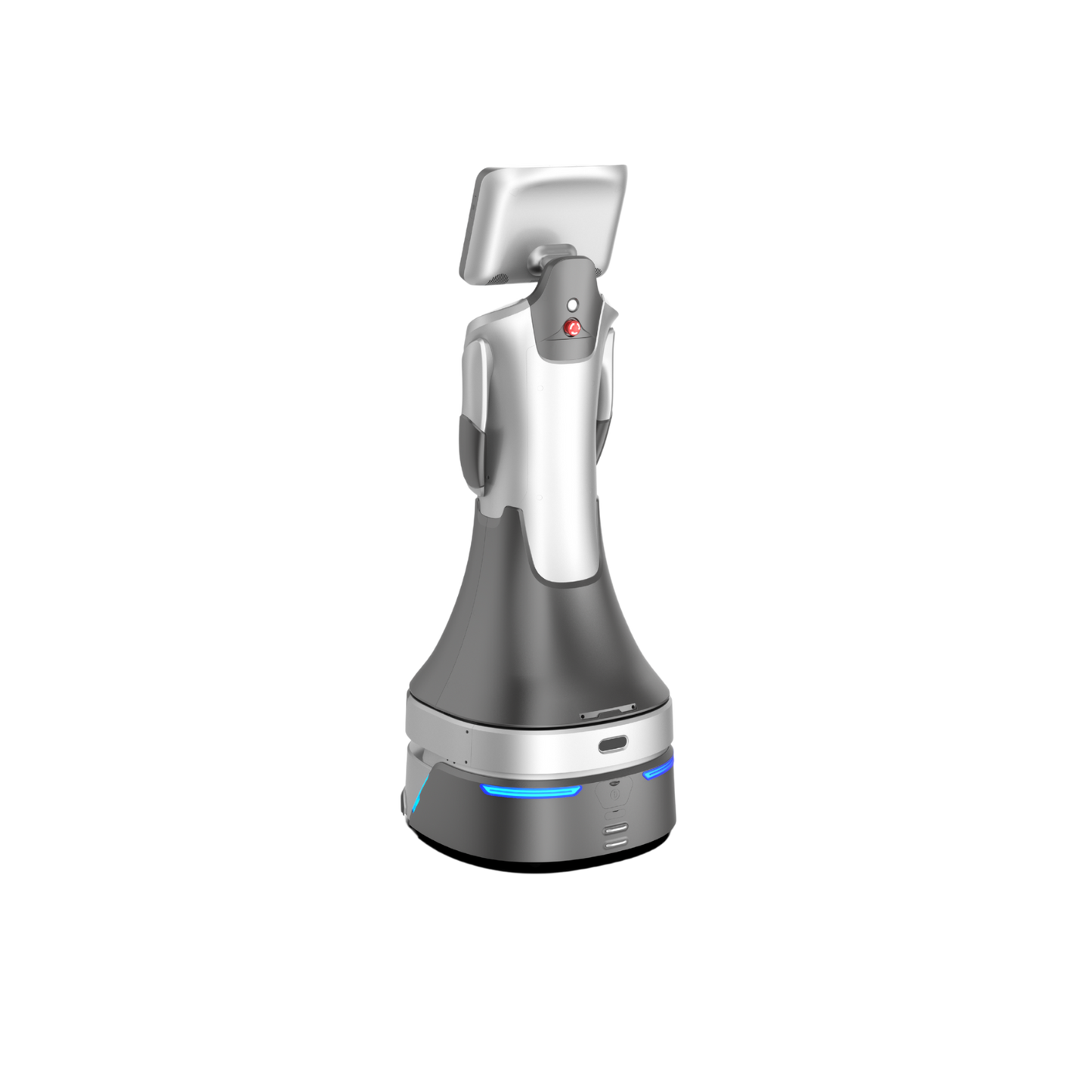
The Orionstar GreetingBot Nova is a professional AI service robot for companies looking to modernize their reception, visitor guidance, information services, and digital customer engagement. It has been developed for public and semi-public indoor areas where visitors, customers, guests, or patients regularly require orientation, information, or an initial point of contact. This makes the Nova particularly suitable for companies, trade fairs, hotels, restaurants, nursing homes, hospitals, office buildings, exhibitions, showrooms, museums, and retail spaces.
At its core, the GreetingBot Nova combines three areas of responsibility: It can actively greet visitors, provide information interactively, and guide people to defined destinations within configured areas. This is complemented by a 14-inch FHD display, which can be used for marketing content, notices, brand messages, or informational material. OrionStar describes the Nova as the manufacturer's first robot featuring a large language model for the global market, citing functions such as reception, tours, explanations, intelligent Q&A, and advertising as its central capabilities.
Why Nova makes the reception more visible and efficient
The first point of contact often determines how professionally a company is perceived. Particularly in entrance areas, waiting zones, exhibition halls, or large buildings, the same questions arise time and again: Where is the right room? Where can I find the contact person? What event is taking place? Where is registration? Which products or services are being showcased here? These recurring information and orientation situations are precisely the ideal areas of application for the Orionstar GreetingBot Nova.
The robot does not replace personal reception staff. Its value lies in relieving teams of repetitive questions, standard information requests, and navigation tasks. Employees can focus more on individual concerns, consultation, escalations, or personal assistance while the Nova greets visitors, provides information, and navigates to target points. This allows the reception to appear more structured, modern, and consistent – especially in locations with high foot traffic or changing visitor groups.
For companies, the presentation effect is an additional relevant factor. An AI reception robot is not just a functional tool, but also a visible signal of digitalization, innovation, and service orientation. Especially in showrooms, at trade fairs, in hotels, or in modern corporate headquarters, the Nova can contribute to brand perception without being reduced to mere spectacle.
AI voice interaction with over 30 languages
A significant differentiating feature of the Orionstar GreetingBot Nova is its AI-powered voice interaction. According to the manufacturer, Nova utilizes ChatGPT, Google Dialogue, and OrionStar LLM technology, supporting voice interactions in over 30 languages. This allows the robot to be used in international environments where visitors speak different languages or wish to access information quickly.
This is particularly relevant for hotels, trade fairs, clinics, museums, international companies, or public institutions. A multilingual reception robot can answer common questions, greet visitors, provide orientation, and display defined information. However, maintaining realistic expectations is important: AI communication should be configured, tested, and limited to the desired content on a project-specific basis. Particularly with sensitive topics such as health, legal matters, data protection, or internal company information, the Nova should not be used as an uncontrolled source of knowledge, but rather as a controlled point of information and interaction.
When set up correctly, however, the robot can create clear added value: It reacts quickly, offers a modern interaction experience, and can answer recurring questions in a scalable manner. This reduces waiting times, improves orientation, and ensures a uniform level of information for visitors.
Navigation, guidance, and orientation in indoor areas
The GreetingBot Nova is designed for intelligent guidance and navigation in configured indoor areas. OrionStar describes a marker-free deployment, which is particularly suitable for larger areas and high ceilings compared to traditional marker-based setups. This can simplify mapping and commissioning because visible markers or QR codes do not necessarily have to be placed in the environment.
Guidance can be valuable in various scenarios: In office buildings, Nova accompanies visitors to meeting rooms. At trade fairs or exhibitions, it can lead to booth areas, product zones, or information points. In hospitals or care facilities, it can support general orientation, such as directing people to reception, waiting areas, or service points. In museums or showrooms, it can be used as a tour guide that explains content and leads visitors through defined areas.
It must be noted that the actual quality of navigation always depends on the specific environment. Floor conditions, narrow passages, crowd volume, Wi-Fi/network conditions, lighting conditions, target points, and mapping all influence operations. For professional use, paths should be checked in advance, maps cleanly set up, and staff trained.
Display, marketing, and digital visitor communication
Nova features a 14-inch FHD screen that, according to the manufacturer, supports personalized marketing materials. This turns the robot into a mobile communication point within a space. Companies can use the display to greet visitors, show offers, present orientation guides, promote events, make product information visible, or stage brand messages.
This advantage is particularly strong in environments where attention is scarce. At trade fairs, companies compete for visibility. In retail, offers must be grasped quickly. In hotels and reception areas, information should appear clear and professional. In showrooms, Nova can complement explanatory content and lead customers to specific product areas.
The robot does not guarantee higher sales or leads. However, it can help to place information more prominently, actively involve visitors, and make digital content tangible directly in the space. For marketing teams, this creates an additional touchpoint between classic display, personal service, and interactive consultation.
Technology, sensors, and mobility
The technical specifications show that the Orionstar GreetingBot Nova is designed for professional indoor use. According to the manufacturer, it measures 558 × 525 × 1350 mm, weighs 56 kg, features a 13-MP HD camera in the head area, and achieves an adjustable roaming speed of 0.5 to 1.2 m/s. The runtime in a typical roaming scenario is 12 to 14 hours; charging time is 4.5 hours when using the charging station. Automatic charging station and cable are listed as charging modes.
For perception, OrionStar mentions 3D LiDAR with a 170-degree field of view and a 240-degree horizontal plane. The manufacturer highlights that the system is designed for busy, high-traffic environments such as exhibition halls and museums and can detect low obstacles.
This combination of sensors, display, camera, navigation, and voice interaction makes Nova a versatile reception and service robot. At the same time, technical performance should always be tested against the actual space. For productive deployments, test runs, defined target points, clear content, staff training, and regular process reviews are recommended.
Customizability through interfaces and peripheral space
A key advantage of the GreetingBot Nova is its customizability. OrionStar notes extended hardware interfaces and additional peripheral space in the chest and abdominal area. This allows the robot to be more strongly adapted to individual requirements depending on the project.
For B2B projects, this is an important point because reception and information processes are rarely identical. A hotel has different requirements than a hospital, a trade fair booth different goals than an office building, a museum different content than a showroom. Through interfaces, peripheral space, and project-specific configuration, Nova can be better integrated into concrete scenarios.
Nevertheless, integrations should not be promised as a matter of course. Whether specific peripheral devices, systems, or processes can be connected must be checked on a project-by-project basis. Therefore, for the product detail page, wording such as "advanced customization options" or "project-dependent integratable peripherals" is safer than a blanket statement regarding specific third-party systems.
Areas of application: Reception, trade fair, care, health, office, and retail
Reception and corporate headquarters
In corporate headquarters or office buildings, Nova can greet visitors, provide information, and lead them to meeting rooms or reception points. This appears professional, reduces standard questions, and supports a structured first point of contact.
Trade fair and event
At trade fairs, Nova can generate attention, engage visitors, display brand messages, and lead them to booth areas or product zones. Especially for companies with products that require explanation, the robot can serve as an interactive entry point.
Hotel and catering
In hotels, Nova can provide information on check-in, breakfast, events, or services. In the catering industry, it can greet guests, provide orientation, or highlight offers. Personal service remains central, but recurring information tasks can be digitally supported.
Hospital and nursing home
In hospitals and care facilities, Nova can support general orientation, greet visitors, or provide non-medical information. A clean distinction is important here: The robot should not be used for medical consultation, diagnosis, or sensitive information, but rather for reception, orientation, and general service communication.
Retail, showroom, and museum
In retail, showrooms, and museums, Nova can lead visitors through defined areas, explain products, display promotions, or be used as a mobile information point. In doing so, it connects digital content with a physical presence in the room.
Profitability and project assessment
The profitability of an AI reception robot does not arise from a single key figure, but from the specific use case. Relevant questions include: How many visitors are there per day? How often are the same questions asked? How many walking paths are created by visitor guidance? Which languages are needed? How often should marketing or event information be updated? How heavily is the reception burdened at peak times?
The GreetingBot Nova is particularly useful where multiple benefit levels come together: recurring visitor questions, a need for orientation, high frequency, international target groups, content requiring explanation, and a visible commitment to innovation. In such scenarios, Nova can relieve reception teams, standardize processes, and make visitor communication more modern.
For the assessment, purchase price, leasing model, setup, maintenance, training, content management, and ongoing support should be taken into account. At Terra-Robotics, the Orionstar GreetingBot Nova is offered as a purchase and leasing solution; the product page mentions a purchase price of €17,000, leasing starting at €11.33 per day, as well as consulting, support, training, and add-on maintenance contracts.
Service, implementation, and introduction with Terra-Robotics
A reception robot is only successful if technology and process align. Before introduction, it should be clarified which questions Nova should answer, which target points should be navigated to, which content should appear on the display, which languages are required, and which teams will operate the robot. Equally important are site inspection, mapping, test runs, and training.
Terra-Robotics supports this with implementation consulting, technical support, staff training, and initial installation. As a result, the GreetingBot Nova is not just delivered as a device, but planned as an application-oriented solution. This is especially important for companies that wish to integrate the robot into reception processes, trade fair appearances, visitor guidance, or digital customer communication.
Conclusion: Orionstar GreetingBot Nova as a modern AI service robot for reception and visitor communication
The Orionstar GreetingBot Nova is a powerful solution for companies looking to modernize their reception, visitor guidance, information services, and digital brand communication. Its strengths lie in the combination of AI voice interaction, support for over 30 languages, a 14-inch FHD display, autonomous navigation, marker-free deployment, 3D LiDAR perception, and advanced customization options.
Nova is particularly suitable for trade fairs, hotels, office buildings, showrooms, museums, hospitals, care facilities, retail spaces, and other indoor areas with recurring information and orientation tasks. It is not a replacement for personal consultation, but a powerful digital assistant for standardized communication, visitor guidance, and modern service experiences.
Those looking for a reception robot that not only stands out but can also take on clear tasks will find a professional solution in the Orionstar GreetingBot Nova for the next step toward automated, multilingual, and interactive visitor communication.