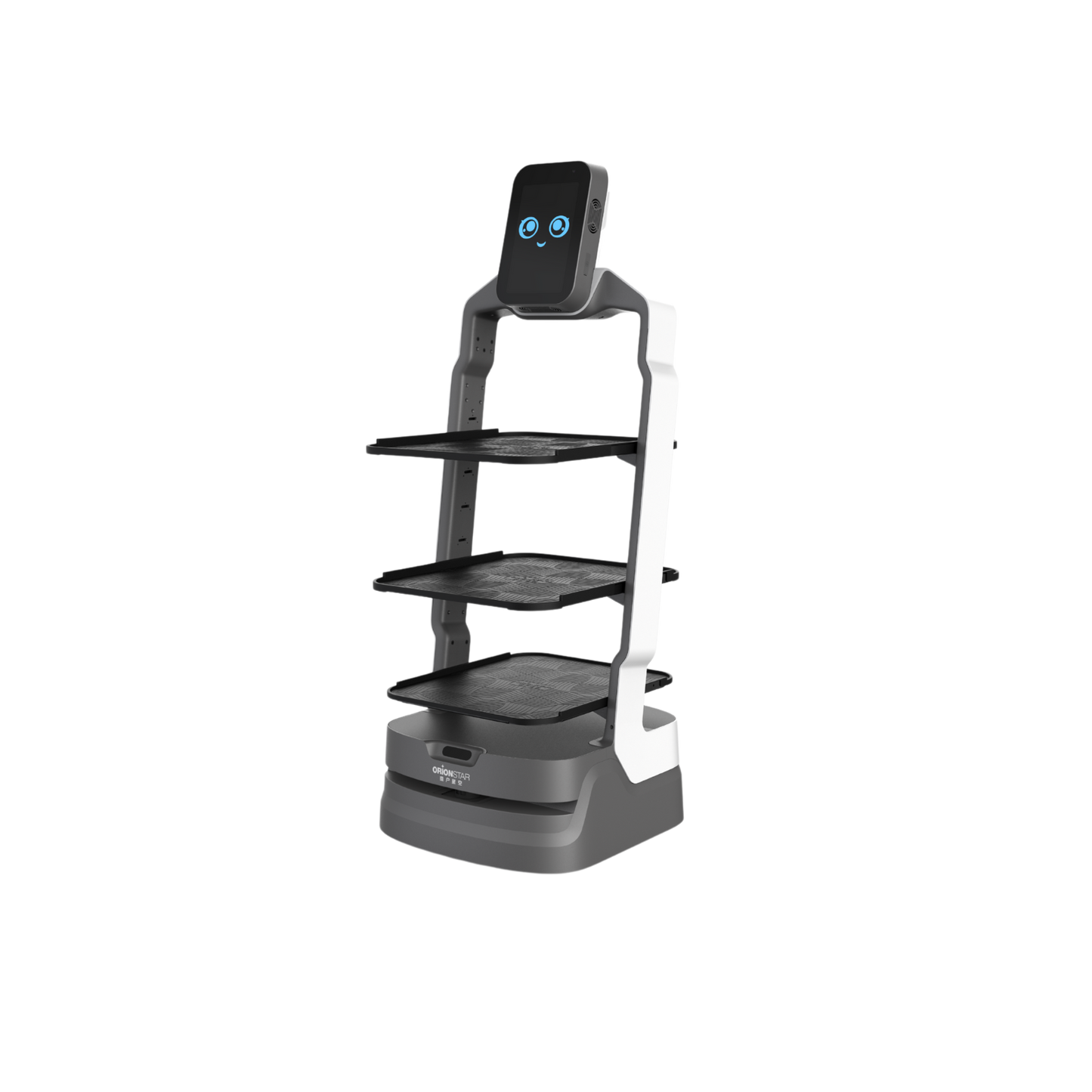
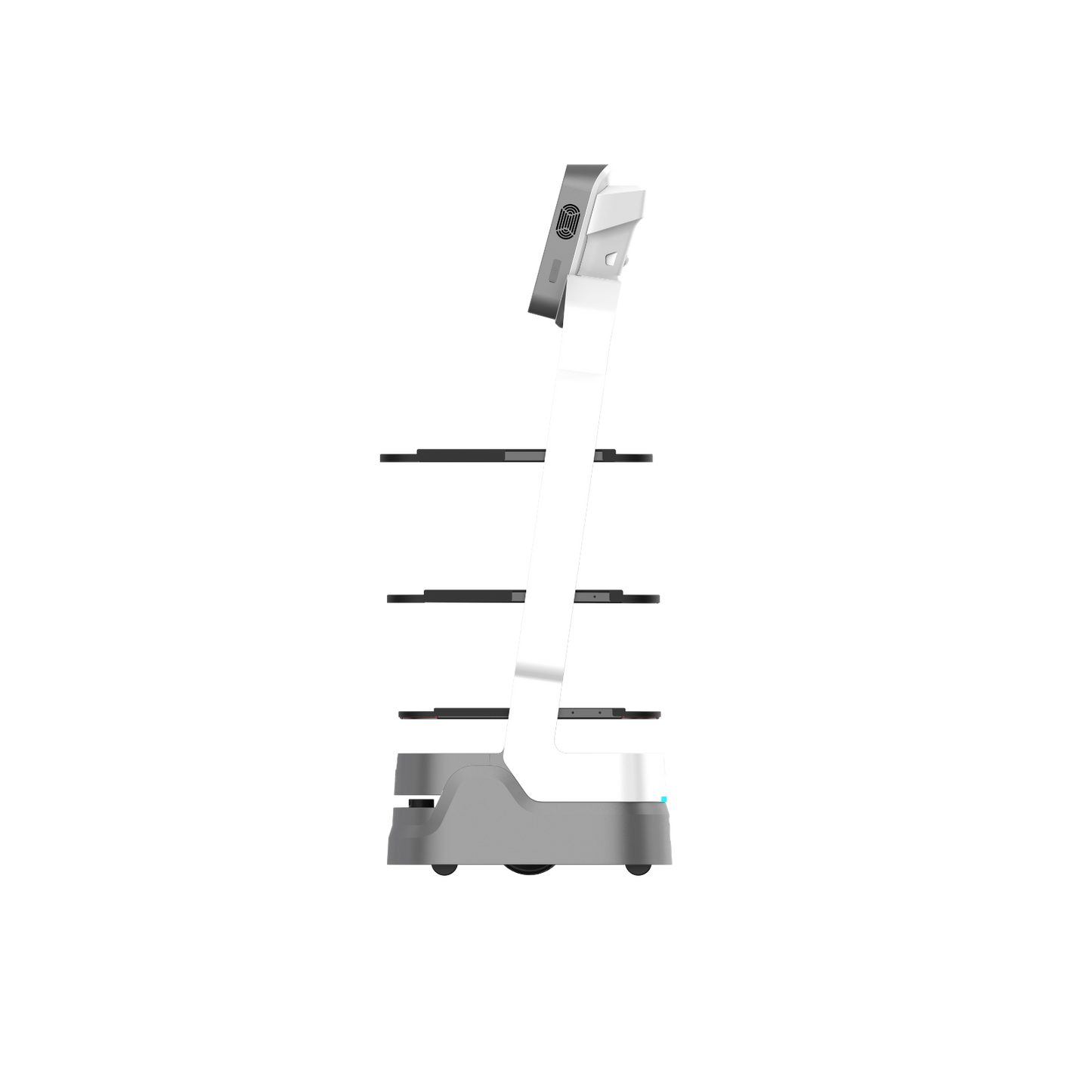
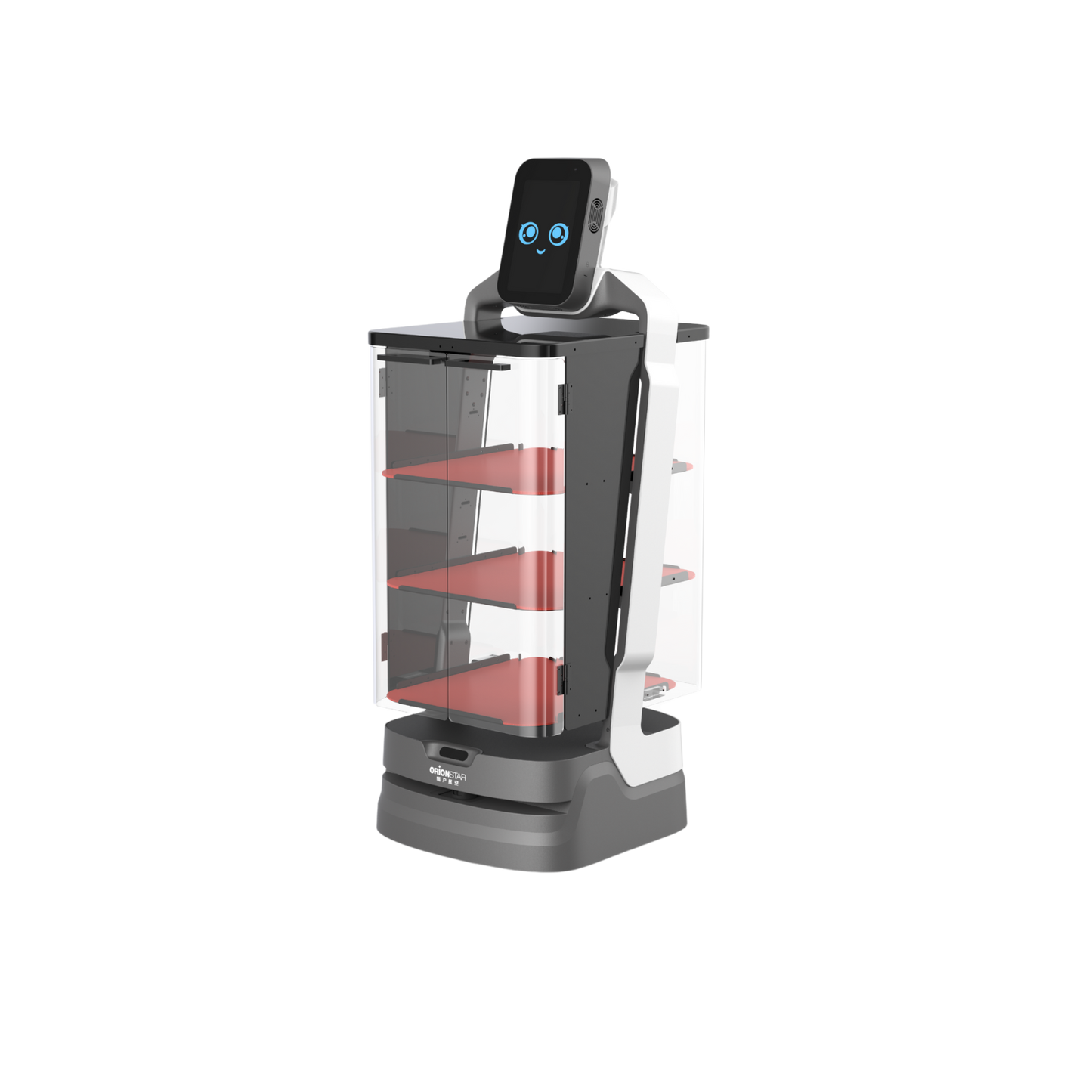
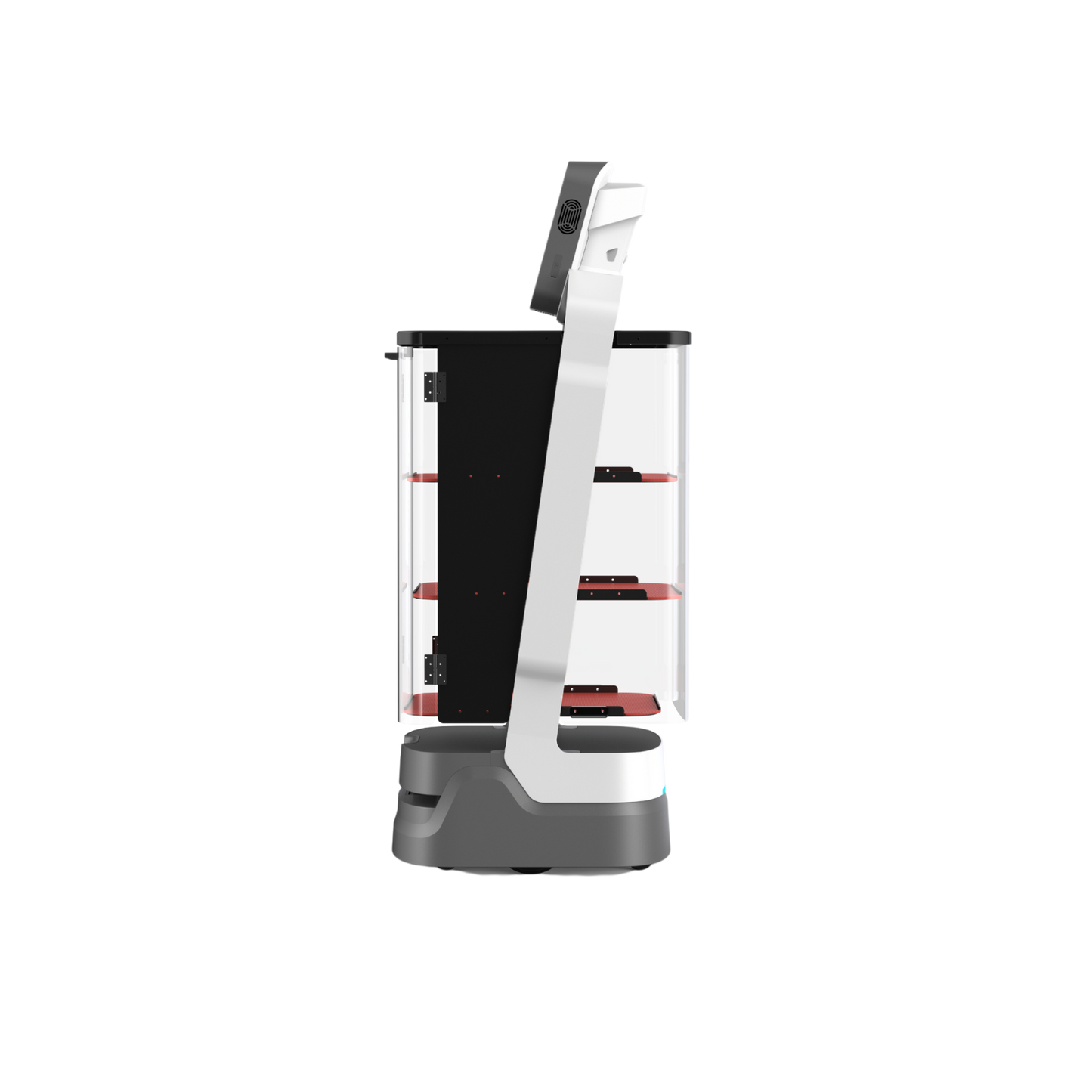
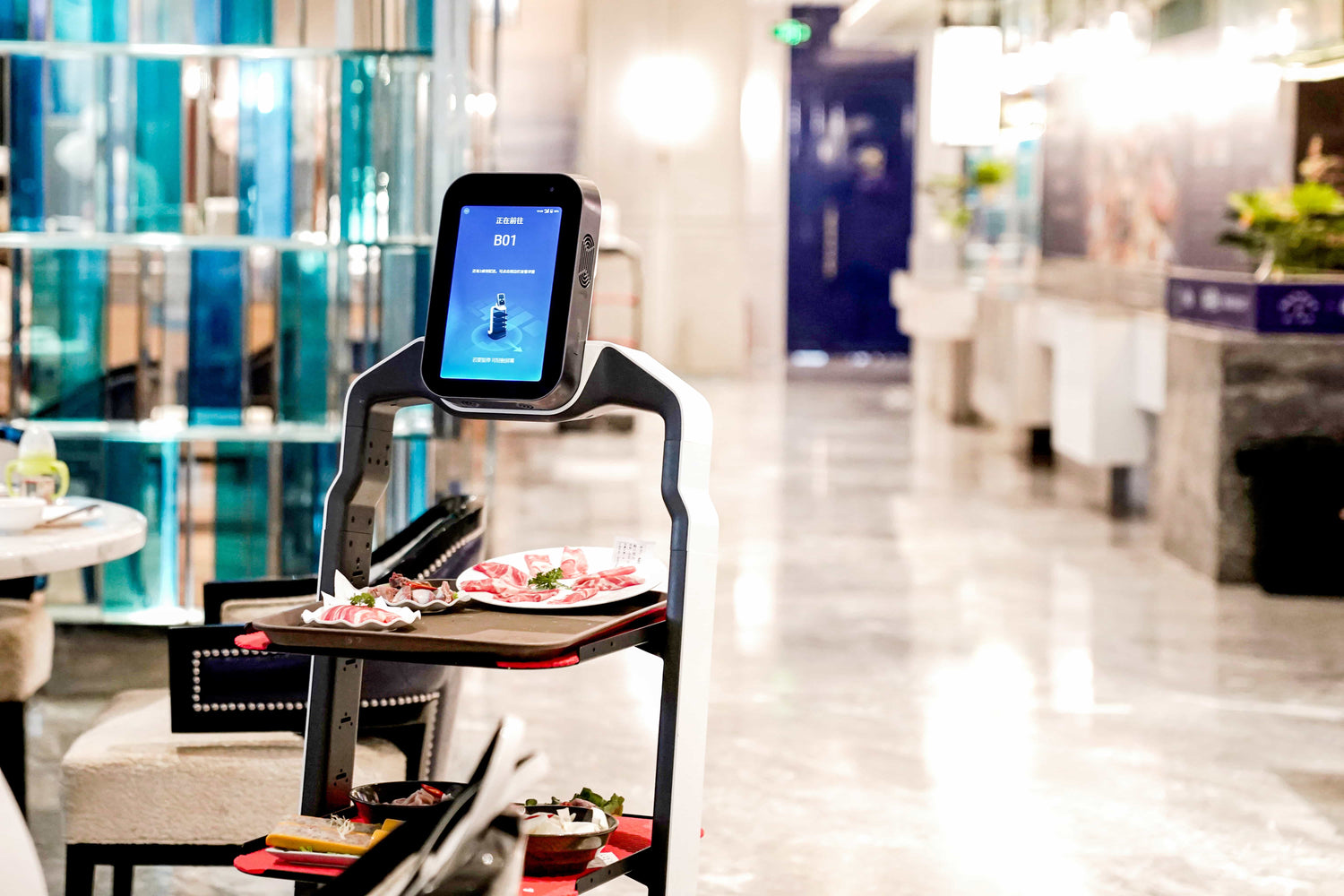
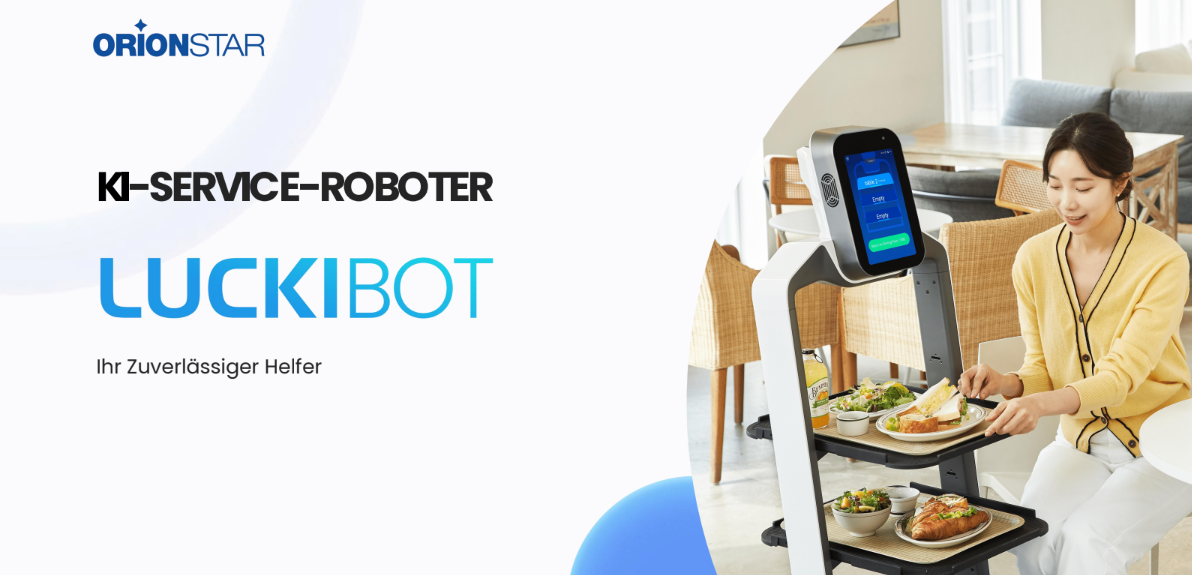
The OrionStar LuckiBot is an AI-powered indoor delivery and service robot that reliably handles recurring transport routes. In restaurants, canteens, and hotels, it supports service staff with the delivery of food and beverages, in retail with promotions, and in reception areas with customer-oriented service workflows. As an autonomous service robot, the LuckiBot combines precise navigation with a scalable tray system and interaction that does not just "deliver," but also actively contributes to the customer experience.
For businesses, this is particularly relevant when walking distances are long and the workload on the team is increasing: the robot handles standardized rounds, relieves staff, and stabilizes processes – especially during peak times. At the same time, it fits into modern concepts surrounding service automation, in-store marketing, and process optimization.
Tray system and load capacity: 3–4 levels for predictable delivery
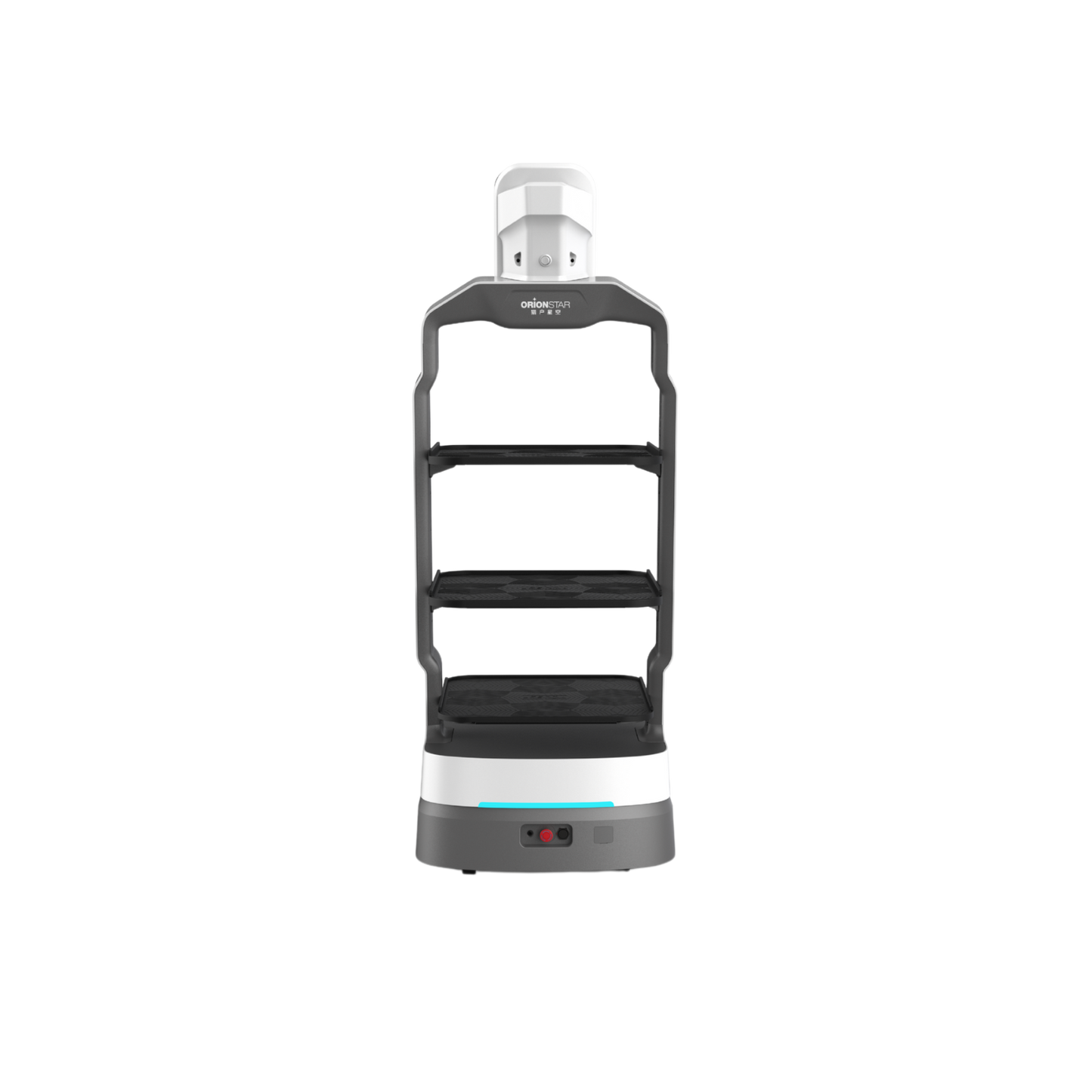
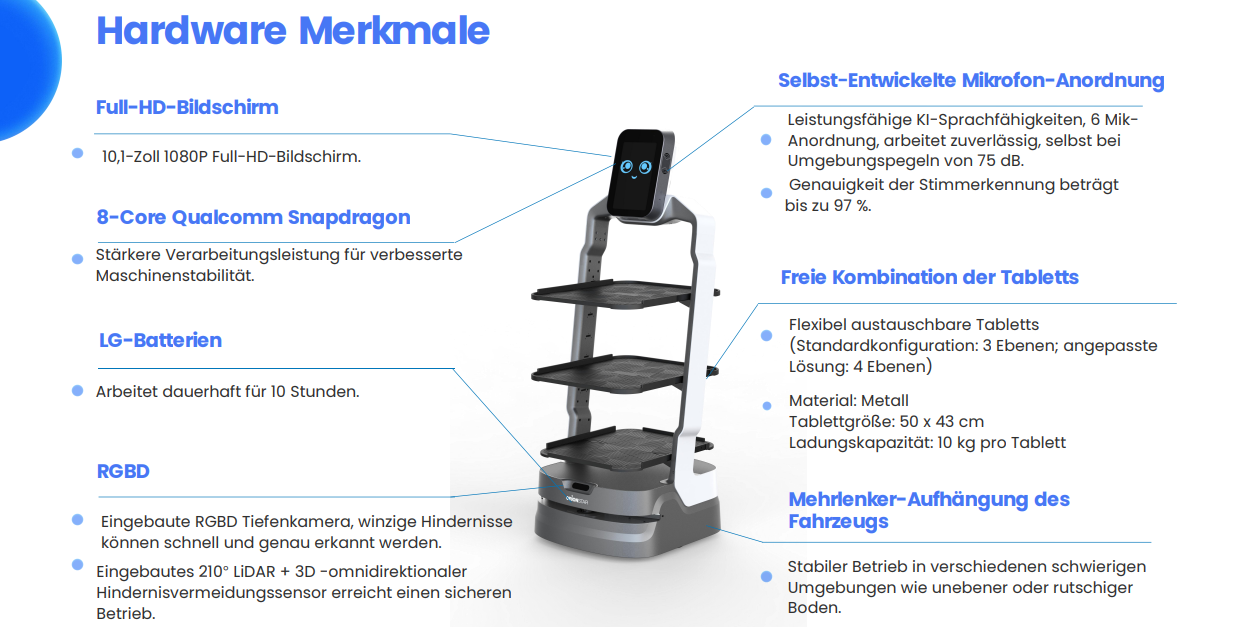
A decisive factor in day-to-day operations is capacity per trip. The LuckiBot can be configured with 3 or 4 levels, allowing it to be adapted to different operational profiles: fast delivery with fewer levels, or more stops per route with additional shelf space. The maximum load capacity is up to 40 kg, with up to 10 kg per level – a practical value for transporting multiple plates, rounds of drinks, or shopping baskets in a single run.
Thanks to the clearly structured storage, the robot becomes a reliable tray robot: routes between the kitchen, pick-up point, and table are standardized, deliveries become more predictable, and the team gains time for consultation and guest interaction. In the catering industry in particular, this is a noticeable lever, as the benefit lies not just in "more speed," but in less idle time and more stable service processes.
Tasks for which the LuckiBot is particularly well-suited
- Food and beverage delivery (restaurant, canteen, hotel)
- Clearing and collection routes (e.g., returning dishes)
- Indoor material transport (e.g., documents, small goods, giveaways)
- Promotions and product presentations while in motion (retail, showroom)
Autonomous navigation: LiDAR SLAM, optical positioning, and obstacle avoidance
For a service robot to function in real-world operations, navigation must be reliable and feel "human-friendly": no abrupt stops, clean lane guidance, and stable reactions to people and obstacles. The LuckiBot uses LiDAR-based navigation in combination with optical positioning and SLAM. This allows it to map environments, robustly determine its position, and follow routes repeatably – central to recurring delivery trips and defined service workflows.
Obstacle avoidance ensures that the robot reacts safely in dynamic situations, e.g., when guests stand up, children run through the aisle, or objects are briefly left in the path. For SEO, this section is important because many users specifically search for terms such as LiDAR service robot, SLAM delivery robot, autonomous indoor navigation, or robot obstacle avoidance.
Stable even on difficult floor conditions
In everyday life, floors are not always ideal: transitions, joints, small edges, or slippery areas are typical challenges. The LuckiBot is designed to travel stably even in such situations so that deliveries do not become a risk and the operation does not constantly require manual intervention.
Stable chassis and handling: designed for service routines
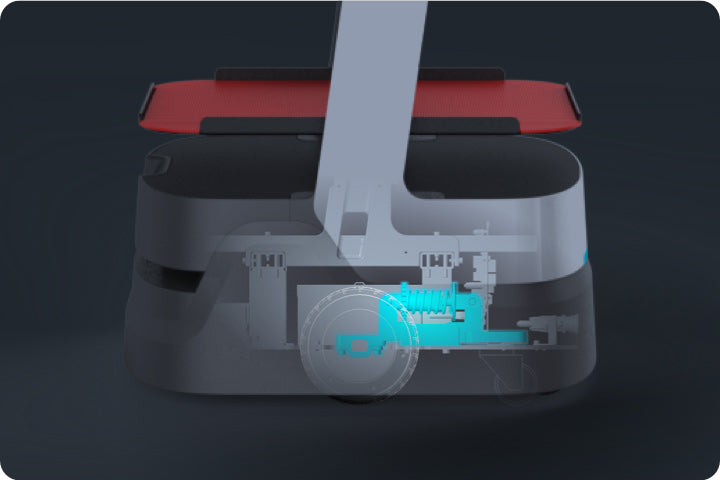
In service environments, it is not just the technology that counts, but the smoothness of operation: the robot should move quietly, stand securely, and remain stable when stopped. The LuckiBot relies on a stable chassis and a suspension concept that can better compensate for unevenness. This pays off directly in terms of benefits in a restaurant or lobby: less "wobbling," less uncertainty when placing items down, and better predictability in narrow passages.
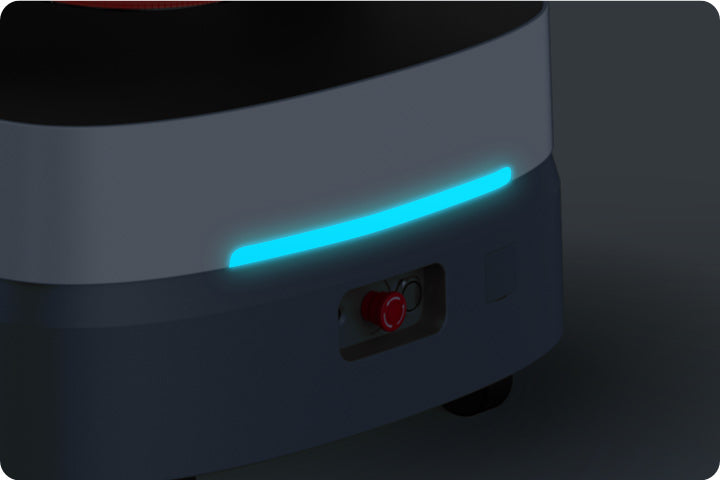
Additionally, an intelligent LED status strip supports operational safety in everyday use. The robot clearly indicates whether it is charging, in operation, has been stopped, or a malfunction is present. This reduces inquiries, makes operations more transparent, and helps teams quickly integrate the robot into their routines.
Touch system, computing platform, and connectivity: 4G and WLAN for flexible control
The LuckiBot is designed as an AI service robot for simple operation. A touch system supports daily interaction: selecting destinations, controlling modes, approaching delivery points, or triggering service tasks. For technical stability, a high-performance system platform is relevant: an 8-core processor combined with an MCU and sensor system forms the basis for navigation, delivery, and real-time response.
For operation in larger areas or in environments with changing setups, connectivity is crucial. The LuckiBot supports both WLAN (2.4 / 5 GHz) and 4G, allowing it to be operated flexibly in a wide variety of locations. This is particularly interesting for chain operations, hotels, or larger gastronomy spaces, where a stable connection contributes to control and planning.
In-store marketing and customer interaction: more than just a delivery robot
A major advantage of many modern service robots is the combination of logistics and interaction. The LuckiBot can actively recognize and greet customers, helping to ensure that guests in the room are not "overlooked." Additionally, it supports versatile service tasks such as distributing coupons, presenting dishes, or promoting specials – an approach that has proven particularly effective in retail, showrooms, and modern catering concepts.
This turns the robot into a marketing robot in the best sense: it brings attention to where foot traffic already occurs and can support communication with guests without staff having to invest additional time. Search terms like in-store marketing robot, service robot promotion, AI service robot greeting, or restaurant robot recommendation are thus covered organically.
Areas of application: restaurant, canteen, hotel, retail, and reception
The LuckiBot is particularly suitable for businesses that want to standardize recurring routes – and at the same time value a modern public image. In restaurants and canteens, the focus is on relieving the burden of delivery and clearing. In hotels, it can support walking routes in lobby and event areas. In retail, it is exciting for promotions, product presentation, and couponing. And at reception, it can be used as a service aid when visitor guidance and customer interaction are to be integrated into the process.
The result is a clear benefit: more stable processes, relieved teams, and a modern service experience.