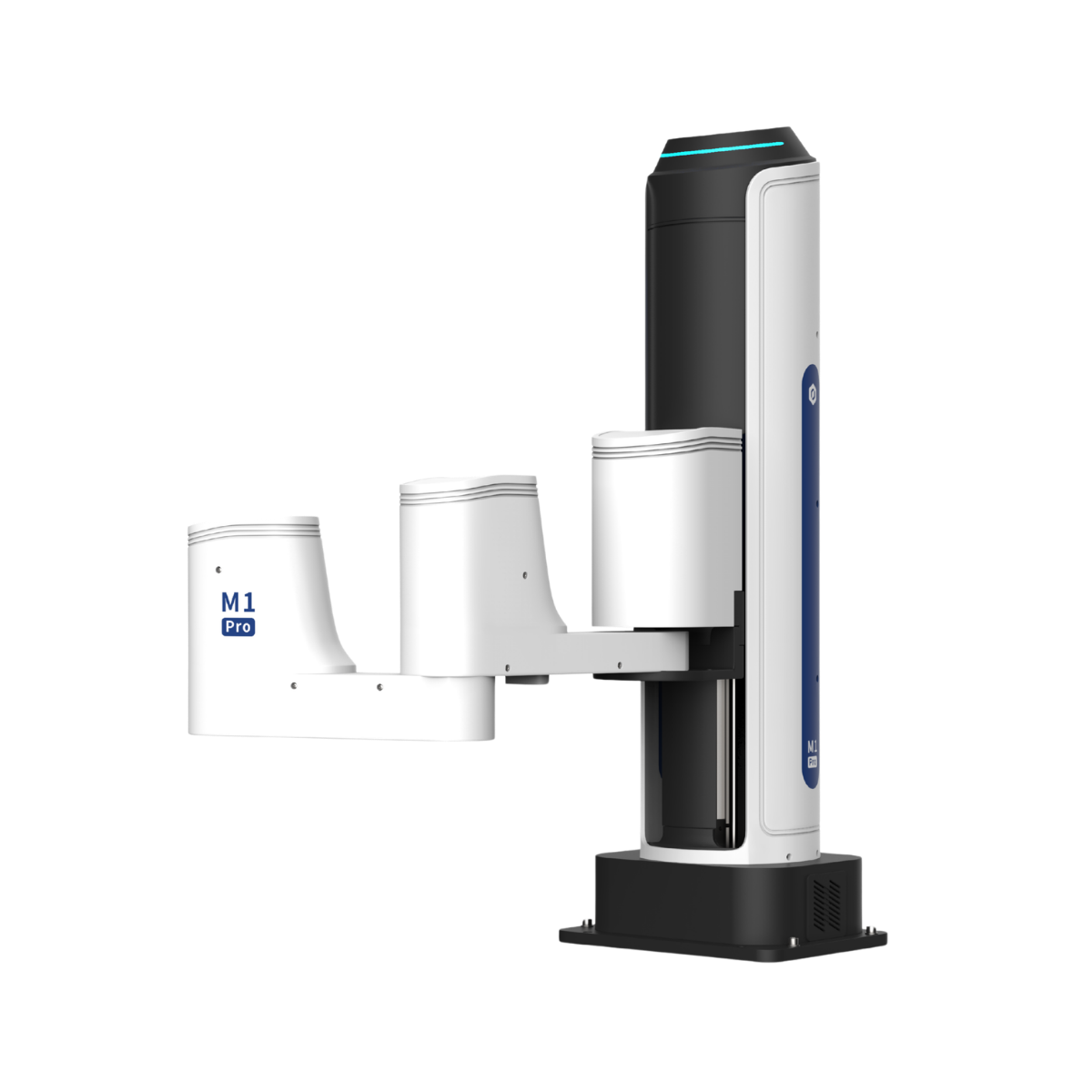
DOBOT M1 Pro: Precise SCARA robot for compact automation cells
The DOBOT M1 Pro is a compact collaborative 4-axis SCARA robot for fast and precise automation tasks in light industry. With a maximum payload of 1.5 kg, a 400 mm working radius, and a repeatability of ±0.02 mm, it is particularly suitable for pick-and-place, assembly, loading, quality inspection, gluing, and loading/unloading small production stations. The integrated all-in-one design reduces cabling and space requirements, facilitating the setup of flexible workstations.
1.5 kg payload for small parts and compact tools
The maximum payload of 1.5 kg offers sufficient reserve for many electronic components, small assemblies, packaging parts, and lightweight end effectors. The total load includes the workpiece, gripper, adapter, and other attachments. Therefore, tool design should be based not only on the weight of the parts but also on the center of gravity, gripping path, and desired acceleration.
With its 400 mm working radius, the M1 Pro can reach multiple provisioning, processing, and storage positions within a compact cell. Its SCARA kinematics are particularly efficient for horizontal movements, vertical insertion, and the rotation of components around the tool axis. Further solutions for recurring gripping and positioning tasks can be found in the Assembly and Handling section.
High repeatability for assembly and loading
The DOBOT M1 Pro achieves a repeatability of ±0.02 mm. This allows the robot to reliably return to defined positions and precisely place small components into trays, fixtures, or test jigs. Typical applications include the assembly of electronic components, sorting of components, and the insertion of lightweight parts.
The four axes are designed for fast SCARA movements. J1 and J2 each reach up to 180° per second, the vertical J3 axis up to 1,000 mm per second, and the rotation axis J4 up to 1,000° per second. The actual cycle time also depends on gripper movement, workpiece supply, safety parameters, and the duration of the respective testing or processing step.
Dynamic gripping on conveyor belts
An integrated encoder interface supports dynamic gripping and tracking. In combination with a conveyor belt and the appropriate software, the M1 Pro can detect moving products and pick them up at defined positions. This is suitable, for example, for sorting, packaging, parts feeding, and handover to downstream stations.
Multithreading and on-the-fly I/O controls make it possible to link signals and movements efficiently. Sensor queries, gripper commands, and process steps can thus be integrated into the motion sequence. For a stable conveyor belt application, the encoder, camera, lighting, gripper, and belt speed must be coordinated.
Quality inspection and camera-assisted automation
The M1 Pro can be combined with vision systems to localize components, determine their orientation, or support visual inspection tasks. The robot can position components in front of a camera, sort them based on inspection results, or pick detected parts from a conveyor belt. An official DOBOT case study describes the use of the M1 Pro in the visual inspection of electronic circuit boards.
For reproducible results, stable lighting, defined camera positions, and suitable image processing are crucial. The robot takes care of the precise feeding and positioning. Suitable grippers, cameras, and other accessories can be found in the DOBOT Accessories collection.
All-in-one design for quick commissioning
The M1 Pro weighs 15.7 kg and integrates the controller directly into the robot system. As a result, no separate large control cabinet is required. This reduces additional cabling and simplifies installation on worktables, machine frames, and mobile demonstration setups. Power is supplied via 100 to 240 V AC at 50 or 60 Hz.
The compact design is particularly suitable for small and medium-sized enterprises that wish to automate individual process steps without extensive system modifications. When products change, the cell can be adapted for new variants with appropriate fixtures, grippers, and programs. Further compact automation solutions can be found in the Industry section.
Graphical programming and open interfaces
Operation is carried out via DobotStudio Pro or the CRStudio App. Programs can be created graphically or extended via script. Wired and wireless connections allow for operation via PC, tablet, or smartphone. This allows positions, movements, inputs and outputs, and process steps to be adapted to the respective application.
For facility communication, the M1 Pro supports TCP/IP, Modbus TCP, and Modbus RTU. Via the DOBOT SDK, individual developments are possible using Python, C++, C#, Java, ROS, MATLAB, LabVIEW, and Android, among others. This allows the robot to be integrated into proprietary software, test benches, and research projects. Other robot models from the manufacturer can be found on the DOBOT manufacturer page.
Collision protection and safe working areas
The M1 Pro features collision detection for human-robot collaboration. According to the manufacturer, its forearm is about 40 percent narrower than that of a classic industrial robot arm, which reduces the risk of unintended contact and mechanical collisions. However, operation without additional safety measures is not automatically permissible for every application.
Tools, workpieces, speed, crush points, and the working environment must be considered together as part of a risk assessment. The M1 Pro has an IP20 protection rating and is therefore not designed for dusty, wet, or regularly cleaned production areas without additional protective measures.
Selecting the DOBOT M1 Pro or MG400
Compared to the more compact DOBOT MG400, the M1 Pro offers a higher payload and better repeatability. The MG400 is lighter and has a slightly larger working radius of 440 mm, while the M1 Pro moves up to 1.5 kg and achieves ±0.02 mm. The right choice therefore depends on workpiece weight, available space, precision requirements, and required reach. Further information can be found on the product page for the DOBOT MG400.
Buying and integrating the DOBOT M1 Pro
Before integration, the workpiece, gripper, cycle time, workspace, communication interfaces, and safety requirements should be defined. A test with real components shows at an early stage whether gripping reliability, conveyor tracking, and process speed can be reliably achieved.
Terra Robotics provides support with the selection of the end effector, workspace planning, and technical integration. For a feasibility check, you can describe your process using the contact form for robotics projects.