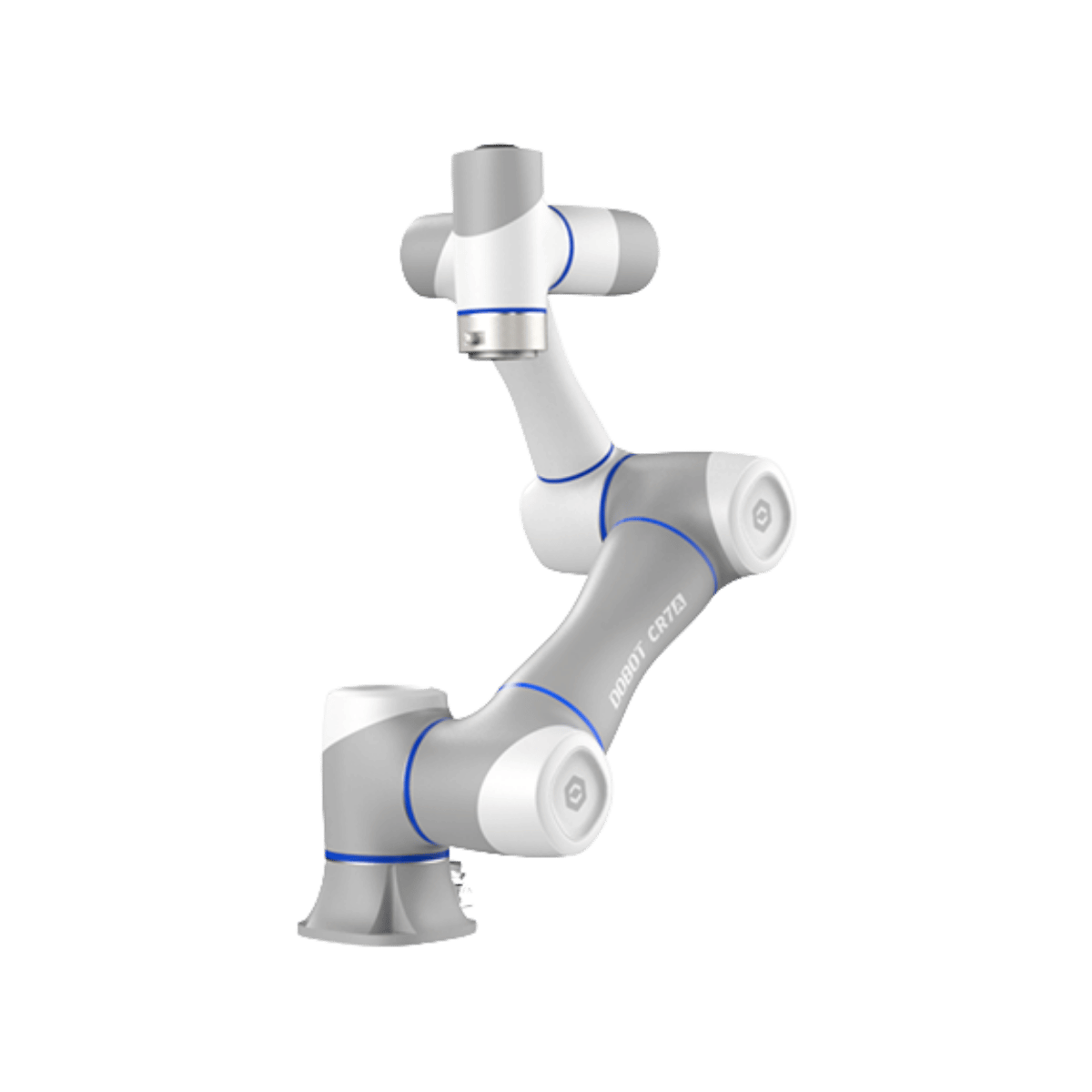
DOBOT CR7A: High-performance cobot for flexible production processes
The DOBOT CR7A is a collaborative 6-axis robotic arm for companies that want to flexibly automate repetitive production tasks. With a 7 kg payload, 800 mm working radius, and a repeatability of ±0.02 mm, the cobot combines a compact design with industrial performance. This makes it particularly suitable for assembly, pick-and-place, machine tending, quality inspection, packaging, and material handling. As part of the current DOBOT CRA series, the CR7A also benefits from fast integrated joints, modern control technology, and the DobotStudio Pro programming environment.
Precision and reach for demanding tasks
The combination of a 7 kg maximum payload and 800 mm reach covers numerous applications in the mid-load range. The CR7A can move and precisely position workpieces, grippers, screwdriving systems, and other end effectors within a compact workspace. Its repeatability of ±0.02 mm supports reproducible processes for inserting, inspecting, assembling, and aligning components. When designing the system, the dead weight of the tool must be taken into account in addition to the workpiece weight so that sufficient payload reserve remains for the center of gravity, acceleration, and process forces.
With a maximum linear speed of 2 m/s and joint speeds of up to 223° per second, the collaborative robot is not only precise but also designed for productive cycle times. However, the speed that can be used in a real-world process depends on the tool, workpiece, motion path, workspace, and safety concept. For reliable planning, reach, cycle time, interference contours, and required safety distances should therefore be evaluated together.
Flexible assembly, pick-and-place, and material handling
A key area of application for the DOBOT CR7A is the automated gripping, sorting, and provisioning of components. In pick-and-place processes, the robot can pick up components from conveyor belts, workpiece carriers, or provisioning areas and place them into fixtures, containers, or downstream stations. For assembly tasks, it assists with joining, inserting, screwing, and positioning small to medium-sized components, among other things.
The six axes enable flexible motion paths and allow workpieces to be approached from different angles. This is particularly relevant for products with many variants, tight fixtures, or limited work areas. Further potential applications and selection criteria can be found on our page regarding assembly and handling, where cobots, dual-arm systems, and other robotics solutions for flexible manufacturing processes are classified.
Machine tending and automated quality inspection
The CR7A also offers a suitable combination of reach, payload, and precision for loading and unloading CNC machines, testing stands, or processing equipment. The cobot can pick up raw parts, insert them into a fixture, and subsequently remove processed components. By connecting it to PLCs, machine signals, and safety technology, the robot sequence can be coordinated with existing production equipment.
In combination with a 2D or 3D vision system, the CR7A can additionally detect position deviations, localize parts, or support visual inspection tasks. Camera systems are suitable, for example, for checking presence, orientation, completeness, or defined surface features. The specific inspection process must be validated based on the component, lighting, camera position, and quality requirements. A broader overview of cobots and robotics solutions for production and logistics is provided on the industrial robots page.
Integrating grippers, sensors, and tools
The DOBOT CR7A can be adapted to different processes via the tool flange and the available interfaces. Depending on the application, electric or pneumatic grippers, vacuum cups, screwdriving systems, dispensing technology, force sensors, and camera solutions can be used. This results not in a rigid standard solution, but in an automation cell adapted to the workpiece and the process.
When selecting the end effector, not only payload and gripping force are decisive. The center of gravity, component surface, required accuracy, compressed air supply, cable and hose routing, and possible tool changes must also be considered. An early gripping and feasibility check reduces the risk that a technically compatible component will not operate stably or quickly enough under real production conditions.
DobotStudio Pro and industrial communication
The CR7A is programmed via DobotStudio Pro. Simple motion sequences can be taught via drag-to-teach or graphical programming. For more complex applications, scripting, offline programming, and the integration of external controllers are available. This makes the robotic arm suitable for a quick start as well as for more demanding projects with multiple process steps.
For facility communication, the CRA series supports TCP/IP, Modbus TCP and RTU, EtherNet/IP, PROFINET, and RS485, among others. The controller also provides extensive digital and analog inputs and outputs. This allows the cobot to communicate with PLCs, HMIs, conveyor technology, sensors, valve terminals, and machine controls. Further collaborative robotic arms and automation solutions can be found on our DOBOT manufacturer page.
Collaborative safety requires a risk assessment
The DOBOT CR7A is designed as a collaborative robot and features an independent safety controller with PLd Cat. 3 as well as more than 20 configurable safety functions. These include, among others, limits for speed, force, and workspace. An electromagnetic quick-stop brake supports short reaction times for safely stopping the system.
However, the term "cobot" does not automatically mean that every application can be operated without additional protective measures. Sharp-edged workpieces, dangerous tools, or high process speeds may make scanners, safety zones, or enclosures necessary. Before commissioning, the robot, tool, workpiece, process, and workstation must therefore be assessed together.
Which companies is the DOBOT CR7A suitable for?
The CR7A is particularly interesting for medium-sized production companies, integrators, development departments, and companies with highly varied or recurring manual tasks. Its compact reach is suitable for workplaces where larger robot models would take up unnecessary space, while the 7 kg payload offers sufficient reserve for numerous industrial tools and components.
Sensible entry scenarios are clearly defined repetitive processes with measurable time expenditure and stable boundary conditions. Above all, assembly, machine tending, sorting, inspection, and packaging can often be automated in stages. Further solutions for manufacturing, production, and logistics can be found in the Industry section.
Buying and professionally integrating the DOBOT CR7A
Before purchasing, payload, reach, cycle time, gripping technology, interfaces, safety requirements, and spatial conditions should be checked. Terra Robotics provides support in selecting the appropriate end effector, assessing technical feasibility, and planning a complete automation solution. A proof of concept with real workpieces shows at an early stage whether the gripping process, motion path, and desired cycle time can be reliably achieved.
For an individual assessment, you can describe your process, the components to be moved, and the existing system via our contact form for robotics projects. This allows us to clarify whether the DOBOT CR7A is the right solution or if another model in the CRA series is a better fit for the payload, reach, and application.