

UBtech
UBtech uKit AI
UBtech uKit AI
Leasing enquiry



From building blocks to AI – learning with uKit Explore & uKit AI
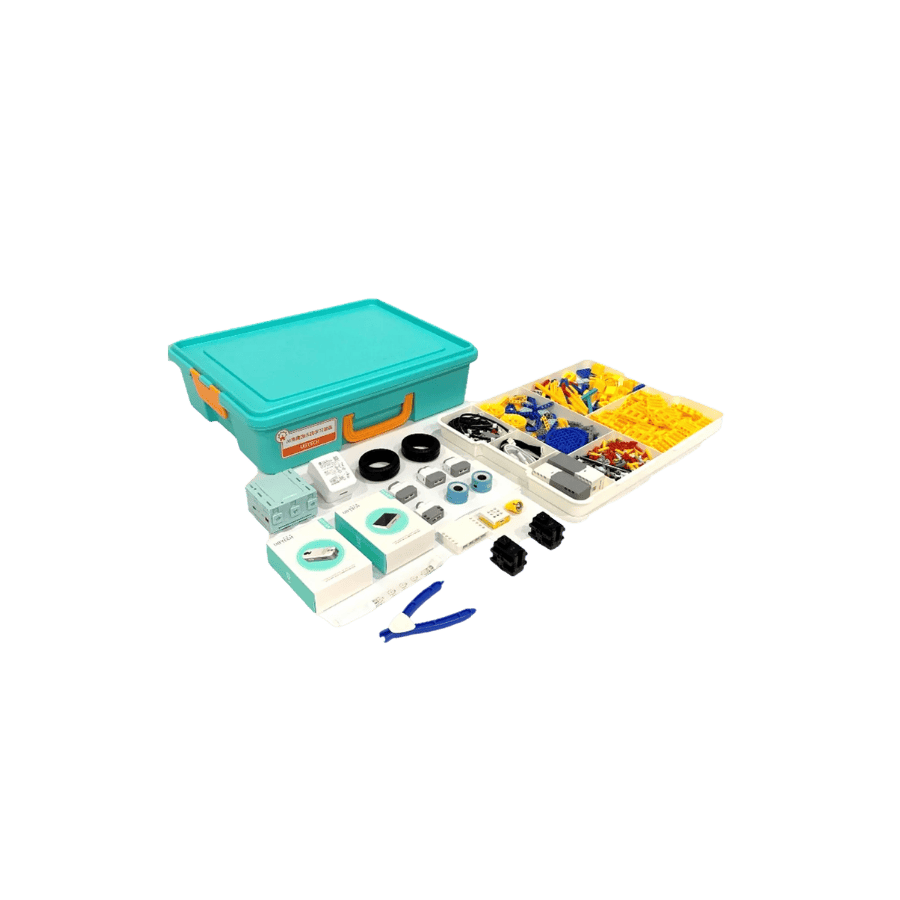
With uKit Explore, learners build complex robotic vehicles, gripper arms, or automated systems from hundreds of modular components, servo motors, and sensors. Supplemented by uKit AI, these models become a complete AI system: cameras, microphones, and an intelligent control board enable image, speech, and object recognition right in the classroom—ideal for practically connecting robotics, computer science, and artificial intelligence.

uKit Explore – Hardware for real STEM projects
The uKit Explore is aimed at middle and high school students as well as ambitious robotics clubs. Over 1,000 mechanical parts, multiple DC motors, a double-digit number of servos, and ultrasonic, infrared, and other sensors form the basis for realistic robot platforms. The assembly, wiring, and commissioning are modeled on professional robotic systems, making topics such as mechanics, electronics, and control directly tangible.

From Block Coding to Arduino & Python
Both uKit Explore and uKit AI use graphical block programming for first steps and subsequently open the path to text-based languages. Via uCode and compatible Arduino environments, learners can develop their own algorithms in C/C++ or Python, process sensor values, and programmatically control AI functions. This makes the kits suitable from the first contact with coding through to project-oriented STEM courses.

AI-powered perception and interaction
With its 8 MP camera, microphones, and speakers, Yanshee becomes a compact platform for AI projects in the classroom. Face recognition, object detection, voice control, or dialogue-based assistants can be tested directly on the robot. In this way, students experience computer vision, natural language processing, and human-robot interaction directly on a live system.

uKit (AI & Explore)
With uKit Explore and uKit AI, schools, learning labs, and makerspaces receive an integrated learning system that ranges from mechanical assembly to the application of AI algorithms. The uKit Explore provides robust components, servo motors, gears, and sensors for mobile robots, vehicles, or gripping systems. uKit AI supplements these models with an AI-enabled controller featuring a camera, microphone, and speaker, allowing object recognition, voice control, and intelligent decision-making to be performed directly on the robot. Teaching teams combine both kits flexibly: one course focuses on construction and electronics, another on programming, data acquisition, and training AI models—the underlying hardware remains identical and ensures a consistent learning path.

Key Features


Frequently Asked Questions
What are the application areas for the UBtech uKit AI?
The UBtech uKit AI is suitable for STEM instruction, robotics clubs, computer science classes, technology classes, vocational schools, university preparatory courses, makerspaces, learning labs, and project-based educational programs. Terra Robotics positions the UBtech uKit AI specifically for learning environments where robotics, mechanics, electronics, programming, and artificial intelligence are to be combined in a practical manner.
What is the UBtech uKit AI?
The UBtech uKit AI is a modular educational robot and AI construction kit from UBtech. The system enhances mechanical robot designs with an AI-enabled control unit featuring a camera, microphone, and speaker, allowing learners to test functions such as object recognition, facial recognition, voice control, and intelligent responses directly on a physical robot.
What is the difference between uKit Explore and uKit AI?
The uKit Explore is the mechanical robotics construction kit for design, drives, sensors, and control. It can be used to build robotic vehicles, gripper arms, conveyor systems, or interactive models. The uKit AI supplements this hardware with AI functions such as a camera, microphone, speaker, image processing, voice recognition, and intelligent decision-making logic. Together, uKit Explore and uKit AI form a comprehensive learning platform for robotics and artificial intelligence.
Why is the UBtech uKit AI interesting for schools and STEM education?
The UBtech uKit AI is interesting for schools and STEM education because learners experience the entire process practically, from mechanical construction and sensor technology to programming and AI application. Instead of just covering artificial intelligence theoretically, students can collect data, train models, test robot behavior, and see their results directly on the built model.
What programming options does the UBtech uKit AI offer?
The UBtech uKit AI supports getting started via graphical block programming using the uKit app and uCode. For advanced projects, the system can be used in Arduino-compatible development environments with C/C++ or Python, depending on the kit and learning objectives. This makes the educational robot suitable for both beginners and more demanding STEM, computer science, and robotics projects.
Which AI functions can be taught with the UBtech uKit AI?
With the UBtech uKit AI, key AI functions such as object recognition, facial recognition, voice control, image processing, voice interaction, and simple classification models can be taught. Learners can capture their own image or audio data, train models, and then test how the robot reacts to new inputs.
Which robot models and projects can be implemented with UBtech uKit AI?
With the UBtech uKit AI and matching uKit Explore components, you can build robotic vehicles, gripper arms, automated systems, conveyor models, interactive installations, and AI-driven robotics projects. This makes the system suitable for project weeks, elective courses, robotics competitions, open learning formats, and practical tasks in technology and computer science classes.
Which sensors and hardware are particularly important for the UBtech uKit AI?
The UBtech uKit AI is primarily defined by its modular robotics hardware, servo motors, DC motors, ultrasonic, infrared, tilt and color sensors, as well as its AI-enabled control board featuring a camera, microphone, and speaker. This combination enables projects involving movement, distance measurement, color recognition, object perception, voice control, and data-driven robot control.
Are there any teaching materials for the UBtech uKit AI?
Yes, lesson plans, sample projects, and step-by-step guides are available for UBtech uKit AI and uKit Explore. This allows teachers to structure individual double periods, project weeks, or multi-week STEM courses without having to develop all the content themselves.
Can the UBtech uKit AI be purchased, leased, or requested as a project solution from Terra Robotics?
The UBtech uKit AI can be requested by price from Terra Robotics and planned via a leasing inquiry. A project inquiry is particularly useful if schools, universities, makerspaces, or educational institutions wish to implement multiple kits, suitable add-ons, training concepts, teaching materials, or scalable STEM and AI education programs.
UBTECH uKit AI – Educational Robot for STEM, Coding & Artificial Intelligence
The UBTECH uKit AI is a modular learning platform for robotics, programming, and artificial intelligence. The system is aimed at schools, vocational schools, universities, student labs, and makerspaces that want to teach technical content not just theoretically, but by making it directly tangible through real hardware. Learners develop their own robot models, program movement sequences, process sensor data, and engage step-by-step with modern AI applications.
The connection with uKit Explore is particularly interesting. While uKit Explore focuses on construction, mechanics, drives, and sensor technology, uKit AI expands the platform with features related to camera, audio, and intelligent perception. This creates a continuous learning path from the first robot construction to projects in computer vision, speech interaction, and data-based control.
You can find further systems for practical technical education in the Educational Robots section.
Robotics construction kit for schools and STEM education
The biggest advantage of a modular learning robot is that students do not just work with a finished machine. They must first understand how mechanical components, motors, sensors, and controllers interact.
In combination with uKit Explore, various robot vehicles, gripping mechanisms, conveyor models, or custom technical constructions can be created. The Explore platform includes a wide selection of mechanical components, drives, and sensors, thereby creating the foundation for practice-oriented tasks in mechanics, electronics, and automation.
This makes the system suitable for classic STEM subjects as well as computer science classes, technology education, robotics clubs, and project weeks. Tasks can be structured incrementally: from simple motor operation and sensor queries to more complex automated sequences.
Understanding artificial intelligence in practice
With uKit AI, the learning focus can be expanded from classic robotics to AI education. An AI-capable control unit combines image processing with a microphone and speaker, enabling projects centered on perception and interaction.
For example, learners can investigate how a robot system detects objects or visual features and subsequently reacts to them. Speech and audio can also be integrated into relevant learning projects.
The crucial difference from purely theoretical AI instruction lies in the physical implementation: detected information leads to a real action by the robot. This makes the relationships between training data, perception, algorithms, and robot behavior much more intuitive.
Topics such as computer vision, classification, and human-robot interaction can thus be connected to a concrete technical system.
From block programming to text-based coding
To get started, the uKit platform offers graphical programming options via the uKit app or uCode. Movements, sensor queries, and other sequences can initially be assembled using visual programming blocks. This allows even learners without extensive programming experience to quickly develop their own functional processes.
As experience increases, the level of difficulty can rise. Depending on the kit used and the teaching concept, Arduino-compatible development environments and text-based programming with C/C++ or Python can also be incorporated.
This allows a learning environment to be used across multiple grade levels. Beginners start by working with logical sequences and simple sensors. Advanced users can develop their own functions, analyze sensor data, or program more complex control logic.
Sensor technology as a link between software and the real world
Robotics becomes particularly interesting as soon as a system can perceive its environment and react to it. Various sensors are available for this purpose within the uKit platform.
With suitable uKit Explore components, for example, ultrasonic, infrared, tilt, or color sensors can be used. Learners use these to examine distances, colors, movements, or states and then apply this data for their own programs.
This turns a simple programming project into a complete automation task: a sensor captures a state, the software processes the information, and motors or servos execute a corresponding reaction.
This basic logic is also found later in professional automation, mobile robots, and industrial robot systems.
Projects instead of pure theory
The UBTECH uKit AI is particularly suitable for project-oriented learning. Instead of just rebuilding fixed exercises, groups can develop their own assignments and test different solutions.
Possible projects range from autonomous vehicles and gripping mechanisms to interactive robots and AI-supported models. In combination with other components from the UBTECH uKit ecosystem, different scenarios and difficulty levels can be established.
In addition to uKit Explore, Terra Robotics carries other uKit and AI education kits in its range. This allows equipment to be expanded step by step.
This makes the platform attractive for schools that want to start with a few systems and build a larger robotics or AI lab later on.
UBTECH uKit AI for schools, vocational schools, and universities
Its use is not limited to a single type of school. In secondary education, uKit can be used for initial robotics, coding, and AI projects. Vocational schools can focus more on sensor technology, automation, construction, and programming.
University preparatory courses, student labs, and makerspaces can also use the platform for practice-oriented events. Its modularity allows for different tasks without having to immediately purchase a completely new robot platform for every new topic.
You can find more suitable application concepts in the School & University section.
Educational robotics as preparation for modern careers
Today, robotics combines mechanics, electronics, computer science, and artificial intelligence. It is exactly this combination that makes educational robots interesting for modern STEM education.
In a uKit project, learners must construct, program, analyze errors, and further develop solutions together. In addition to technical understanding, this also fosters structured problem-solving, project work, and teamwork.
At the same time, it creates initial points of contact with topics that will later play an important role in automation technology, mechatronics, software development, robotics, or AI.
Buy UBTECH uKit AI and scale educational concepts
Anyone looking to buy the UBTECH uKit AI should first consider which learning goals and age groups are to be covered. For foundations in construction and robotics, the mechanical assembly is more of a focus. For advanced courses, programming, sensor technology, and artificial intelligence can be weighted more heavily.
The number of learners, desired group sizes, existing IT infrastructure, and existing robotics offerings should also be taken into account during planning.
Terra Robotics supports schools, universities, and educational institutions in the selection of suitable UBTECH systems and the assembly of a scalable educational robotics solution.
The UBTECH uKit AI thus creates a practical link between robotics kits, STEM education, programming, and artificial intelligence. Learners not only experience how software works but also develop physical systems that perceive their surroundings and react to programmed or AI-based decisions.