


Humanoid robotics
Anthropomorphic finger movements and an opposable thumb enable versatile gripping patterns for humanoid robots, assistance systems, and human-like manipulation tasks.
Inspire


Switch between the tabs to view content.
Anthropomorphic finger movements and an opposable thumb enable versatile gripping patterns for humanoid robots, assistance systems, and human-like manipulation tasks.

Ideal for grasping strategies, machine learning, teleoperation, and sensor-based control. Selected models provide force or tactile information for practical robotics experiments.

For flexible pick-and-place, sorting, and assembly processes with changing components. The individually controllable fingers support precise alignment, insertion, and operation.

For mobile robots, remote-controlled systems, and assistance applications that must interact with a human-designed environment and manipulate various objects.

The human-like kinematics support research projects on prostheses, assistive systems, and biomechatronic gripping solutions with controllable finger movements.

For universities, research laboratories, and training centers for the practical teaching of robotics, mechatronics, programming, sensor technology, and gripping technology.
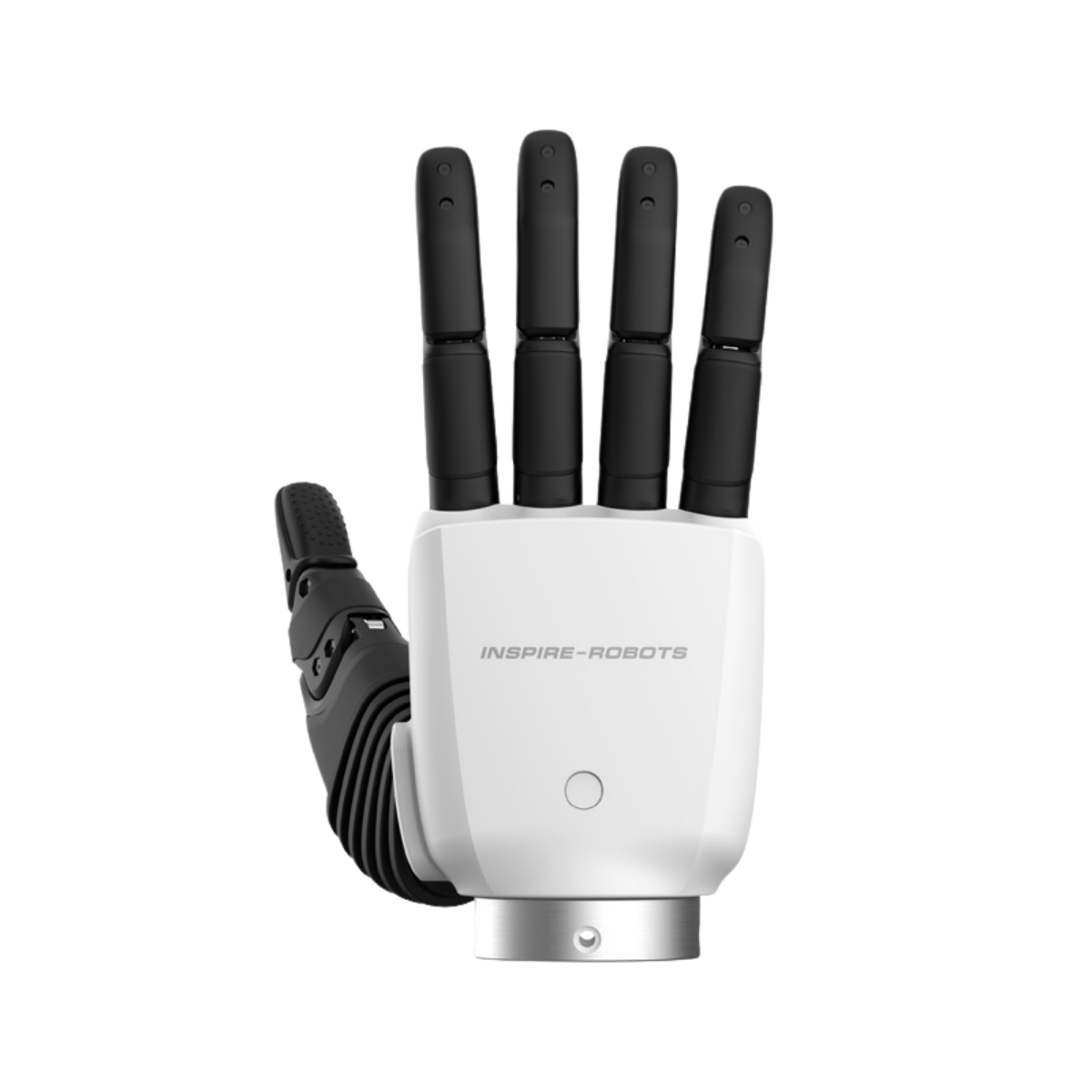
The Inspire RH56F1 series sets new standards for developers, research institutions, and industrial automation experts in the field of humanoid robotics. With its extremely robust all-metal skeleton, 6 degrees of freedom (DoF), and an impressive passive load capacity of up to 30 kg, this robotic hand handles even demanding manipulation tasks with ease. Thanks to EtherCAT and RS485 interfaces as well as a real-time communication rate of 1 kHz, the hand can be seamlessly integrated into modern control systems.
Advantage for Professionals: The Inspire RH56F1-E2 combines an immense passive load capacity of 30 kg with sensitive tactile sensing and reliable EtherCAT/RS485 communication. Thanks to various color and hand options (Left/Right, White/Black/Silver/Gray), developers receive a perfectly customizable high-end robotic hand for demanding robotics projects.
Terra Robotics
https://terra-robotics.de/
mail@terra-robotics.de
Zeißstraße 10,
32584 Löhne
Germany

Precise gripping
The dexterous INSPIRE robotic hands combine precise position control with force-controlled gripping. Depending on the model, integrated force and tactile sensors detect contact, pressure, and gripping behavior in real time. This allows delicate components, irregular objects, and everyday items to be picked up, held, rotated, and placed in a controlled manner. The RH56E2 extends these capabilities with 17 tactile sensors for highly differentiated contact information.

Anthropomorphic hand design
With five fingers, six degrees of freedom, and twelve motorized joints, INSPIRE robotic hands replicate the core movement patterns of a human hand. The opposable thumb and differentiated, controllable finger movements enable precise pincer, three-finger, and power grasps, as well as defined gestures. This creates a flexible foundation for humanoid robots, service robotics, teleoperation, and AI-supported manipulation tasks.

Suitable for the application
The various model series focus on specific areas: the RH5DG2 serves as a versatile platform for precise gripping tasks, the RH56E2 for tactile perception, the RH56DFX for more powerful manipulation, and the RH56BFX for fast gestures and dynamic finger movements. The RH56F1 complements the range with an especially robust all-metal skeleton for demanding research and automation projects.

Flexible system integration
INSPIRE robotic hands are designed for integration into humanoid platforms, robotic arms, research setups, and automated systems. Common communication interfaces facilitate control, while selected series support ROS and matching plug-ins. This makes the hands suitable for research and teaching as well as for industrial automation, service robotics, prosthetic development, and practical AI experiments.
A dexterous robotic hand is a human-like end effector with multiple movable fingers and an opposable thumb. Through combined position and force control, INSPIRE robotic hands can controllably grasp, hold, rotate, and place various objects. They are particularly suitable for humanoid robotics, research, automation, and demanding manipulation tasks.
The appropriate INSPIRE robotic hand is determined by gripping force, movement speed, sensor technology, and required dexterity. The RH5DG2 is suitable for particularly flexible and tactile gripping movements, the RH56E2 for sensitive contact and pressure sensing, the RH56DFX for powerful manipulation, the RH56BFX for fast gestures, and the RH56F1 for particularly robust robotics applications.
Depending on the model, INSPIRE robotic hands are suitable for humanoid robots, industrial automation, service robotics, research and development, universities, AI projects, teleoperation, and prosthetic research. Typical tasks include gripping tools and components, operating switches, and manipulating objects of various shapes.
Most INSPIRE robotic hands in the RH56 series feature six degrees of freedom and twelve movable joints. The RH5DG2 offers even greater mobility with 13 degrees of freedom and 18 joints. Which kinematics are appropriate depends on the required gripping patterns and the complexity of the application.
Tactile sensors detect touch and local pressure distributions directly on the fingers or palm. This allows the robotic hand to monitor contact with an object more precisely and execute gripping movements in a more controlled manner. Depending on the version, the RH56E2 is available with up to 17 tactile sensors for real-time tactile feedback.
With the appropriate sensors, gripping force, and programming, INSPIRE robotic hands can also grasp delicate or irregularly shaped objects in a controlled manner. The weight, surface, geometry, and stability of the object are decisive factors here. Models with force or tactile sensors are suitable for particularly sensitive applications.
Depending on the model, control is implemented via interfaces such as RS485, CAN, RS232, EtherCAT, or Modbus TCP. PC software, development routines, and, for suitable models, ROS support are available for development and commissioning. Before integration, the communication protocol and control system should be coordinated with each other.
Several INSPIRE model series are available as left and right robotic hands. This allows for the construction of both individual robotic arms and bimanual humanoid robot systems. When ordering, the model series, hand side, sensor variant, and required interface must be clearly specified.
INSPIRE robotic hands can be integrated into humanoid robots, cobots, research platforms, and custom robot arms. Beforehand, the mechanical connection, robot arm payload, supply voltage, communication interface, and available control software must be verified. Early technical coordination reduces integration effort.
Before purchasing a robotic hand, the gripping task, object weight, required gripping force, speed, agility, and sensor technology should be defined. In addition, the hand side, interface, operating voltage, mounting situation, and software integration must be considered. Terra Robotics provides support in selecting the appropriate INSPIRE robotic hand and the technical configuration for the planned robotics project.
INSPIRE robotic hands combine human-like agility with precise gripping technology for research, development, and industrial automation. As dexterous robotic hands, they feature five movable fingers, an opposable thumb, and, depending on the model, integrated force or tactile sensing. This allows them to not only pick up and put down objects, but also hold, rotate, align, and adapt to different shapes in a controlled manner. For companies, universities, and research institutions, this creates a versatile end-effector for humanoid robots, robotic arms, and custom experimental systems. Further information on the manufacturer, grippers, and actuators can be found on our INSPIRE ROBOTS manufacturer page.
The anthropomorphic design enables movement sequences that are difficult to implement with classic two-finger grippers. Depending on the model, six or thirteen degrees of freedom and twelve to eighteen joints are available. This allows for the execution of pincer grips, three-finger grips, enclosing grips, and differentiated finger positions. A five-fingered robotic hand can offer advantages, especially with changing object shapes, small components, or operating tasks on existing infrastructure. Their use is therefore not limited to humanoid systems: dexterous hands can also be a flexible alternative to rigid grippers in laboratory setups, teleoperation solutions, prototypes, and special end-of-arm applications.
The model series focus on specific priorities. The RH5DG2 offers particularly high mobility with thirteen degrees of freedom and eighteen joints. The RH56E2 focuses on real-time tactile perception and can detect local pressure information on the hand. The RH56DFX combines a compact, human-like design with force sensing and is suitable for controlled manipulation tasks. The RH56BFX was developed for fast gestures and dynamic finger movements. The RH56F1 complements the range with a robust all-metal skeleton, EtherCAT and RS485 connectivity, and optional tactile sensing. This allows the product selection to be specifically aligned with mobility, speed, gripping force, sensor technology, and communication interface.
For sensitive, smooth, or irregularly shaped objects, simple position control is often insufficient. Models with force or tactile sensors can detect contact and pressure during the gripping process and provide it for finer control. The RH56E2 uses integrated tactile sensors for this, while other versions offer force sensors or optional T1 tactile sensors depending on the model. This supports tasks where an object needs to be held securely without applying unnecessarily high pressure. Typical examples include the handling of sensitive components, picking up laboratory vessels, aligning small workpieces, or investigating learning-based gripping strategies in AI and robotics projects.
In industrial automation, dexterous robotic hands can be particularly interesting where frequently changing components, different gripping positions, or human-like operating actions occur. These include pick and place, kitting, sorting, reorienting, inserting into fixtures, as well as operating buttons, switches, or knobs. Picking up tools, transferring components between stations, and positioning small workpieces are also possible fields of application.
For standardized high-speed processes, a specialized gripper often remains the more efficient solution. For varied tasks, flexible pilot cells, or existing workplaces, however, an anthropomorphic robotic hand can create more operational leeway. Practical information on such applications can be found on our page on robots for assembly and handling.
A five-fingered robotic hand is particularly interesting when a system needs to master not just a single standardized component, but various objects and interactions. Thanks to the individually controllable fingers, grip patterns can be adapted to the shape, size, and position of the object. This is relevant, for example, for small series, changing research setups, service tasks, or work in an environment designed for humans.
When considering economic efficiency, however, complexity and flexibility should be weighed against each other. A parallel gripper is often easier to integrate for a stable, consistent process. A dexterous robotic hand offers its advantages primarily when multiple grip types, object variants, or operating actions are to be covered with a single end-effector.
For research, education, and AI development, five-fingered robotic hands offer a practical platform for investigating motion planning, gripping strategies, teleoperation, and sensor-based control. Learning systems can test different object shapes, contact points, and grip sequences, while students can understand the interaction between mechanics, sensors, control, and software.
The choice of different hand models is also relevant for demonstrators and prototypes. Depending on the research question, the focus can be on high mobility, tactile feedback, fast finger movement, or mechanical robustness. This allows experimental setups to be more specifically tailored to the respective application and gradually expanded with additional sensors, camera systems, or AI-based controls.
Before purchasing a robotic hand, mechanical, electrical, and software requirements must be considered together. The available mounting surface, the permissible weight on the robot arm, the power supply, the desired hand side, and the communication interface are decisive. Depending on the INSPIRE model, RS485, CAN, Modbus TCP, or EtherCAT are available, among others. For two-handed robot systems, various series are available as left and right versions.
The control architecture is also important: Should the hand merely execute defined grip positions, report back force values, or become part of a learning manipulation pipeline? An overview of suitable platforms, application areas, and selection criteria is provided on our topic page on humanoid robots.
Anyone wanting to buy a robotic hand or integrate it into an existing system should first define the specific use case. What objects are being gripped? How heavy, sensitive, or variable are they? Which grip types are required, and what cycle time is realistic? Equally relevant are repeatability, fingertip force, speed, sensors, interface, and available software.
For research and education, mobility, data access, and programmability may be in the foreground. In industrial projects, robustness, reproducible processes, spare parts strategy, and integration effort gain importance. A clearly defined proof of concept reduces risks and shows at an early stage whether mechanics, perception, and gripping strategy work together reliably.
Terra Robotics provides support in selecting a suitable INSPIRE robotic hand and in technically classifying the available models. Together, the gripping task, object geometry, required force, mobility, sensors, hand side, and system integration are evaluated. For complex projects, a step-by-step approach is recommended: first check requirements and interfaces, then carry out a realistic gripping test or proof of concept, and only then scale the integration.
This creates not an isolated component, but a robotic solution that fits the application and the existing system. For an individual assessment, you can describe your project directly via our contact form for robotics projects.