Skip to product information
1 of 1

SKU: 53141

Dobot

Dobot CRAF Series

Dobot CRAF Series

RRP
Regular price €17.600,00 EUR
Regular price €17.600,00 EUR Sale price €17.600,00 EUR
Sale Sold out

excl. VAT

Leasing enquiry

Company details

Contact person

View full details

Pricing Models

Select the appropriate model

Compare options clearly, quickly, and without the fine print. Our recommendation is highlighted.

Leasing

Price on request

Flexible financing

Inclusive

  • Implementation consulting
  • Flexible terms available
  • Personalized leasing consultation
  • Liquidity is maintained
  • Including technical support
  • Maintenance contract available as an add-on
  • Training for your team
  • On-site installation available
  • Predictable monthly installments
  • Minimum contract period 3 years
Our recommendation

Purchase

€17.600

Lowest price

Inclusive

  • Implementation consulting
  • Personal contact person
  • Robot becomes your property
  • Technical support available
  • Staff training
  • Maintenance contract available as an add-on
  • Manufacturer's warranty
  • Short delivery times

Project Request

Price on request

Flexible terms

Inclusive

  • Implementation consulting
  • Full service mandatory
  • Personal consultation included
  • Flexible Payment Models
  • Technical support available
  • Planning security for projects
  • On-site staff training
  • Short delivery times
  • Efficiency increase
  • Scalable

ㅤ

Product details

Switch between the tabs to view content.

Areas of application
DOBOT CRAF cobot performing force-controlled insertion of a precision component

Precision Assembly & Joining

The integrated 6-axis force-torque sensor system detects contacts and component tolerances for controlled insertion, plugging, pressing, and alignment.

DOBOT CRAF robotic arm during force-controlled polishing of a metal surface

Grinding & Polishing

An automatically regulated contact pressure supports uniform surfaces when grinding, polishing, deburring, and processing complex contours.

DOBOT CRAF cobot during intuitive welding path programming

Welding & Web Guiding

Smooth drag-to-teach functionality and lockable tool orientation simplify the programming of precise welding, gluing, and dispensing paths.

Smooth drag-to-teach functionality and lockable tool orientation simplify the programming of precise welding, gluing, and dispensing paths.

Machine loading

Force-controlled search and insertion movements compensate for positional and component deviations when loading, clamping, and removing workpieces.

DOBOT CRAF robotic arm applying adhesive precisely to a component

Bonding & Dispensing

The cobot guides tools along defined contours and can react to surface deviations – for reproducible gluing and dispensing processes.

DOBOT CRAF cobot performing a delicate collaborative handling task

Sensitive handling

High-resolution force sensing supports careful gripping, inspection, and handling of sensitive components, as well as safe collaborative workflows.

Force control directly at the tool flange

Integrated 6-axis force-torque sensor system

The DOBOT CRAF series integrates a high-precision 6-axis force-torque sensor directly into the robot flange. The cobot detects forces and torques from multiple directions and can adapt its movement to contact, component tolerances, and surface deviations. This allows sensitive assembly, insertion, and machining processes to be implemented without an additionally mounted external force sensor.

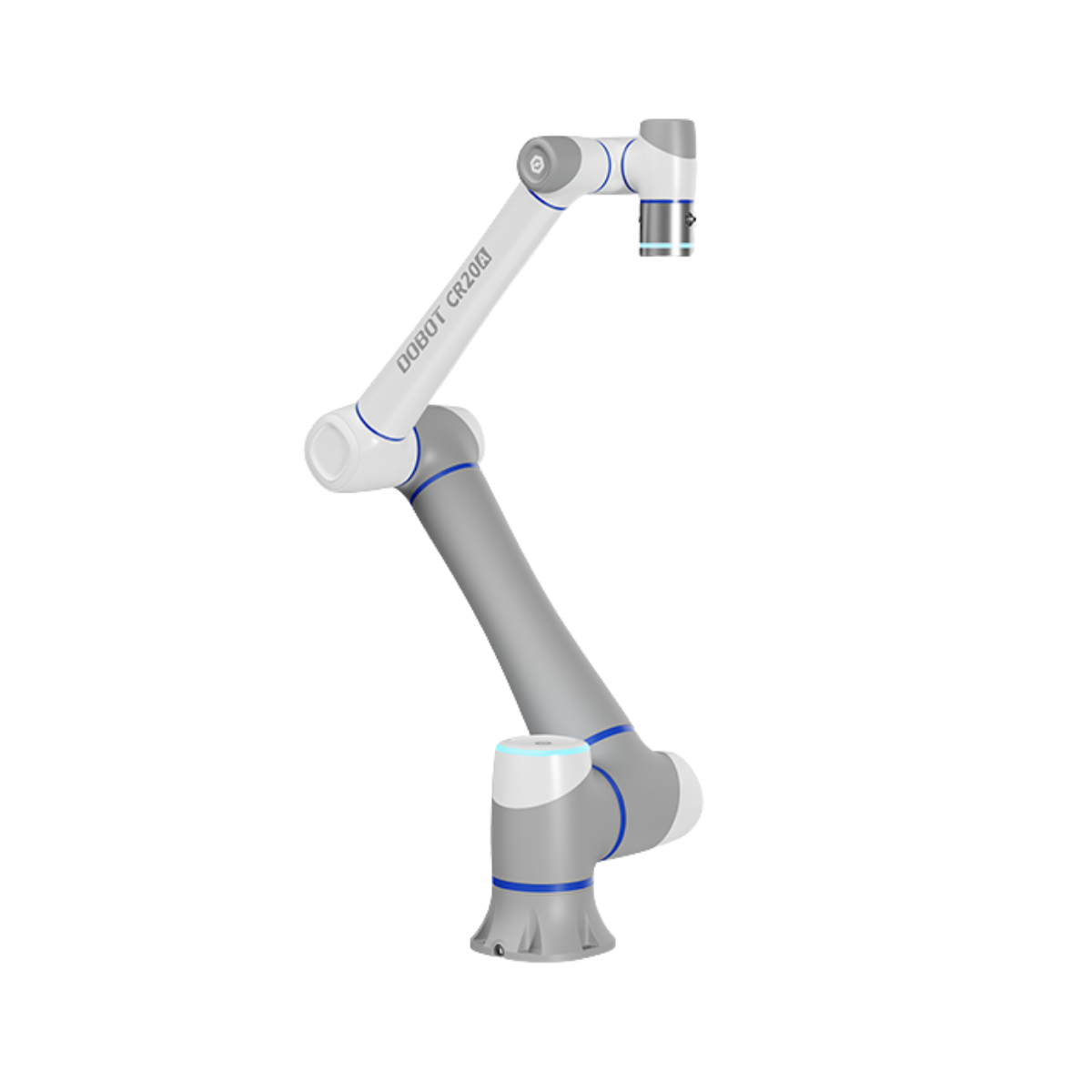
CR5AF · CR10AF · CR20AF

Three models for different load and range requirements

The CRAF series includes the CR5AF with a 5 kg payload and 900 mm reach, the CR10AF with 10 kg and 1,300 mm, as well as the CR20AF with 20 kg and 1,700 mm. Depending on the model, repeat accuracy ranges from ±0.02 to ±0.05 mm. This allows the force-controlled platform to be precisely adapted to workpiece weight, tools, and the required workspace.

Micro-force-sensitive drag-to-teach

Intuitive programming of complex motion paths

The entire flange acts as a sensitive drag zone, allowing for particularly smooth manual guidance of the robot arm. With an activation force of less than 2 N, positions and paths can be taught with great sensitivity. The lockable tool orientation simplifies the teaching of defined welding, grinding, or dispensing paths without having to laboriously program each point individually.

Plug-and-play force control

Full tool connectivity despite integrated sensors

The integrated force sensor system occupies neither the RS485 nor the I/O ports at the tool end. Electric grippers, camera systems, and other end effectors can therefore still be connected directly. An annular status light and a flange button facilitate operation and status monitoring. DobotStudio Pro supports graphical programming, drag-to-teach, and LUA scripting for customized automation processes.

Frequently Asked Questions

What is the DOBOT CRAF series?

The DOBOT CRAF series consists of 6-axis collaborative robot arms with integrated force-torque sensing at the tool flange. These cobots can detect contact, process forces, and surface irregularities and adjust their movements accordingly. This makes them particularly suitable for precision assembly, joining processes, grinding, polishing, and other force-controlled applications.

Which models belong to the DOBOT CRAF series?

The series includes the CR5AF with a 5 kg payload and 900 mm reach, the CR10AF with 10 kg and 1,300 mm, and the CR20AF with a 20 kg payload and 1,700 mm operating radius. The appropriate model depends on workpiece weight, end effector, process forces, and the required working range.

What distinguishes the CRAF series from the DOBOT CRA series?

CRAF models are based on the CRA platform but additionally feature a factory-integrated high-precision 6-axis force-torque sensor on the flange. This allows them to perform force-controlled and compliant movements directly, without the need to mount and wire a separate external force sensor.

What are the advantages of a cobot with force control?

A force-controlled cobot can detect when a tool or component touches a surface and how much pressure is applied. This allows for the compensation of tolerances, the maintenance of constant contact forces, and the more controlled handling of sensitive components. This improves process stability in assembly, joining, and surface finishing tasks.

Is the DOBOT CRAF series suitable for grinding and polishing?

Yes. The integrated force control can automatically adjust a defined contact force and compensate for surface deviations. This makes CRAF robots suitable for grinding, polishing, and deburring tasks on flat or complex-shaped components. The tool, abrasive material, and target force must be matched to the process.

DOBOT CRAF Series: Force-controlled cobots for precise automation

DOBOT CRAF Series with integrated force-torque sensing

The DOBOT CRAF series combines the proven CRA cobot platform with a high-precision 6-axis force-torque sensor directly at the tool flange. While conventional robots perform movements primarily based on programmed positions, the CRAF models can additionally detect mechanical contacts, forces, and torques. As a result, they react in a controlled manner to component tolerances, surface deviations, and process resistance. This opens up new possibilities for precision assembly, joining, grinding, polishing, deburring, gluing, and other demanding automation tasks.

Three CRAF models for 5 to 20 kg payload

The series comprises three coordinated models. The DOBOT CR5AF offers a 5 kg payload, a 900 mm working radius, and a repeatability of ±0.02 mm. The CR10AF extends the working range to 1,300 mm and moves up to 10 kg with a repeatability of ±0.03 mm. For larger workpieces and tools, the CR20AF is available with a 20 kg payload, 1,700 mm reach, and ±0.05 mm repeatability.

The CRAF series thus covers both compact precision workstations and large-scale handling and processing operations. However, the payload always includes the workpiece, gripper, adapter, and other attachments. Model selection should therefore not be based solely on part weight, but also take into account the tool center of gravity, process force, and movement dynamics.

Force control for precision assembly and joining processes

In a classic position-controlled insertion process, even small deviations between the component and the fixture can lead to tilting or process aborts. The CRAF series can detect the initial contact and subsequently react with defined compliance. Search movements, controlled insertion, and force-dependent joining can thus be designed more robustly.

Possible applications include plug connections, component alignment, press-fit processes, and the assembly of parts with tolerances. The actual suitable force strategy depends on the geometry, material, permissible load, and required cycle time. Further solutions for flexible manufacturing processes can be found on our assembly and handling page.

Constant contact pressure for grinding and polishing

Surface processing places high demands on robots and tools. Fluctuating component heights or curved contours can cause a position-controlled robot to exert too little or too much pressure. The CRAF series detects the occurring contact force and can automatically adjust to a specified contact pressure.

This supports uniform results during grinding, polishing, and deburring. At the same time, the cobot can adapt its movement to minor surface deviations. For a stable process, the tool, abrasive, rotation speed, path velocity, and target force must be coordinated. A real-world processing test therefore remains an important part of project planning.

Intuitive drag-to-teach for complex process paths

Another advantage of the CRAF robots is the highly sensitive manual teaching. The entire flange can be used as an active drag zone. With a required breakaway force of less than 2 N, the robot can be easily guided to positions or along desired process paths. The tool orientation can be fixed so that, for example, a welding torch, dispensing head, or polishing tool remains in a defined alignment.

These functions reduce programming effort for spatially complex contours. After manual teaching, points, speeds, and process parameters can be further optimized in DobotStudio Pro. Graphical programming and LUA scripting are also available for individual sequences.

Tool connections remain fully usable

The force-torque sensor is structurally integrated into the flange and does not occupy the RS485 communication or the existing tool I/O connections. This allows electrical grippers, camera systems, and other end effectors to continue to be connected directly. This reduces the need for additional adapters, external cabling, and potential interference contours between the robot and tool.

Which component is suitable depends on the model, payload, required supply, and software support. You can find suitable grippers, vision systems, and other components in our DOBOT accessories section.

Use in machine tending, gluing, and handling

In addition to sensitive assembly and processing tasks, the CRAF series is also suitable for classic industrial processes. When loading and unloading machines, the robot can pick up workpieces, position them in clamping devices, and detect occurring contacts. For gluing or dispensing, the combined position and force control supports tracking along defined surfaces.

For pick-and-place, material transport, or bin picking, the CRAF series remains a fully-fledged 6-axis cobot. The force sensor technology complements these applications but does not replace the correct selection of gripper, camera system, and fixture. Further solutions for production and logistics can be found in the Industry section.

Correctly assessing collaborative safety

According to DOBOT, the integrated sensor system enables force-based collision detection with a sensitivity of up to 1 N. Unexpected contacts can thus be detected early and occurring collision forces reduced. This facilitates flexible work concepts and supports human-robot collaboration.

However, an integrated force sensor does not automatically make an application safe. Sharp-edged workpieces, rotating tools, high speeds, or hot processes may still require protective zones, scanners, or enclosures. Before commissioning, the robot, tool, workpiece, and the entire working environment must therefore be assessed together.

Purchasing and integrating the DOBOT CRAF series

Terra Robotics provides support in choosing between the CR5AF, CR10AF, and CR20AF, as well as in the design of force control, end effectors, workspace, and interfaces. A proof of concept with real components shows whether target force, process quality, and cycle time are reliably achieved. Subsequently, the solution can be integrated step-by-step into the existing production facility.

You can find further DOBOT cobots and automation solutions on our DOBOT manufacturer page. For a concrete feasibility check, you can describe your process via the contact form for robotics projects.