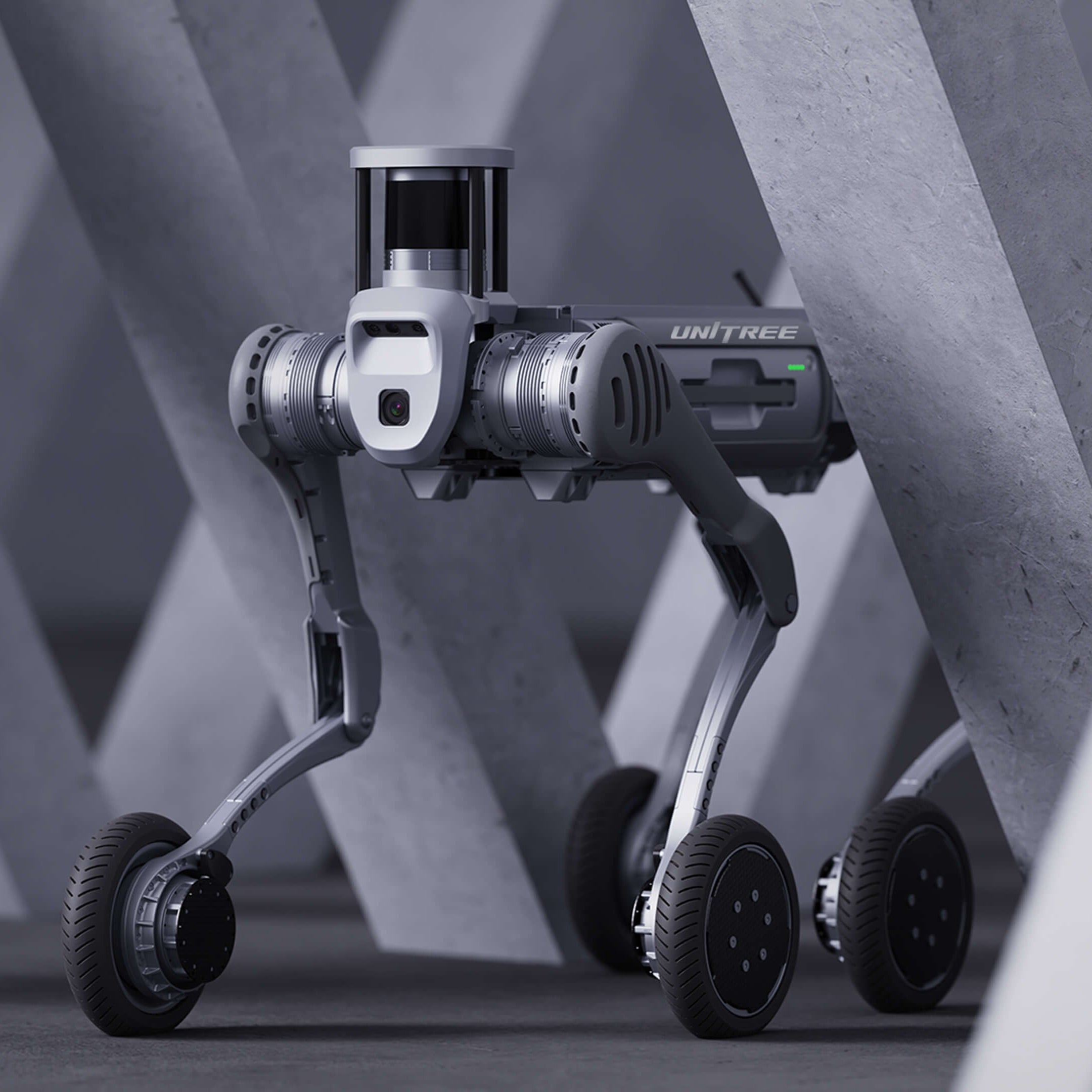
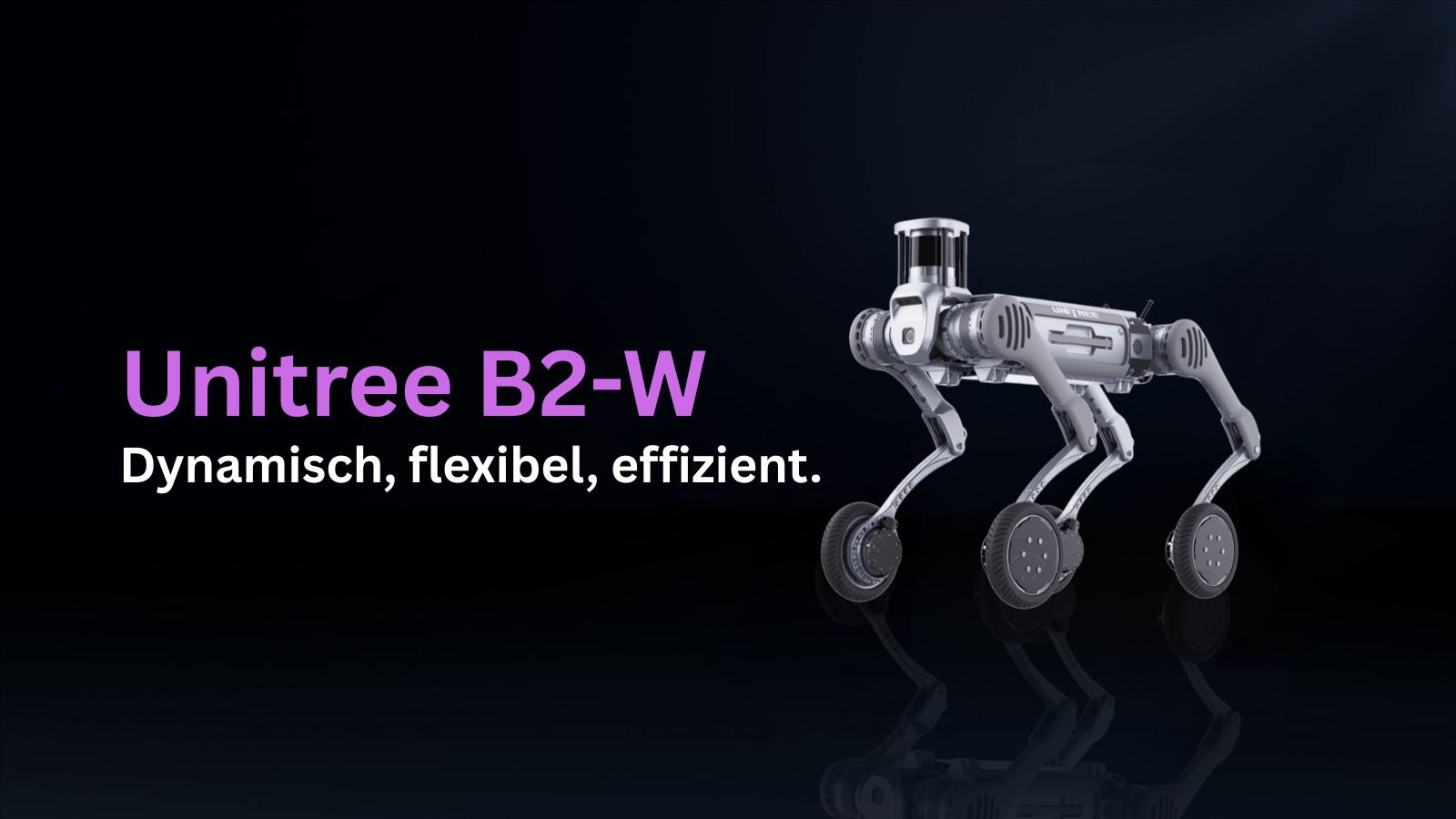
The Unitree B2-W robot dog is a highly sophisticated industrial quadruped robot with a wheel-leg hybrid drive for companies, research institutions, and organizations looking to deploy mobile robotics in demanding environments. It combines the all-terrain capabilities of a four-legged walking robot with the efficiency and speed of a wheeled mobile robot. This makes the B2-W particularly suitable for inspections, security patrols, infrastructure monitoring, research, development, mapping, logistics surveillance, energy facilities, industrial areas, construction sites, and difficult-to-access terrain.
Unlike traditional robot dogs, the Unitree B2-W does not just move on legs but also uses wheels on its feet. This hybrid structure allows for fast and energy-efficient movement on flat surfaces as well as precise control on uneven terrain. On paved paths, warehouse floors, or factory roads, the robot can roll to cover longer distances more efficiently. In more complex environments, it can utilize its leg mechanics to navigate obstacles, inclines, stairs, or irregular surfaces with greater control.
This makes the Unitree B2-W not just a simple demonstration platform, but a professional industrial quadruped for real-world scenarios. It was developed for applications where traditional wheeled robots reach their limits and purely walking robots are less efficient over longer distances. It is precisely this combination that makes it particularly attractive to companies that want to regularly inspect, document, or automatically traverse large areas, changing surfaces, or hard-to-reach areas.
Why the Unitree B2-W is a compelling choice for industry and research
Many companies face the challenge of regularly monitoring large or difficult-to-access areas. These include energy facilities, industrial sites, outdoor warehouse areas, construction sites, tunnels, factory grounds, technical facilities, infrastructure corridors, or security zones. Manual inspections are time-consuming, physically demanding, and, depending on the environment, involve risks. Classic mobile robots often fail to perform reliably on uneven terrain, stairs, gravel, ramps, or obstacles.
The Unitree B2-W addresses exactly these issues. It combines high mobility, a robust design, and long range with an open, developer-friendly platform. Companies can deploy the robot for inspection routes, as a sensor carrier, for mobile data acquisition, mapping projects, or autonomous patrols. Research teams can use it for motion algorithms, navigation, AI applications, sensor fusion, or field tests.
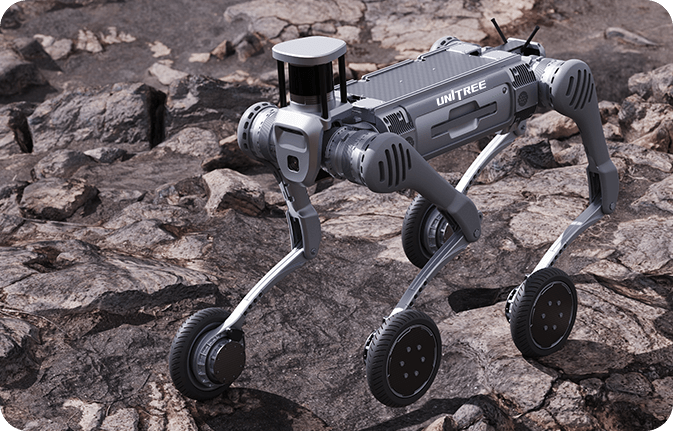
The greatest advantage lies in the combination of efficiency and terrain capability. The wheel mode allows for rapid movement over longer distances. The leg architecture ensures that the robot is not limited to perfectly flat surfaces. As a result, the B2-W can be used in scenarios where various surfaces are encountered within the same mission: asphalt, concrete, gravel, grass, ramps, stairs, industrial floors, or uneven ground.
Wheel-leg hybrid drive for maximum mobility
The core feature of the Unitree B2-W is its wheel-leg hybrid drive. Each leg is equipped with a wheel, allowing the robot to roll efficiently or work in a controlled manner via its leg mechanics depending on the environment. On flat surfaces, the wheel mode enables high speed and energy-efficient movement. On more complex terrain, the leg mechanism provides support for stability, balance, and obstacle traversal.
This combination is particularly valuable for industrial areas. Many locations do not consist of a uniform ground profile. A robot might need to drive through a hall, roll over a factory road, traverse a ramp, and then maneuver in a controlled manner on uneven ground. The B2-W is designed exactly for such mixed environments.
The wheels have a diameter of approximately 225 mm and are designed for dynamic movements. In combination with the powerful joints, this results in a platform that can support both fast long-distance travel and precise maneuvers. For operators, this means the robot can efficiently cover ground in suitable areas while simultaneously managing complex passages in a controlled way.
Speed, range, and endurance for long missions
The Unitree B2-W is designed for high mobility and long mission distances. Under specific configurations, the robot reaches a maximum speed of up to 15 km/h. The maximum range is up to 25 km with a 40 kg load and approximately 30 km without a load. These figures demonstrate the system's potential for long inspection routes, patrol runs, or expansive industrial sites.
For practical planning, it is important to note: Such values always depend on configuration, terrain, load, speed, environment, temperature, driving profile, and safety limitations. In real-world projects, the robot is often not operated at maximum speed continuously. Instead, speed, range, and driving behavior are adapted to the safety concept, terrain, sensor technology, and specific tasks.
For companies with large areas, the range is a key factor. Factory grounds, energy facilities, logistics sites, or outdoor areas can require long distances to be covered. The B2-W can be a powerful platform here to automate recurring inspection trips or enable data acquisition over larger distances. This requires clean route planning, suitable communication, defined safety zones, and a clear deployment strategy.
High payload for sensors, accessories, and industrial applications
The Unitree B2-W offers high payload capacity for professional applications. When walking, it can carry loads of over 40 kg; significantly higher static loads are possible when standing. This makes it a suitable mobile platform for sensors, cameras, LiDAR systems, measuring instruments, edge computing units, or project-specific attachments.
For industrial inspections, this load capacity is particularly relevant. The robot can be equipped with thermal imaging cameras, 3D LiDAR, gas cameras, optical cameras, communication modules, or other sensors, provided they are technically and mechanically integrated appropriately. This allows the B2-W to be adapted to various tasks: facility monitoring, thermography, security patrols, mapping, object control, research, or mobile data acquisition.
The specific payload should always be planned on a project-specific basis. Weight, center of gravity, mounting, power supply, cable management, and sensor protection influence stability, battery life, and operational behavior. For professional projects, we therefore recommend clean technical integration rather than improvised attachments.
Robust design with IP67 protection class
The Unitree B2-W is developed for demanding operating conditions. Its construction is designed for industrial and near-outdoor scenarios. The IP67 protection class supports use in dusty and humid environments. Additionally, the robot is designed for a wide temperature range of approximately −20 °C to +55 °C. This makes it suitable for environments where simple indoor robots cannot be deployed reliably.
Typical areas of application include construction sites, energy facilities, outdoor logistics areas, industrial sites, tunnels, technical facilities, factory grounds, or research test fields. Dust, humidity, temperature fluctuations, uneven ground, or changing light conditions can occur in such places. The B2-W provides the mechanical and technical foundation to better cover these deployment profiles.
Despite its robust design, deployment should not be considered risk-free across the board. Heavy rain, extreme contamination, chemical exposure, deep mud, unstable ground, or hazardous facility areas must be assessed separately. For professional applications, operational limits, maintenance, cleaning, and safety requirements should be clearly defined.
Stairs, inclines, and rough terrain
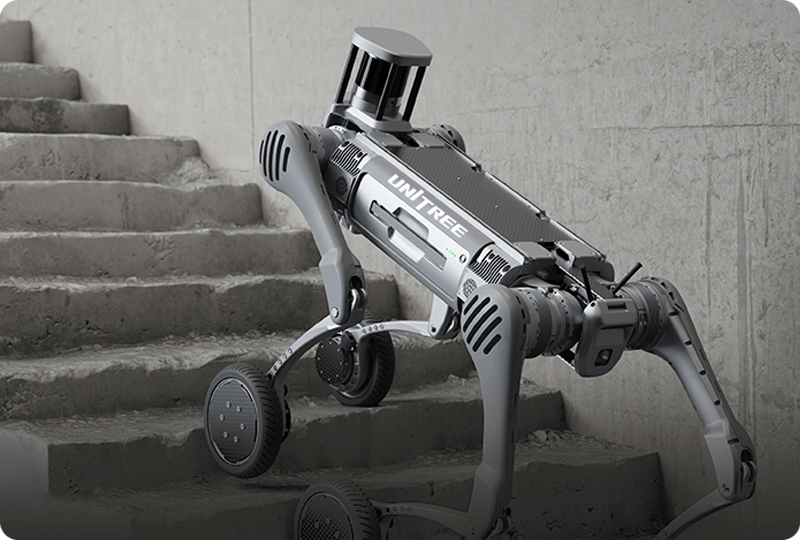
An important advantage of the Unitree B2-W is its ability to overcome different terrain structures. It can master stairs, inclines, barricades, and various ground types, provided the conditions are within the technical operating limits. The platform is designed to support movement on grass, stone, gravel, ramps, and rougher surfaces.
The robot can continuously handle stairs in the range of approximately 20 to 25 cm and overcome steps or obstacles up to approximately 40 cm in the forward direction. Inclines of more than 45° are also stated as a capability by the manufacturer. In practice, such values should always be checked with regard to safety, ground surface, load, weather, and the actual environment.
This all-terrain capability is particularly valuable for inspection and security applications. A robot that only functions on flat surfaces is too limited for many industrial and outdoor areas. The B2-W, by contrast, can also be deployed where paths are not fully standardized. This is precisely what makes it interesting for infrastructure, energy, construction, research, and demanding mobile robotics projects.
Sensor technology, 3D LiDAR, and autonomous navigation
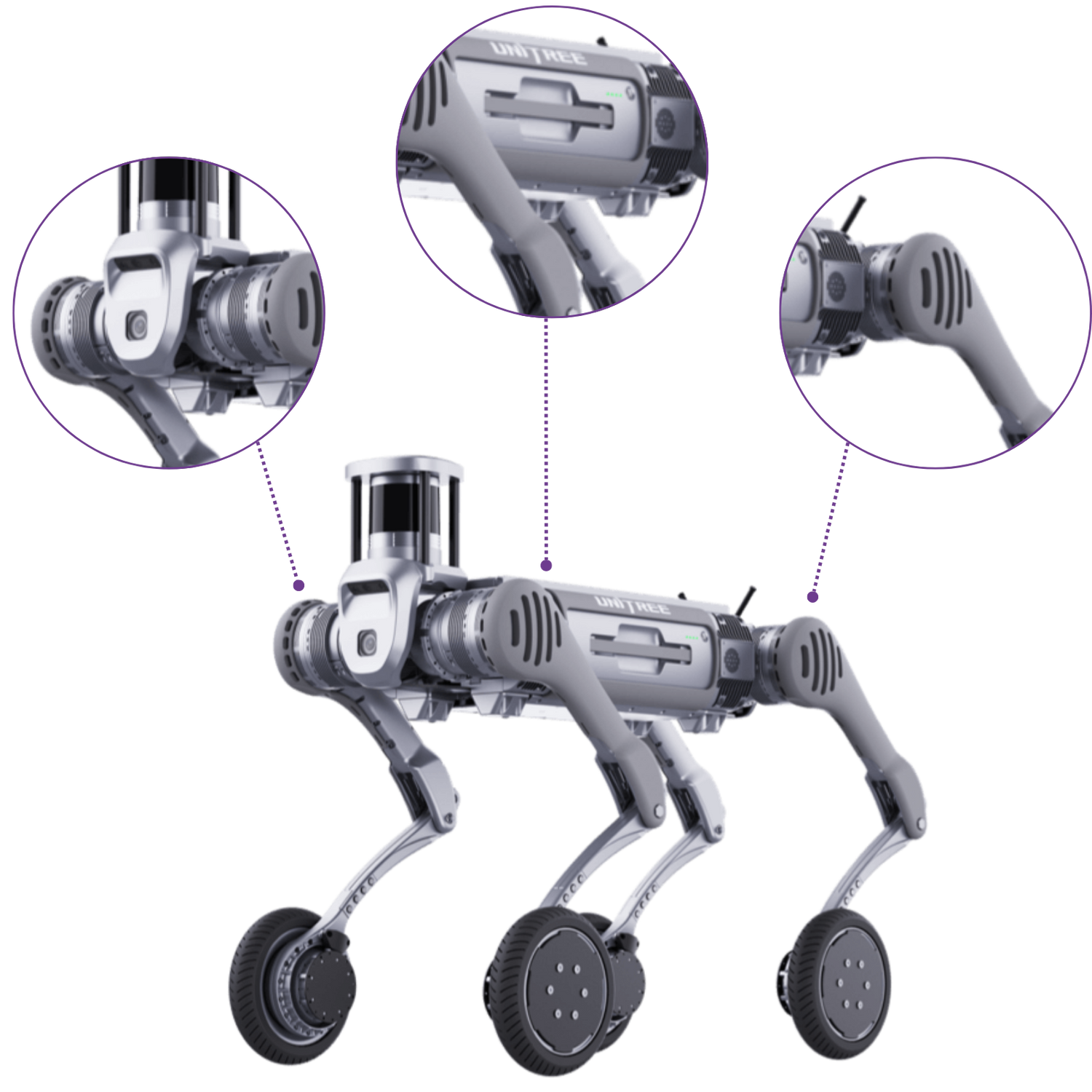
The Unitree B2-W can be equipped with 3D LiDAR, depth cameras, and IMU sensor fusion. This sensor suite supports orientation, obstacle detection, mapping, and autonomous navigation. In the variant with 32-line LiDAR, the robot can capture particularly detailed 3D environmental data, which is relevant for mapping, inspection, and autonomous navigation in complex environments.
For companies, this is especially important if the robot is to be used not just by remote control, but as a mobile data platform. During inspections, sensor data can be collected, environments documented, and recurring routes analyzed. In research and development, custom algorithms for perception, localization, path planning, or object recognition can be tested.
However, autonomy should be viewed realistically. Many advanced functions depend on configuration, software, sensors, environment, and potentially additional development. Not every autonomous application is fully available out of the box. For professional projects, requirements, level of autonomy, safety concept, and integration should be clearly defined in advance.
Edge computing, ROS, and development platform
The Unitree B2-W is not just a finished robot dog, but also an open development platform for demanding robotics projects. As standard, the platform can work with Intel computing units; optionally, more powerful configurations with Jetson Orin NX for AI and edge computing applications are available. This makes the B2-W particularly interesting for research, industrial development, universities, automation projects, and AI applications.
Through support for modern development environments and ROS-based workflows, the robot can be integrated into custom software projects. Research teams can develop algorithms for navigation, mapping, sensor fusion, autonomous inspection, motion control, or human-robot interaction. Companies can build project-related applications, for example, for data acquisition, monitoring, route planning, or the integration of external sensors.
This openness is a significant advantage, but it also carries responsibility. Anyone using the B2-W as a development platform should have the corresponding technical competence. Custom extensions must be implemented cleanly in terms of mechanics, electronics, and software. Especially in the case of autonomous deployments in real-world environments, tests, safety concepts, and clear operational limits are indispensable.
Fields of application: inspection, security, construction, energy, and research
Construction sites and infrastructure monitoring
On construction sites, the Unitree B2-W can be used for documentation, walkthroughs, and data acquisition. It can handle uneven paths, changing ground surfaces, and larger areas, making it suitable for monitoring construction progress, site surveying, and recurring inspection routes.
Energy facilities and technical infrastructure
In energy facilities, substations, power plants, or technical operational areas, the robot can support inspection routes. With suitable sensor technology, visual data, thermal images, or environmental information can be collected. This can relieve staff of recurring walkthrough tasks.
Factory grounds and security patrols
On large factory grounds, the B2-W can be used for patrols, visual checks, or mobile surveillance. Especially on long paths, outdoor areas, or difficult-to-access zones, it can help make regular rounds more structured and better documented.
Outdoor logistics areas and logistics monitoring
In logistics and warehouse environments, the robot can monitor outdoor areas, access roads, storage spaces, or difficult-to-access zones. The combination of wheels, legs, and long range makes it particularly interesting for expansive locations.
Tunnels, special inspections, and critical infrastructure
Tunnels, underpasses, piping systems, or special technical areas place high demands on mobility, sensors, and operational safety. The Unitree B2-W can serve as a mobile platform for exploration, documentation, or inspection here, provided the environment and safety concept are suitable.
Research, development, and education
For universities, research institutions, and development departments, the B2-W is a powerful platform for mobile robotics. It is suitable for projects involving autonomous navigation, AI, sensor fusion, motion control, mapping, edge computing, and all-terrain mobility.
Safety, operation, and responsible use
The Unitree B2-W is a powerful mobile robot platform. Precisely for this reason, responsible operation is crucial. Before deployment, areas, routes, pedestrian traffic, emergency procedures, communication links, safety zones, and operational limits should be precisely defined. Particularly with high speeds, heavy payloads, or autonomous functions, careful planning is essential.
The robot should only be operated by trained personnel. Staff must know how to start, stop, charge, transport, maintain, and secure the B2-W in an emergency. The use of sensors, cameras, or data transmission should also be planned in compliance with data protection and security regulations.
For public or semi-public areas, additional requirements apply. There, persons, vehicles, animals, obstacles, and unforeseeable situations must be given special consideration. The B2-W can be a strong platform for inspection and automation, but it should always be operated within the framework of a professional safety and deployment concept.
Economic efficiency and project assessment
The economic efficiency of the Unitree B2-W does not arise from a single key figure, but from the specific use case. The robot is particularly useful where regular inspections, long distances, difficult terrain, safety risks, or high documentation requirements exist. If staff have to cover long distances daily or check hazardous areas, a mobile robot platform can be strategically valuable.
For a sound assessment, companies should check which routes are inspected regularly, how often inspections take place, what data is to be collected, what risks exist for staff, and which sensors are required. Integration, maintenance, training, communication infrastructure, and software development should also be considered.
The B2-W is particularly interesting for organizations that do not view robotics just as an individual device, but as part of a larger automation strategy. In combination with mapping, AI evaluation, teleoperation, sensors, or autonomous routes, the robot can become a scalable platform for inspection, monitoring, and research.
Service, implementation, and introduction with Terra-Robotics
An industrial robot dog only unfolds its benefits when the deployment scenario, technology, and operating concept fit together. Before introduction, goals, routes, terrain, sensors, communication links, charging planning, safety requirements, and operating processes should be defined. The question of whether the robot should be used primarily by remote control, semi-autonomously, or as a development platform is also decisive.
Terra-Robotics provides support in consulting, project planning, implementation, training, and technical execution. As a result, the Unitree B2-W is not just viewed as hardware, but as part of a professional robotics project. Especially in industrial, research, and outdoor applications, this planning is important so that the robot can be deployed reliably, safely, and meaningfully.
A sensible start is made with a clearly defined use case: for example, a regular inspection tour on factory grounds, data acquisition in an outdoor area, research tests on defined terrain, or mobile surveillance of an infrastructure area. After the first deployments, sensors, routes, software, and processes can be further optimized.
Conclusion: Unitree B2-W as a powerful robot dog for demanding industrial applications
The Unitree B2-W robot dog is a professional mobile robotics platform for companies and research institutions that require high mobility, a robust design, and long range in demanding environments. Its strengths lie in the wheel-leg hybrid drive, high speed, long range, strong payload, IP67 protection class, 3D LiDAR option, edge computing, ROS support, and flexible expandability.
The B2-W is particularly suitable for industrial inspection, security patrols, construction sites, energy facilities, outdoor logistics areas, tunnels, critical infrastructure, research, and mobile robotics development. It is not a toy and not a simple consumer robot, but a powerful industrial quadruped for professional projects. Planned correctly and used responsibly, the Unitree B2-W can open up new possibilities for autonomous inspection, all-terrain mobility, data acquisition, and robot-assisted automation.