


Schools & STEM Education
Teaching robotics, programming, sensor technology, and artificial intelligence in a practical way in STEM, computer science, and technology classes.
UBtech


Switch between the tabs to view content.
Teaching robotics, programming, sensor technology, and artificial intelligence in a practical way in STEM, computer science, and technology classes.

For courses and university projects involving robotics, AI, kinematics, autonomous systems, and modern programming.

Design, program, and expand your own robots – ideal for creative projects, prototyping, and collaborative experimentation.

Providing practical instruction in robotics, control technology, sensor technology, and programming – for vocational schools and technical training sectors.

Open development platform with Python, ROS 2, and Open SDK for custom robotics, AI, sensor, and research projects.

Ideal for project weeks, coding courses, workshops, and hackathons with practical tasks and immediately visible results.
The UBTECH UGOT is a modular, AI-enabled learning and development robot for schools, universities, robotics clubs, makerspaces, and technical education projects. The system combines a powerful control hub with interchangeable wheels, joints, legs, sensors, and other components. This allows different robot configurations to be built using a single platform and various areas of robotics to be explored in a practical way.
With graphical programming, Python, AI functions, and development access, UGOT guides learners from their first steps in programming to more advanced development projects. A camera, ToF sensor, motion sensors, and a 3-microphone array enable applications involving computer vision, voice recognition, autonomous movement, and human-robot interaction. The platform can also be expanded and integrated into individual projects using Micro:bit, Arduino, Raspberry Pi, as well as custom sensors and hardware.
SpecificationUBTECH UGOTSystem & DevelopmentProduct typeModular AI learning and development robotProcessorQuad-core Cortex-A55, up to 1.8 GHzAI computing powerNPU with up to 1 TOPSRAM2 GB LPDDR4Internal storage32 GB eMMCProgramminguCode block coding, uPython / PythonDevelopment accessPython, ROS 2, Open SDKExternal integrationMicro:bit, Arduino, Raspberry Pi, and custom sensor technologySensors & PerceptionCameraRGB camera with 720pDistance sensor technologyToF sensorMotion sensor technology3-axis accelerometer and 3-axis gyroscopeOrientation3-axis geomagnetic sensorMicrophone3-microphone arraySpeaker1 WConnectivity & InterfacesWi-Fi2.4 / 5.8 GHz dual-band, 802.11 a/b/g/n/acBluetoothBluetooth 5.0PortsUSB 2.0, USB 3.0, USB-C, GPIO, 9-pin and 6 × UGOT connectorMobility & PowerBattery11.1 V lithium-ion battery, 2,600 mAhOperating timeUp to 2.5 hoursMax. speedUp to 160 cm/s, depending on robot configurationDriveWheel and joint servo motors depending on configuration
Area of applicationPurposeSchools & STEM educationPractical teaching of robotics, programming, artificial intelligence, sensor technology, computer science, and technical foundations.Colleges & UniversitiesCourses and project work on robotics, AI, kinematics, autonomous systems, and software development.Robotics clubs & MakerspacesDevelopment of custom robot configurations, programming projects, prototyping, and experimental hardware extensions.Technical trainingTeaching control engineering, sensor processing, programming, and basic concepts of modern robotics.Research & DevelopmentDevelopment platform for Python, ROS 2, Open SDK, AI applications, as well as the integration of custom sensors and external hardware.Workshops & Project workSuitable for coding workshops, hackathons, project weeks, and practice-oriented robotics and AI courses.
Terra Robotics
https://terra-robotics.de/
mail@terra-robotics.de
Zeißstraße 10,
32584 Löhne
Germany

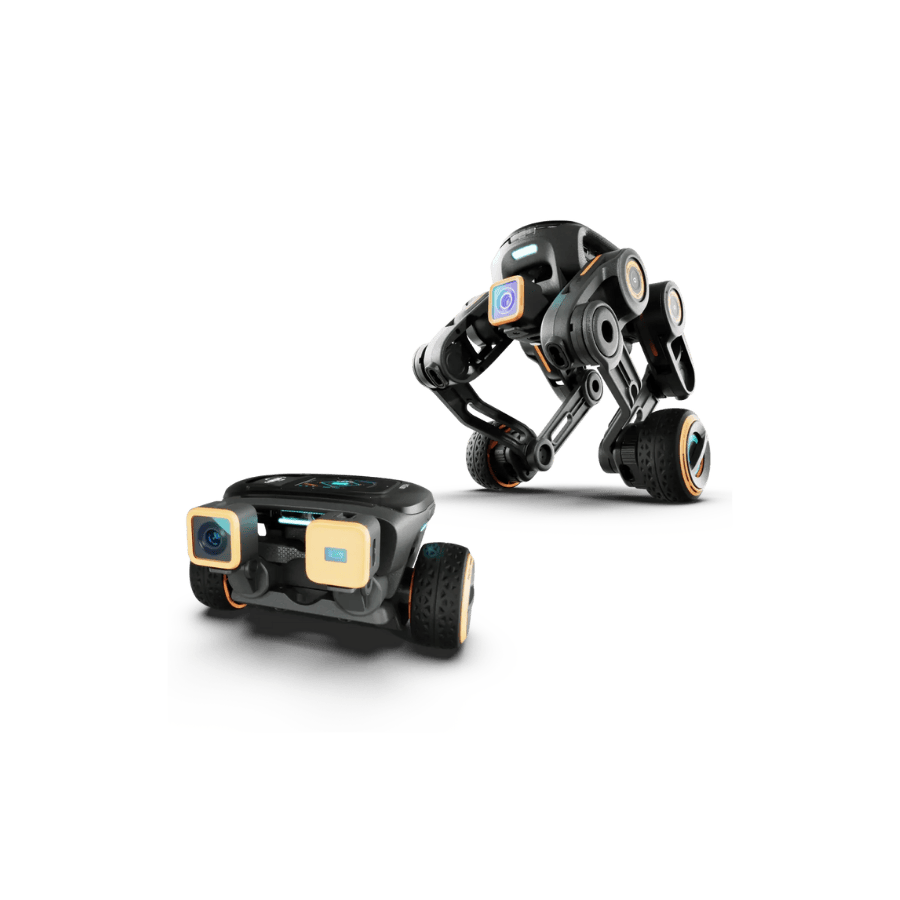
UGOT is a modular robot construction kit in which a central control element containing a processor, battery, and interfaces can be combined with legs, wheels, joints, or robotic arms as needed. This allows completely different robots to be created in minutes—from a fast rover and a balance bot to a dexterous manipulator arm.

Every UGOT configuration uses extensive peripherals including a camera, infrared, distance, and motion sensors. This allows for obstacle detection, line following, motion analysis, or telemetry experiments to be implemented directly in the classroom or makerspace – without any additional hardware.

Using the app, you first program UGOT via block coding and switch to Python if needed. Movement sequences, driving logic, and AI functions are transferred to the robot in real time, so learners immediately see how code turns into real actions – ideal for STEM classes and project work.

Through integrated AI functions such as object and face recognition, speech recognition with a 3-microphone array, and a first-person view via the camera, pupils and students experience modern AI applications firsthand. UGOT responds to voice, tracks targets, and can act as a learning assistant thanks to ChatGPT integration.

The UB-Tech UGOT is a modular, AI-enabled educational robot for schools, universities, and demanding robotics projects. Its powerful control module can be flexibly combined with legs, wheels, joints, or robotic arms, enabling a variety of robot configurations—from rovers and walkers to manipulators. A camera, infrared and distance sensors, an IMU, and a microphone array support perception, object recognition, and interaction.
For advanced development projects, UGOT offers extensive development access via Python, ROS 2, and an open SDK. In addition, Micro:bit, Arduino, Raspberry Pi, as well as custom sensors and hardware can be integrated. This makes UGOT suitable not only as a learning platform but also for individual robotics, research, and prototyping applications.


The UBtech UGOT is suitable for schools, universities, STEM education, robotics clubs, makerspaces, hackathons, project work, AI instruction, programming courses, and ambitious hobby projects. Terra Robotics positions the UGOT specifically for learning environments where robotics, sensor technology, programming, artificial intelligence, and creative prototyping are to be taught in a practical manner.
The UBtech UGOT is a modular, AI-enabled educational robot from UBtech. The system is based on a central control hub featuring a processor, battery, and interfaces, which can be combined with wheels, legs, joints, sensors, or robotic arms depending on the learning objective. This allows for the creation of various robot forms such as a rover, walker, balance-bot, or a manipulatable arm.
The UBtech UGOT distinguishes itself from classic educational robots through its modular design. Instead of using just one fixed robot model, learners can test various kinematics and configurations. This allows for direct comparison of driving behavior, balance, gripping, sensor technology, autonomous navigation, and AI functions.
The UBtech UGOT can initially be programmed via an app using visual block coding. Advanced users can switch to Python and develop their own applications via Development Access with ROS 2 and the open SDK. In addition, Micro:bit, Arduino, Raspberry Pi, as well as custom sensors and hardware can be integrated. This allows for the implementation of custom motion logic, sensor queries, AI functions, and data processing, among other things. As a result, UGOT is suitable for both beginners and more demanding robotics, STEM, research, and development projects.
The UBtech UGOT is interesting for schools and STEM education because it combines topics such as computer science, robotics, sensor technology, kinematics, control engineering, AI, and data processing in real-world projects. Students see directly how code, sensor values, and AI functions lead to real movements, reactions, and robot behavior.
Depending on the configuration, the UBtech UGOT uses a camera, infrared sensors, distance sensors, motion sensors, an IMU, and a 3-microphone array. This allows for projects involving obstacle detection, line following, motion analysis, object and face recognition, voice control, first-person view, and telemetry to be implemented in the classroom or makerspace.
The UBtech UGOT supports AI functions such as object and face recognition, voice recognition, target tracking, image processing, and ChatGPT integration. This allows learners to not only study modern AI applications theoretically, but also test them directly on a physical robot that can see, hear, react, and move.
Depending on the kit and module configuration, the UBtech UGOT can be used to build various robot forms, including a fast rover, a four-legged walker, a balance bot, a manipulative arm, or an experimental special-purpose robot. This makes UGOT particularly well-suited for project-based learning, where different designs and movement principles can be compared.
The UBtech UGOT is particularly well-suited for projects such as autonomous patrols, line following, FPV teleoperation, obstacle avoidance, simple delivery prototypes, grasping experiments, voice control, object recognition, face recognition, motion analysis, and ChatGPT-based assistant functions. This makes the educational robot highly versatile for use in classroom instruction, university internships, workshops, and hackathons.
The UBtech UGOT can be purchased, leased, or requested as a custom project solution at Terra Robotics. Purchase is suitable for schools, universities, makerspaces, and companies that wish to use the educational robot on a permanent basis. Leasing or a project inquiry are particularly sensible for multiple kits, training concepts, STEM labs, hackathons, educational programs, or scalable robotics learning environments.
The UBTECH UGOT combines robotics, artificial intelligence, programming, and mechanical engineering into a modular learning and development platform. Instead of being limited to a single robot shape, the robotics kit can be reconfigured repeatedly with various drives, joints, wheels, legs, and gripping components. This makes the UGOT suitable both as an AI learning robot for schools and educational institutions and as a flexible platform for universities, makerspaces, robotics clubs, technical training, and custom development projects. Learners can explore mechanical design, sensor technology, motion control, computer vision, and programming directly on a real robotic system.
A key advantage of the UBTECH UGOT is its modular design. The central control module serves as the technical core and can be combined with various mechanical components depending on the project. This allows for the creation of mobile rovers, self-balancing systems, walking robots, and applications with gripping and manipulation functions, among others. The individual configurations make different principles of robotics immediately tangible – from kinematics and control engineering to autonomous navigation and the precise control of motors and joints.
For STEM education, this means: pupils and students do not just work with theoretical program code, but see immediately how changes to construction, sensor values, or algorithms affect a robot's behavior. The UGOT is therefore particularly well-suited for project-based learning, robotics classes, computer science, technical education, and interdisciplinary STEM projects.
The control module is powered by a quad-core Cortex-A55 processor with up to 1.8 GHz. An integrated NPU provides up to 1 TOPS of computing power for AI applications. The platform is complemented by 2 GB of LPDDR4 RAM and 32 GB of eMMC storage, allowing the UBTECH UGOT to process various algorithms and AI functions directly on the robotic platform.
To perceive its surroundings, UGOT utilizes a 720p RGB camera, a ToF distance sensor, as well as accelerometer, gyroscope, and geomagnetic sensors. A 3-microphone array and an integrated speaker further enable voice-based applications. This allows for projects involving object recognition, gesture recognition, facial recognition, voice recognition, motion analysis, obstacle detection, and autonomous reactions. The combination of sensors, actuators, and AI makes the UGOT a versatile educational robot for practical experiments with modern artificial intelligence.
Programming can be initiated via the graphical development environment uCode. Functions and processes are assembled visually, allowing even learners without extensive programming experience to develop initial movements, sensor queries, and robotic sequences. As proficiency increases, uPython offers a transition to text-based Python programming.
This allows the UBTECH UGOT to be used across various learning levels. Beginners start by understanding fundamental concepts such as conditions, loops, variables, and events. Advanced users can then program more complex motion logic, sensor evaluations, AI functions, and their own custom applications. As a result, UGOT is not just a robot for beginners, but a platform that remains relevant for more demanding computer science, AI, and robotics projects.
For advanced development projects, the UBTECH UGOT offers comprehensive development access. In addition to Python, ROS 2 and an open SDK are available, allowing for much more flexible implementation of custom applications, control logic, and research projects. Particularly for universities, technical educational institutions, developers, and makerspaces, this extends the application possibilities well beyond those of traditional educational robots.
The open ecosystem also supports Micro:bit, Arduino, and Raspberry Pi. Custom sensors and additional hardware can be integrated into individual robotics projects. Interfaces such as USB, USB-C, GPIO, UGOT connectors, and other ports provide the technical foundation for this. For example, additional measurement systems, external controllers, custom sensor solutions, or self-developed hardware components can be connected to the robot. Anyone looking for a programmable robot with Python, a ROS 2 robot for learning and development projects, or an expandable robotics platform for Arduino and Raspberry Pi will find an unusually open foundation in the UGOT.
UGOT makes it possible not only to cover central topics of modern robotics theoretically, but to translate them directly into functional applications. The camera can be used for visual recognition and computer vision projects, while motion sensors provide information about position, acceleration, and orientation. Distance measurements can be incorporated into autonomous driving or collision-avoidance strategies. At the same time, the microphone array opens up possibilities for voice control and interactive applications.
The connection between AI and physical robotics also plays an important role. Recognition results can trigger actions immediately: a recognized object can be tracked, a gesture can be converted into a movement, or a voice command can be linked to a programmed action. This direct link between software, artificial intelligence, and real-world motion is what makes the UBTECH UGOT particularly interesting for classroom instruction and practical AI training.
The UBTECH UGOT is aimed at users who are looking for more than a simple programmable learning robot. Schools can use it for STEM, computer science, and robotics classes, while universities can use it for courses and development projects revolving around robotics, AI, and autonomous systems. In makerspaces and robotics clubs, the modular hardware provides room for custom designs, while developers and students can delve deeper into the platform via Python, ROS 2, the Open SDK, and external sensor integration.
Dual-band Wi-Fi, Bluetooth 5.0, and various hardware interfaces facilitate integration into different project environments. The combination of modular mechanics, a powerful computing unit, camera and motion sensors, graphical programming, Python, and open development access makes UGOT a versatile platform for modern robotics education.
Those looking for a modular AI robot for schools or universities, a robotics kit for STEM education, or an open development platform for Python, ROS 2, Micro:bit, Arduino, and Raspberry Pi will find that the UBTECH UGOT is a system that brings learning, experimentation, and custom development together into one platform. This makes the UGOT suitable both for getting started in robotics and artificial intelligence, as well as for advanced projects where personal ideas are to be realized as functioning robotic applications.


