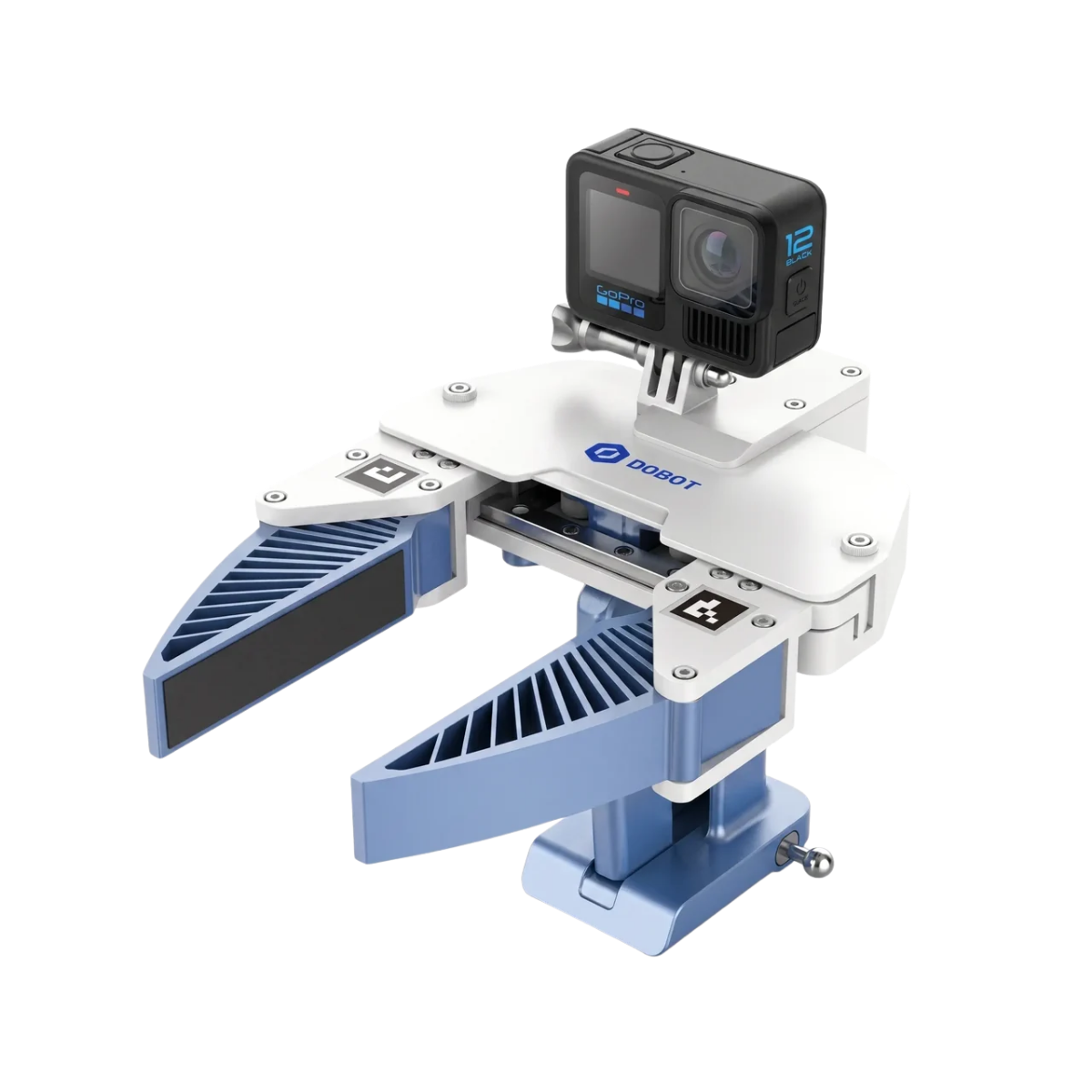
DOBOT Pocket Go: Portable Data Acquisition for Robot Learning
The DOBOT Pocket Go is a portable data acquisition platform for Embodied AI, imitation learning, and the development of autonomous manipulation skills. Instead of generating motion sequences exclusively in simulations or via complex teleoperation systems, developers can demonstrate a desired task directly with a handheld gripper. A camera, IMU, and visual-inertial tracking record the relevant movement and environmental information. These demonstrations create training data that can subsequently be used to develop robotic manipulation models.
Pocket Go is thus primarily aimed at robotics companies, AI developers, universities, and research departments that want to quickly generate high-quality data for real-world gripping, sorting, assembly, or handling tasks.
Human demonstrations instead of complex robot programming
In imitation learning, a task is first demonstrated by a human. With Pocket Go, the user guides the compact handheld gripper directly through the desired motion sequence. This could be, for example, picking up an object, moving it between two containers, sorting different components, or a controlled insertion process.
The handheld kit weighs 0.93 kg and offers a gripper opening of 73.5 ± 1.5 mm as well as 100 mm of effective gripping depth. Objects up to 2 kg can be handled within the specified gripping parameters. This allows for many realistic demonstrations to be carried out without first having to program a complete robot workstation.
For companies that wish to automate such tasks later on, our page on assembly and handling offers further application examples.
5.3K camera and visual-inertial 6D pose tracking
A central component of the system is the GoPro Hero 12. The camera offers a field of view of 155° and recordings of up to 5.3K at 60 frames per second. HyperSmooth 6.0 supports stable video data even during dynamic motion sequences.
In addition, camera data and information from the integrated IMU are processed via ORB-SLAM3. The visual-inertial SLAM method reconstructs the spatial movement as a 6D pose with position and orientation. As a result, every demonstration produces not only video sequences but also spatially usable trajectory information for downstream training processes.
Up to 4,000 demonstrations per working day
Modern Embodied AI projects often require a large number of different demonstrations. A model should not only master a task under a single ideal condition but also be able to handle changed object positions, gripping points, and environmental situations.
Pocket Go is therefore designed for high acquisition speeds. According to product specifications, the platform supports up to 4,000 demonstration datasets per working day. The actual throughput depends on the respective task and the duration of a demonstration.
Thanks to portable acquisition, variants can be recorded directly where they are relevant later on. This facilitates the creation of extensive datasets for pick-and-place, sorting, household manipulation, service tasks, or industrial assembly.
From handheld gripper to robot arm
The Pocket Go concept includes a handheld gripper for human demonstration and a separate end-effector gripper kit for use on a robot arm. The robot-mounted kit weighs 1.58 kg and also has a gripper opening of 73.5 ± 1.5 mm and 100 mm of gripping depth. The specified object size range is 5 to 75 mm.
This creates a direct connection between data acquisition and subsequent robotic execution. Pocket Go is designed for compatible models of the DOBOT Nova and CR series. One possible robot system, for example, is the compact DOBOT Nova 2. An overview of other platforms is provided on our DOBOT manufacturer page.
End-to-end workflow for training and deployment
Pocket Go does not end with recording videos. The platform concept includes a software stack for data acquisition, calibration, SLAM trajectory processing, model training, and deployment. Additionally, an SDK and a Docker-based development environment are available for individual research and integration projects.
The published system requirements mention Ubuntu 20.04 or 23.10. For model training, at least 11 GB of GPU VRAM is specified; for inference, at least 2 GB. As an optional local computing unit, a Mini AI Computer with Intel Core i9, NVIDIA RTX GPU, 64 GB DDR5, and 2 TB SSD is available.
Embodied AI for research and universities
For universities, Pocket Go opens up a practical approach to topics such as imitation learning, computer vision, SLAM, diffusion models, robot learning, and autonomous manipulation. Students can investigate the entire process from recording human demonstrations through data preparation and training to execution on a real robot.
Pocket Go thus complements classic robot programming with data-driven methods. Further robotics solutions for research and education can be found in the schools and universities section. For dual-arm experiments and more advanced robot learning scenarios, the DOBOT X-Trainer is also a related platform.
Using DOBOT Pocket Go for your own robot learning projects
Before starting a project, the target task, objects used, desired robot arm, required amount of demonstrations, and available computing power should be defined. Especially with imitation learning, the quality and variety of the training data determine how reliably a model can handle different situations later on.
Terra Robotics assists in selecting the appropriate DOBOT platform and in setting up a suitable robotics and Embodied AI setup. For a concrete project assessment, you can submit your use case via the contact form for robotics projects.