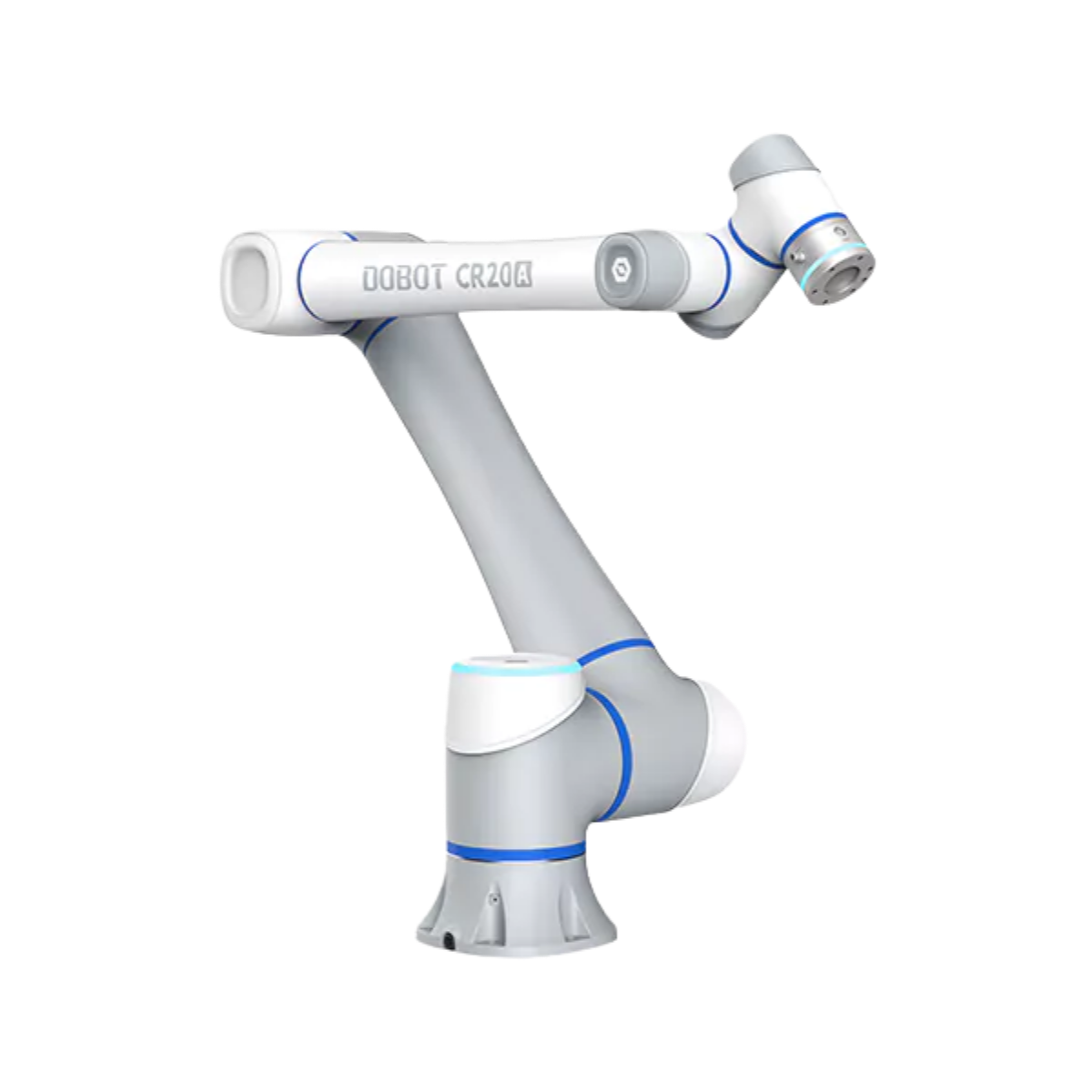
DOBOT CRAP series for dust, moisture, and oil
The DOBOT CRAP series, officially designated as the CRA-IP68 series, was developed for automation in demanding environmental conditions. While standard cobots often have limited protection against dust, water mist, or oily residues, the CR5AP, CR10AP, and CR20AP models feature an IP68-protected robot design. This makes them particularly suitable for metalworking, CNC machine tending, grinding, cutting, welding, and other processes with high exposure to dust, moisture, or oil.
Three models for different payloads and reaches
The CR5AP moves up to 5 kg and offers an operating radius of 900 mm. It is especially suitable for compact stations, fast pick-and-place processes, and the machining of smaller workpieces. The CR10AP combines a 10 kg payload with a 1,300 mm reach, covering numerous tasks in machine tending, handling, and production. For larger components, the CR20AP is available with a 20 kg payload and a 1,700 mm operating radius.
All three models reach a maximum linear speed of 2 m/s. Depending on the variant, the repeatability ranges between ±0.02 and ±0.05 mm. The payload includes not only the workpiece but also grippers, adapters, sensors, and other components mounted on the flange. Selection should therefore be based on the complete tool configuration.
IP68 protection under defined test conditions
According to DOBOT, the IP68 protection rating of the robot arm was tested by SGS in a 72-hour test according to IEC 60529. As a result, the series is designed for high humidity, dust, and water mist. The control cabinet additionally has an IP54 protection rating. However, a clear distinction is important: DOBOT explicitly states that the robots are not suitable for long-term operation underwater.
The other components of a robot cell must also be appropriately protected. An IP68 robot arm alone does not automatically make a standard gripper, camera, or an unprotected cable connection water- or dust-resistant. Therefore, all end-effectors, sensors, cables, and connection components used should be checked against the actual load before the project starts.
Oil resistance and internal pressurization
For machining environments with oil and cooling lubricants, DOBOT uses fluororubber for the outer plastic components. This material has high chemical stability and corrosion resistance. In addition, the series features an internal pneumatic system. Pressurization creates positive internal pressure, which supports the sealing of the robot.
This design is particularly relevant for CNC machines, machining centers, and processes involving oil mist or liquid splashes. Nevertheless, the media, concentrations, temperatures, and cleaning procedures used must be verified before integration.
CNC machine tending in harsh machining environments
In automated CNC machine tending, the cobot picks up raw parts, inserts them into the machine, and removes the machined components after the process is complete. Oil mist, cooling lubricants, and metal chips place high demands on the robotics used. The CRA-IP68 series was specifically developed for such working conditions.
For a reliable process, gripping points, workpiece positioning, machine doors, clamping devices, and communication must be coordinated. You can find more information on suitable applications on our page regarding assembly and handling.
Automating grinding, cutting, and polishing
Grinding and cutting generate fine particles and abrasive residues that can penetrate seals or joints in unprotected robots. The dust-tight design of the CRA-IP68 series is specifically geared toward such applications. Depending on the tool and workpiece, the robot can reproducibly follow defined paths, thereby automating manually strenuous tasks.
For a complete solution, extraction, tool mounting, process force, and cable management must also be planned. Suitable end-effectors and other components can be found in the DOBOT accessories section.
Welding, bonding, and material transport
DOBOT lists welding, bonding, and loading/unloading or transport as further application scenarios. With a 20 kg payload and 1,700 mm reach, the CR20AP offers sufficient workspace for larger components and long motion paths. The CR5AP and CR10AP, on the other hand, are suitable for more compact cells or lower tool loads.
In welding applications, IP68 does not protect the robot from all process risks. Sparks, heat, smoke, and welding spatter require a complete safety and protection concept. The same applies to dangerous cutting tools or chemical media.
Simple programming despite increased environmental protection
The CRA-IP68 series adopts the well-known operating options of the CRA platform. These include drag-to-teach, graphical programming, and code-based development. The increased environmental protection does not restrict basic operability. Movements can be taught manually and then supplemented with process signals, tool control, and machine communication.
Further DOBOT cobot series and automation solutions can be found on our DOBOT manufacturer page.
Selecting and integrating the DOBOT CRA-IP68
Before selecting, payload, reach, environmental media, temperature, cleaning processes, tools, and safety requirements should be evaluated. A proof of concept with real workpieces and actual media will show whether grippers, seals, and motion sequences are suitable for long-term use.
Terra Robotics provides support in choosing between the CR5AP, CR10AP, and CR20AP, as well as with gripping technology, system layout, and technical integration. For a concrete feasibility check, you can describe your process via the contact form for robotics projects.