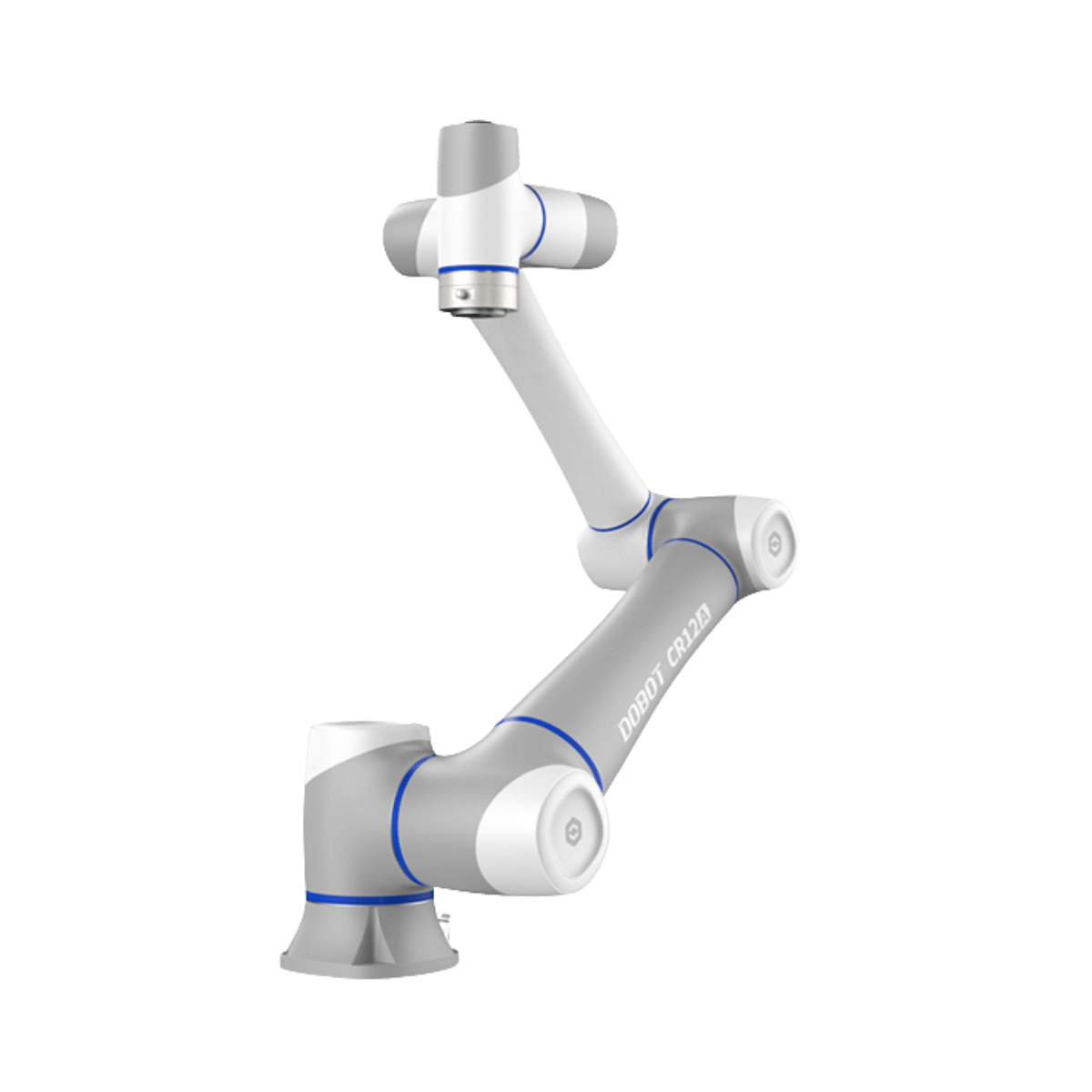
The DOBOT CR12A is a high-performance collaborative robotic arm designed for industrial automation projects that require higher payload capacity, a long reach, and repeatable movements. With a 12 kg payload, a 1,200 mm working radius, and six flexibly controllable axes, it bridges the gap between compact cobots for light assembly and larger robotic systems for demanding handling tasks. The CR12A is suitable for applications such as palletizing, packaging, machine tending, material handling, assembly, welding, and quality inspection.
12 kg payload for larger workpieces and tools
The maximum payload of 12 kg enables the handling of larger components, boxes, containers, and workpiece carriers. It must be taken into account that the specified payload includes both the workpiece and the end effector being used. A heavy gripper, vacuum system, or welding tool therefore reduces the remaining payload available for the actual product.
The CR12A is particularly interesting when smaller models work with sufficient precision but reach their limits in terms of workpiece weight or gripper size. For palletizing, packaging, and machine loading, the combination of a high payload and a 1,200 mm working radius offers a flexible entry into automation. You can find further suitable systems on our page for robots for assembly and handling.
1,200 mm working radius for larger production areas
With its working radius of 1,200 mm, the DOBOT CR12A can reach multiple storage surfaces, machine openings, or pallet positions from a central installation point. This allows the cobot to, for example, pick up workpieces from a conveyor belt, insert them into a machine, and then place them at an inspection station or into a container.
Careful layout planning remains essential. Machine contours, gripper height, cables, pallet positions, and potential collision areas must be considered before programming begins. By mounting it in different orientations, the CR12A can be installed on a pedestal, a machine base, or a suitable support structure, depending on the application.
High dynamics and precise repeatability
The current CRA specification lists a maximum linear speed of up to 5 m/s for the CR12A. The fastest joints reach up to 223° per second. This allows the robot to achieve short movement times and productive cycle sequences in suitable applications. Its repeatability of ±0.03 mm supports reproducible gripping, positioning, inserting, and placing.
Real process performance is not determined by robot speed alone. Gripper opening, vacuum build-up, machine time, safety zones, and workpiece supply also influence the achievable cycle time. For a reliable assessment, a simulation or a proof of concept with real components is therefore recommended.
Automating palletizing and packaging
In palletizing, the CR12A can pick up boxes or bundles from a conveyor line and stack them according to a defined pallet pattern. Its reach allows access to larger areas, while its payload covers numerous typical packaging units. Depending on the box format and the desired stacking height, the robot can be combined with a vacuum gripper and a lifting axis.
You can find a suitable preconfigured solution with the DOBOT CRA palletizing workstation. Before implementation, box weight, surface, cycle performance, pallet format, and maximum stacking height should be checked.
Machine tending and material handling
The DOBOT CR12A can automatically load and unload CNC machines, test benches, or processing equipment. The robot picks up a raw part, positions it in the fixture, and removes the processed workpiece after receiving a signal from the machine control. The sequence can be coordinated via industrial interfaces with PLCs, door controls, clamping devices, and safety components.
The CR12A also offers advantages in material handling. Components can be sorted, reoriented, placed in trays, or transferred between different stations. Further robotics solutions for manufacturing and logistics can be found in the Industry and Production section.
Assembly, joining, and process automation
With suitable tools, the CR12A can insert components, screw, glue, or dispense. DobotStudio Pro supports graphical programming, LUA scripts, and various process packages for this purpose. Plug-ins also facilitate the integration of grippers, force sensors, and vision systems.
For force-dependent joining tasks, it should be checked whether an additional force-torque sensor is required. This can capture process forces and support controlled search or insertion movements. For visually guided applications, the cobot can be combined with a 2D or 3D camera.
Open interfaces for existing systems
The CR12A supports common industrial protocols such as Modbus TCP and RTU, EtherNet/IP, and PROFINET. The controller also offers numerous digital and analog inputs and outputs. This allows the cobot to communicate with PLCs, HMIs, conveyor technology, sensors, valves, and machine controls.
Suitable grippers, vision solutions, and further accessories can be found in the DOBOT accessories and spare parts collection. The specific selection should be tailored to the workpiece, process force, ambient conditions, and desired cycle time.
Planning collaborative safety correctly
The CRA series has an independent safety controller with PLd Cat. 3 and more than 20 safety functions. In the event of a power failure, the system activates its electromagnetic brake within 18 milliseconds. Speed, force, and workspace can be adjusted to the respective application.
A cobot should still not be operated without safety measures as a general rule. Sharp-edged workpieces, high speeds, or dangerous tools may make scanners, safety zones, or an enclosure necessary. The basis for every installation is therefore a complete risk assessment.
Buying and integrating the DOBOT CR12A
Terra Robotics supports companies in selecting the right gripper, designing the workspace, and integrating the DOBOT CR12A into existing production processes. A structured proof of concept helps to validate reach, gripping reliability, cycle time, and machine communication at an early stage.
Further cobots and automation solutions can be found on our DOBOT manufacturer page. For a specific feasibility study, you can submit your application case directly via the contact form for robotics projects.