EcoFlow Power Stations for Mobile Robotics and Professional Technology
EcoFlow power stations enable flexible power supply for robotics, research, development, demonstrations, and professional technology. Instead of requiring a fixed power infrastructure at every location, chargers, computers, network components, sensors, and other technical devices can be operated via a mobile energy source. This can significantly simplify planning, especially for changing locations, trade fairs, research projects, or field tests.
At Terra Robotics, the focus is on EcoFlow power stations for robotics applications. Depending on the required power and capacity, compact systems from the RIVER series or higher-performance models from the DELTA product ranges are suitable. EcoFlow currently offers power stations ranging from compact RIVER systems to scalable DELTA solutions with several kilowatt-hours of capacity.
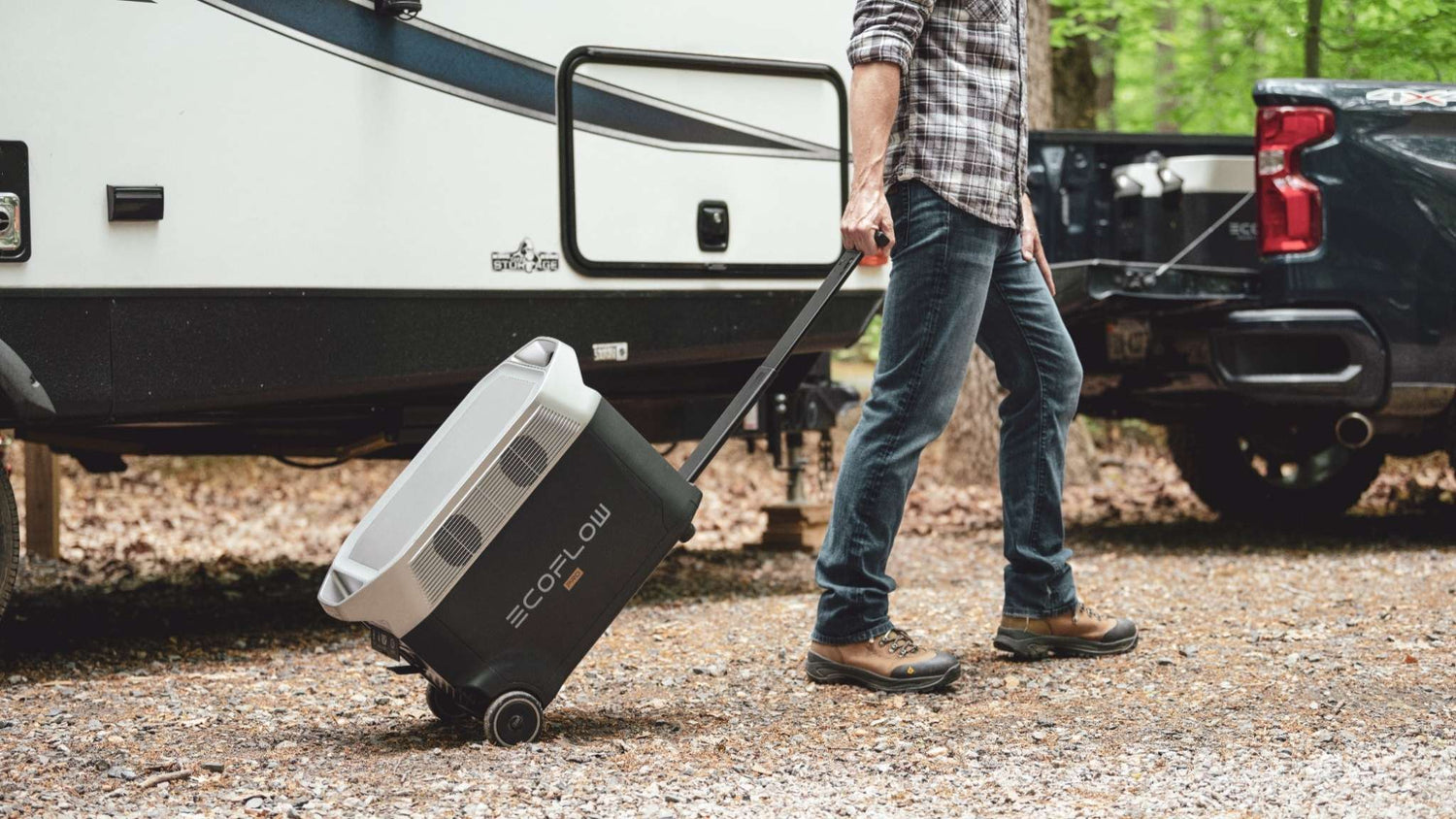
EcoFlow DELTA Power Stations for High-Performance Robotics Setups
The EcoFlow DELTA series is aimed at applications with higher energy requirements. Typical areas of use include robotics demos, research workstations, mobile development stations, trade fair technology, tools, computers, and charging infrastructure for robot batteries.
The current DELTA generation includes systems such as DELTA 3, DELTA 3 Plus, DELTA 3 Max, and DELTA Pro 3. The DELTA 3 series combines 1,024 Wh of base capacity with 1,800 W of output power and can be expanded depending on the configuration. For significantly higher requirements, the DELTA Pro 3 offers a capacity of 4,096 Wh and up to 4,000 W of AC output power.
This allows companies to adapt their energy supply to the actual intended use instead of generally relying on the largest possible power station.
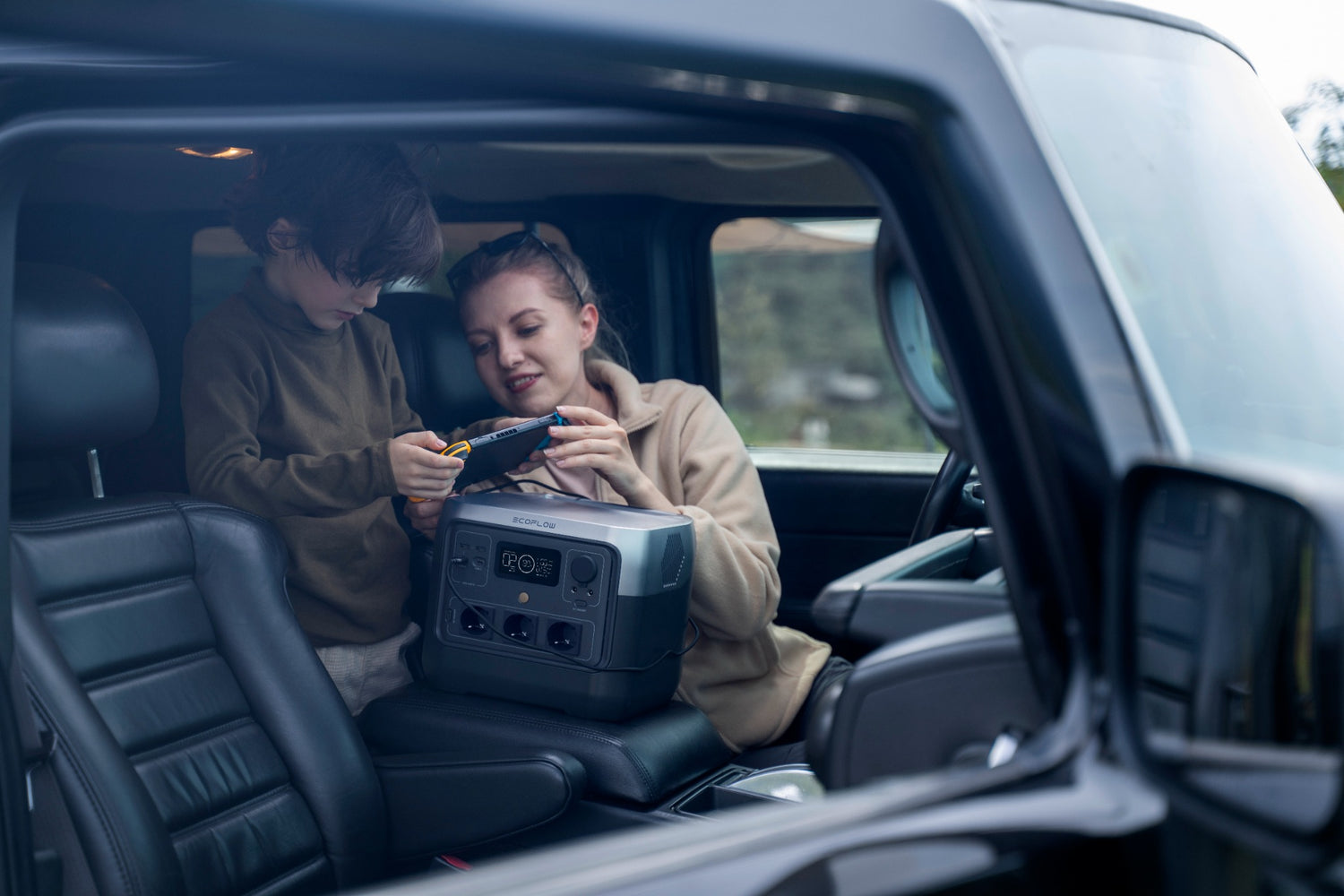
EcoFlow RIVER for Compact and Mobile Applications
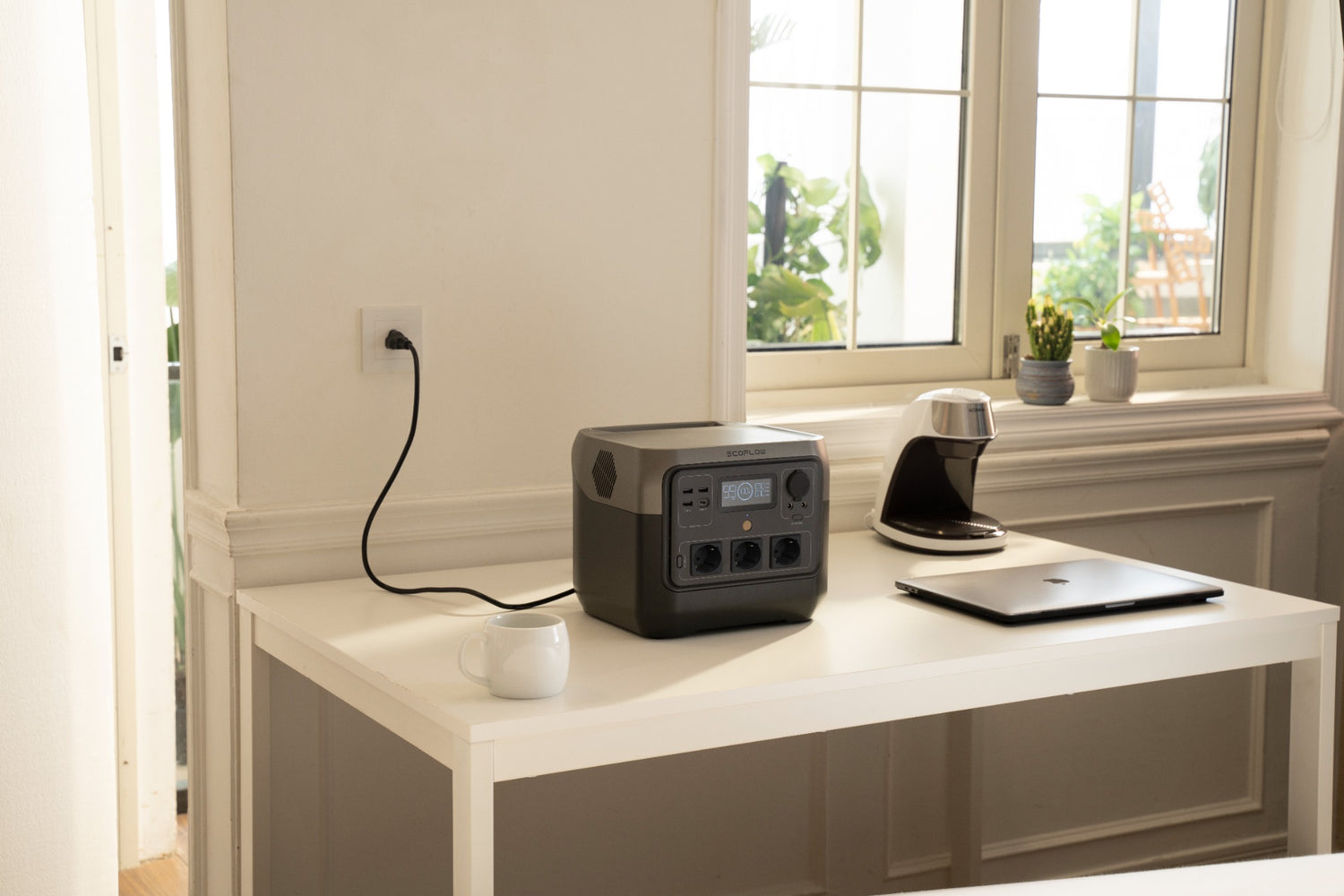
If low weight and high mobility are more important than maximum capacity, the EcoFlow RIVER series offers a more compact alternative. RIVER power stations are particularly suitable for laptops, routers, cameras, development devices, smaller chargers, and accessories during mobile robotics projects.
The current RIVER 3 family includes different power and capacity classes. The compact RIVER 3, for example, starts with 245 Wh and 300 W of output power, while larger variants provide more capacity and power.
For short demonstrations, training courses, or mobile development workstations, a RIVER power station can therefore be more practical than a significantly larger DELTA system.
Mobile Power Supply for Unitree and Other Robotics Platforms
A particularly relevant area of application is the mobile power supply for humanoid robots and robot dogs. During field tests, research, university projects, or events, a suitable electrical outlet is not always available at every location.
A power station can, for example, supply the robot's original charger with AC power here. It is crucial that the output power and connection of the power station match the electrical requirements of the charger being used.
Terra Robotics therefore also offers robotics bundles in which mobile power supply and robotics are combined directly, for example, the Unitree G1 Basic Ultra-Power Bundle or the Unitree Go2 Pro Ultra-Autonomy Bundle.
Power Stations for Research, Universities, and Mobile Robotics Labs
Temporary experimental setups are frequently created in research and education. Robots, workstations, monitors, network hardware, and sensors often have to be operated independently of existing infrastructure.
A mobile power station for robotics can make such setups more flexible. Research groups can conduct experiments in different locations, prepare demonstrations outside the lab, or power mobile measurement and computing technology.
This is particularly interesting for humanoid robotics and autonomous mobile systems, because robots are not tested exclusively within a fixed laboratory. Field tests, presentations, and real-world application scenarios often require a flexible charging and energy infrastructure.
EcoFlow Power Stations for Trade Fairs, Events, and Showrooms
Robotics is increasingly being presented at trade fairs, corporate events, and in showrooms. In addition to the robot itself, displays, computers, routers, cameras, or chargers often need to be operated there.
With an EcoFlow power station, such consumers can also be powered where a permanently installed power supply is not immediately available. This reduces cable runs and enables more flexible demo setups.
Particularly powerful DELTA systems are suitable for extensive technical setups, while compact RIVER models are interesting for smaller presentation and IT applications.
Fast Charging for Short Downtimes
With mobile energy sources, it is not only the capacity that is decisive, but also the time required for recharging. EcoFlow uses its proprietary X-Stream fast-charging technology in its current power stations.
The EcoFlow DELTA 3 series, for example, can be fully charged via AC within about 56 minutes. The RIVER 3 series is also designed for fast charging cycles, according to the manufacturer.
For professional applications, this means that a power station can be made ready for use again relatively quickly between two deployments.
Solar Charging for Mobile and Off-Grid Applications
Many EcoFlow power stations additionally support solar charging. In combination with compatible solar panels, energy can thus be recharged outside of a classic power supply.
This can be interesting, for example, during longer field tests, outdoor research projects, inspections, or mobile demonstrations. The potential solar power differs significantly depending on the power station. High-performance systems such as the DELTA Pro 3 support significantly higher PV power levels than compact RIVER models.
Selection should therefore always be based on the planned energy consumption and the time window available for recharging.
Correctly Dimensioning Capacity and Power
When selecting a power station, capacity in Wh and output power in W should be considered separately.
The output power determines whether a connected device can be operated at all or whether a charger can be powered. Capacity, on the other hand, determines how long or how frequently this is possible.
A robot charger with high power consumption therefore requires a power station with sufficient AC output power. If the same robot is to be recharged multiple times, correspondingly more battery capacity is needed as well.
Conversion losses should also be taken into account in the calculation. Therefore, the theoretical capacity of a power station does not entirely correspond to the energy actually usable at the AC output.
Expandable EcoFlow Power Stations for Growing Energy Needs
Various EcoFlow DELTA models can be expanded with extra batteries. This allows the capacity to be adapted to increasing energy requirements without having to replace the entire basic system immediately.
The DELTA 3 series, for example, can be expanded to several kilowatt-hours depending on the configuration. DELTA Pro 3 can be scaled from 4 kWh up to 12 kWh.
This can be interesting for companies if individual robotics projects are powered initially and additional systems or longer operating times are added later.
Selecting EcoFlow Power Stations at Terra Robotics
Which EcoFlow power station is suitable for a robot depends on several factors: charging power, the robot's battery capacity, the desired number of charging cycles, additional consumers, mobility requirements, and potential solar charging.
Terra Robotics provides support in selecting a suitable combination of robotics and mobile energy supply. In doing so, we do not simply check whether a power station is "compatible with every robot," but rather specifically look at the charger, power consumption, and usage scenario.
The product range is continuously being expanded with new EcoFlow DELTA, RIVER, and energy storage solutions. This way, future robotics platforms, research projects, and mobile applications can also be combined with a demand-oriented energy supply.